



The assignment and allocation of duties have been carried out in accordance with each official’s qualifications, expertise, strengths, and practical experience, maximizing responsibility and accountability in public service.
.jpg)
According to statistics, Điện Biên province currently has 2,838 commune-level officials and civil servants, including 1,591 working in mass organizations and 1,247 in local government agencies. Overall, the grassroots administrative workforce has basically met the demands of the new context, with gradual improvements in professional qualifications, political theory, and management capacity. Most officials demonstrate strong responsibility, maintain close contact with local communities, and proactively monitor local conditions in order to promptly address issues arising at the grassroots level.
In practice, commune-level officials play a core role in bringing the Party’s policies and the State’s laws into daily life. They are also instrumental in implementing national target programs, sustainable poverty reduction initiatives, rural development programs, national defense and security tasks, and strengthening national unity. In particular, following the restructuring of the administrative apparatus and the implementation of the two-tier local government model, many officials and civil servants quickly adapted to new responsibilities, showing innovation, initiative, and flexibility in carrying out their duties, thereby enhancing the effectiveness of the grassroots political system.
.jpg)
Tủa Thàng commune was established through the merger of Tủa Thàng and Huổi Só communes. The commune currently has a total staff of 61 officials and civil servants. Immediately after beginning operations under the two-tier local government model, the commune’s Party Committee and authorities identified organizational stabilization as a key and strategic task to ensure smooth and effective leadership and administration. Based on reviews of each official’s capabilities and expertise, responsibilities were assigned according to specific professional fields, prioritizing the principle of “the right person for the right job.”
Vừ A Hùng, Secretary of the Tủa Thàng commune Party Committee, stated: “The commune focuses on reviewing the strengths and capabilities of each official to ensure proper placement and assignment. At the same time, we pay close attention to the aspirations and concerns of civil servants and create favorable conditions for them to remain committed to their work. This has helped foster strong consensus among officials and employees toward building a streamlined, effective, and efficient commune-level administration.”
.jpg)
After the merger, Lò Thị Tình was assigned to serve as Head of the Party Building Committee of Tủa Thàng commune. Although her commute became longer and working conditions remained challenging with an increased workload, she has consistently demonstrated a strong sense of responsibility and proactively adapted to her new duties.
Lò Thị Tình shared: “With a spirit of responsibility and willingness to learn, I quickly adapted to the new working environment and actively advised on Party-building tasks, contributing to the gradual stabilization of the organizational structure and improving the effectiveness of the grassroots political system.”
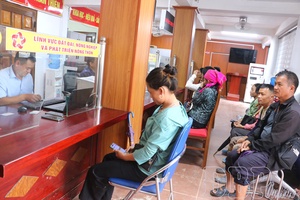
Since the implementation of the two-tier local government model, officials, civil servants, and public employees throughout the province have actively promoted solidarity and responsibility while overcoming difficulties to fulfill their assigned tasks. In many localities, officials work overtime and even use weekends to directly receive administrative applications from elderly and vulnerable residents, clearly reflecting the principle of “putting people at the center of public service.”
According to provincial statistics, during the first quarter of 2026, specialized agencies under the provincial People’s Committee received 9,048 administrative applications and resolved 8,051 of them, with 100% completed on or ahead of schedule. Commune-level authorities received 36,525 applications and resolved 35,748, of which 35,724 cases - or 99.9% - were processed on time or earlier than required.
.jpg)
Ly Seo Tỏa from Huổi Lụ 1 village, Nà Hỳ commune, shared: “When I came to the commune’s Public Administrative Service Center to complete administrative procedures, I found the process convenient and efficient. Commune officials provided detailed and enthusiastic guidance, so my paperwork was handled quickly and on schedule. I am very satisfied.”
To further improve the quality and effectiveness of grassroots officials in meeting the demands of the new development phase, the province is focusing on professional and practical training programs tailored to specific job positions. Every year, the provincial People’s Committee directs departments and agencies to strengthen professional training and refresher courses for commune-level civil servants. Special attention is given to updating knowledge in management, digital transformation, and administrative reform. At the same time, the province continues implementing policies to second provincial-level officials and public employees to grassroots localities in order to provide professional support and strengthen practical capacity, especially in remote and disadvantaged areas.
Practical experience following the restructuring of the administrative system has shown that when officials are assigned according to their abilities, maintain a strong sense of responsibility, and stay close to the people, the administrative apparatus operates more effectively and gains greater public trust and consensus. These positive grassroots transformations are an important foundation for building a professional, modern, effective, and people-centered public administration system.
Sầm Phúc

.jpg)
.jpg)
.jpg)
.jpg)
.jpg)
.jpg)
.jpg)
.jpg)
.jpg)
.jpg)
You have 500/500 characters left
Please enter 5 or more characters!!!