



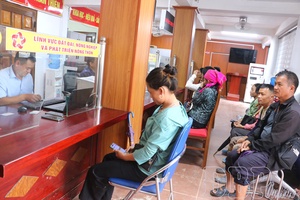
Arriving at the Public Administrative Service Center of Mường Toong commune to carry out procedures for a land use right certificate for her family, Ly Xuấn Dín from Mường Toong 1 village received detailed guidance from cadres on every content to complete. The dossier was received quickly and in accordance with procedures, making her feel reassured and satisfied.
Ly Xuấn Dín shared: “I came to the commune to complete a land use right certificate application. I received enthusiastic guidance from the cadres, with thorough explanations on anything I didn’t understand, making dossier completion much easier.”
Every day, the Public Administrative Service Center of Mường Toong commune receives and settles dozens of dossiers across civil status, authentication, land, and policy sectors. Behind these dossiers processed on time and in compliance with regulations lies the sense of responsibility and public duty execution efficiency of the team of cadres and civil servants. This also serves as one of the important grounds for the commune to evaluate the task completion level of each cadre and position instead of relying on heavy formalistic evaluations as done previously.
.jpg)
Đoàn Xuân Tứ, Chairman of the Mường Toong commune People’s Committee, stated: “Right after implementing the two-tier local government model, the commune directed specialized offices, boards, and units to strictly carry out assigned functions and duties, assigning cadres and civil servants according to position descriptions to ensure every task has a responsible person and tracked progress. The goal is to serve citizens and businesses increasingly better while raising awareness and responsibility among cadres in public duty execution.”
In Mường Lạn commune, innovating cadre evaluation is tied to requirements to elevate task execution efficiency for each agency, unit, cadre, and civil servant. During the implementation of the two-tier local government model, the commune assigns tasks under the principle of “clear person, clear task, clear responsibility, clear progress,” while stepping up checks and supervision over execution to promptly correct limitations and foster proactive, creative spirits among cadres. Instead of evaluating based on qualitative remarks, task execution results are demonstrated through work resolution progress, advisory quality, coordination efficiency between units, and assigned target completion rates. Thereby, heads of organizations gain extra grounds to accurately evaluate individual capacity and responsibility, creating momentum for each person to proactively elevate public duty execution quality.
Ngô Thị Hải Yến, Head of the Party Building Board of Mường Lạn commune, noted: “Clearly defining the authority and responsibility of each collective and individual has contributed to elevating state management effectiveness and efficiency. Every task is specifically assigned with a completion deadline and tracked through regular checks. This approach step-by-step overcomes responsibility shifting and raises proactiveness in handling work, enabling the commune’s team of cadres and civil servants to basically fulfill assigned duties well.”
To unify evaluation methods across the entire political system, on December 12, 2025, the Điện Biên provincial Party Committee issued Regulation No.03-QĐ/TU on review, evaluation, and quality classification for collectives and individuals. The regulation requires evaluations to closely follow assigned duties and responsibilities, taking political task execution results, sense of responsibility, public service mindset, and work efficiency as primary grounds, while linking collective evaluations with the responsibility of heads of organizations.
Materializing the provincial directive’s spirit, alongside annual evaluations and classifications, starting in 2026, localities have drafted and issued quarterly cadre evaluation plans. Classifications are conducted based on task completion results, work products, and specific assigned targets in each quarter. This approach contributes to elevating objectivity in evaluations, creating momentum for cadres and civil servants to promote a sense of responsibility, enhance public duty execution efficiency, and meet development requirements in the new era.
Quang Long

.jpg)
.jpg)
.jpg)

.jpg)
.jpg)
.jpg)
.jpg)


.jpg)
.jpg)
.jpg)
You have 500/500 characters left
Please enter 5 or more characters!!!