



Under the motto of “clear people, clear tasks, clear products,” the movement to study and follow Uncle Hồ has brought forward many exemplary role models, creating a strong driving force to promote hunger eradication, poverty reduction, and socio-economic development in the locality.
Right from the beginning of 2026, the Mường Mùn commune Party Committee issued a plan to implement the thematic study and emulation of Uncle Hồ under the topic: “Officials, party members, civil servants, public employees, and workers of Điện Biên province practice the ‘3 dares’ - dare to speak, dare to do, dare to take responsibility.” From the general plan, each party cell, mass organization, and individual official or party member developed their own registration content to study and follow Uncle Hồ, closely linked to their specific duties.
The implementation does not stop at theoretical study or signing commitments. The commune Party Committee clearly assigns people and tasks, requiring each party member to build a personal action plan and taking task execution results as the yardstick for year-end evaluation. Party cells maintain thematic meetings, linking the emulation of Uncle Hồ with solving practical problems at the grassroots level, such as economic development, poverty reduction, crop conversion, administrative reform, or maintaining security and order. The commune Party Committee assigns officials and party members to be in charge of each party cell, directly disseminating and guiding the people to change their production mindset and boldly restructure crops and livestock to suit actual conditions. Through this approach, many party cells across the commune have developed good models and creative methods.
.jpg)
The Party Cell of Hỏm Hốc village is one of the outstanding collectives. Party Cell Secretary Điêu Chính Thắng stated that the cell determines that if they want the people to believe and follow, party members must set an exemplary lead. Therefore, the Party Cell mobilizes members to boldly develop the economy and convert crop and livestock structures, then disseminates this so that locals can learn and follow. The contents of emulating Uncle Hồ are integrated into regular monthly meetings, attached to the specific tasks of each party member.
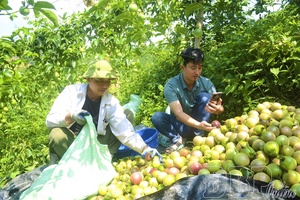
Recently, Hỏm Hốc village has seen many party members taking the lead in household economic development. A prime example is Lò Văn Giót, Deputy Secretary of the Party Cell and Head of Hỏm Hốc village. For many years, Lò Văn Giót’s family has persistently developed an integrated “garden - pond - cage” economic model. Currently, the family maintains 5 breeding cows, over 200 poultry, and a 7,000m² fish pond, combined with growing 2.5ha of fruit trees like longan and pomelo, as well as coffee and macadamia, generating a stable income of over VND 300 million each year. In 2026, responding to the commune’s crop restructuring policy, Lò Văn Giót’s family continued to convert nearly 6ha of cassava-growing land to coffee and macadamia cultivation.
“Studying Uncle Hồ’s teachings means learning from the most practical things, not just talking idly but rolling up one’s sleeves to work. To mobilize villagers to change their way of thinking and doing, abandoning low-efficiency cassava and corn crops to plant long-term industrial crops, the officials and party members themselves must do it first to prove the efficiency,” Lò Văn Giót said.
Commenting on his comrade, Điêu Chính Thắng, Secretary of the Hỏm Hốc Village Party Cell, shared that Lò Văn Giót is an exemplary, dedicated party member and village head who holds great prestige in the community. Along with developing his family economy, he regularly shares experiences and guides villagers to apply techniques into production, helping many households in the village gain more motivation to rise up and escape poverty.
From Lò Văn Giót’s model, many households in Hỏm Hốc have started converting inefficient crop areas to coffee and macadamia cultivation and expanding livestock breeding. Currently, Hỏm Hốc village has 154 households, and the number of poor households in the village has successfully decreased to 30.
Up to now, many economic models in the commune have initially brought positive efficiency. The cultivation models of coffee, macadamia, fruit trees, and livestock and poultry breeding have step-by-step helped residents raise their incomes and change their production mindset. According to statistics, the commune’s poverty rate currently stands at 36.2%, decreasing by an average of 5% to 6% each year, while the infrastructure and transport systems are being gradually improved.
“The work of studying and following Uncle Hồ’s teachings is determined by the commune to be closely linked to specific local tasks, especially economic development and sustainable poverty reduction, which has brought distinct transformations. In the coming time, the commune will continue to widely deploy the 2026 thematic study and emulation of Uncle Hồ associated with the spirit of ‘3 dares,’ promoting the exemplary role of officials and party members; focusing on developing effective economic models, expanding coffee and macadamia areas, improving people’s lives, and achieving the goal of sustainable poverty reduction,” Trần Khắc Tuấn, Secretary of the Mường Mùn commune Party Committee, said.
In the highland commune of Mường Mùn today, studying and following Uncle Hồ is no longer a matter of dry slogans, but has been transformed into concrete actions and deeds. Each official and party member stays close to the people through practical work, creating daily turnarounds in the lives of the residents.
Tú Trinh

.jpg)
.jpg)
.jpg)
.jpg)
.jpg)
.jpg)
.jpg)
.jpg)
.jpg)
.jpg)
You have 500/500 characters left
Please enter 5 or more characters!!!