



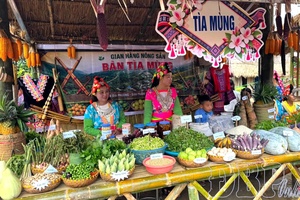
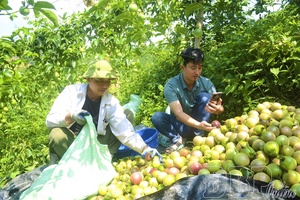
At the end of this past April, an experiential sweet potato harvesting activity took place on the Mường Thanh field, attracting a large number of local residents and tourists. The bustling atmosphere in the fields served as an activity to promote agricultural products, while simultaneously opening up a new direction: linking production with consumption and step-by-step building valuable products. This activity did not occur spontaneously but was set within the framework of implementing Resolution No.11-NQ/TU of the provincial Party Committee on restructuring the agricultural sector towards a commercial and sustainable direction. The ward Party Committee developed a specific plan with clear targets, such as developing 200 hectares of vegetables and crops, forming concentrated production areas, and building production-consumption linkage chains, with specific responsibilities assigned to each organization and individual.
Regarding sweet potato crops, the Party Cell of Residential Group 7 was chosen to pioneer. Through research and practical learning, the Party Cell Committee realized that sweet potatoes are a potential crop suitable for the locality. Two cell committee members were assigned the responsibility of trial planting right on their families’ fields. Following the first harvest, which yielded high capacity and quality, showing good efficiency and local suitability, the Party Cell brought the content of crop structure conversion into thematic meetings, organizing multiple sessions to discuss and unify the approach. After four meetings, the cell issued a thematic resolution on converting inefficient rice-growing areas to planting potatoes and cash crops.
.jpg)
Dương Đức Chính, Secretary of the Party Cell of Residential Group 7, stated that to build trust, the cell assigned committee members to implement it first so the people could clearly see the efficiency. At the beginning, the locals were still hesitant, so they determined they had to pioneer so that the people could see, believe, and then follow. Along with mobilization, the cell and the ward government directly provided technical guidance and supported the people during the production process, while promptly resolving difficulties such as drainage systems and cultivation conditions. This hands-on guidance approach helped residents feel secure about the conversion.
Thanks to the involvement of the party cell, many households boldly made the switch. In this year of 2026, the sweet potato model of Residential Group 7 has increased to 6 hectares, with 16 participating households and a yield of 2.5 - 3 tons per 1,000m². Nguyễn Văn Quang, a resident of Residential Group 7, said his family converted 1,000m² of rice fields to growing sweet potatoes. He shared that his family trusted the policy of the ward and the party cell, so they boldly converted. Compared to growing rice, sweet potatoes require less care, have fewer pests and diseases, and offer higher productivity. This crop is estimated to reach about 2.5 tons. Thanks to the connection of pioneering households, the support of the party cell, and proactively seeking outlets, the products are purchased by traders right at the field or transported for consumption outside the province, thereby increasing his family’s income.
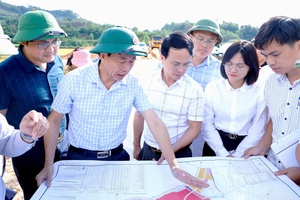
Along with sweet potatoes, Mường Thanh ward identifies intercropping various types of vegetables and cash crops and developing agricultural experiential tourism, contributing to increasing the value on the same land area. Đỗ Thị Thu Thủy, Secretary of the ward Party Committee, stated that the goal is not only to complete the resolution targets but to create sustainable livelihoods for the people; therefore, the party committee and authorities always go directly to the grassroots level, accompanying the people in every step of the conversion.
In Nà Tấu commune, the implementation to realize the resolution is also carried out flexibly, matching the conditions of each area. The Resolution of the Nà Tấu commune Party Congress for the 2025 - 2030 term sets a target of an average economic growth of about 11% per year, with the average per capita income reaching over 55 million VND by 2030. To achieve this goal, the commune focuses on developing high-value agricultural products such as coffee, macadamia, and fruit trees, while encouraging citizens to proactively switch to appropriate production models.
In villages and hamlets, the resolution is concretized in a realistic direction. In Trung Tâm village, where the production land fund is limited, the party cell mobilized residents to develop the economy towards business, services, and construction material production. Lê Văn Lực, Deputy Secretary of the Trung Tâm village Party Cell, said that the cell encourages and guides the people to develop according to available conditions, converting production models to business and services. Typically, several households switched to unburnt brick production or expanded other types of trading, thereby step-by-step raising incomes and stabilizing lives. Thanks to the appropriate approach, Trung Tâm village currently has no poor households.
From the reality in the two localities, it can be seen that the common point in implementing resolutions is specificity, clear tasks, clear responsibilities, and especially the exemplary role of officials and party members. When a resolution is “transformed” into concrete actions linked to practical needs and conditions, the term objectives will contribute to creating clear changes in the people’s lives.
Nguyễn Hiền

.jpg)
.jpg)
.jpg)
.jpg)
.jpg)
.jpg)
.jpg)
.jpg)
.jpg)
.jpg)
You have 500/500 characters left
Please enter 5 or more characters!!!