



Attending the working session were members of the Standing Board of the provincial Party Committee, the Standing Board of the provincial People’s Council, leaders of the provincial People’s Committee, and several provincial departments and branches.
.jpg)
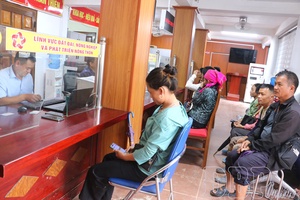
At the working session, Thanh Nưa and Thanh Yên communes reported on the implementation of political tasks, socio-economic development, and national defense and security assurance from July 1, 2025, to December 31, 2025, as well as the tasks for the first five months of 2026, along with key tasks and solutions for the coming time. Accordingly, the communal Party Committees have fully implemented the resolutions and directives of the Central and provincial authorities, concretizing them into programs and plans suitable to the actual local conditions. After nearly a year of implementing the two-level local government model, the grassroots government apparatus has been gradually consolidated and operated stably. Administrative reform and the resolution of procedures for the people have become increasingly convenient.
.jpg)
The localities proactively reviewed and adjusted their economic growth scenarios to closely follow the province’s development goals and orientations, striving to achieve double-digit growth. The fields of agricultural production, new rural construction, and the management of land, natural resources, and the environment continue to receive attention for implementation. Ensuring social welfare and caring for the people’s lives are carried out regularly. National defense and security in the area are maintained, while the political security situation and social order and safety remain fundamentally stable.
Leaders of the communes reported on the implementation progress of several works and projects in the area, site clearance work, resettlement arrangements, and the difficulties and obstacles encountered during implementation.
.jpg)
The localities proposed that the province continue to pay attention to supporting resources for infrastructure investment, removing difficulties in land management, accelerating the implementation progress of projects serving socio-economic development, and supplementing and consolidating cadres and civil servants.
At the working session, delegates focused on discussing and clarifying several contents related to the mobilization, supplementation, and consolidation of cadres and civil servants for the communes, especially in the fields of agriculture, land management, and the environment. They discussed solutions to attract investment in agricultural development, effectively exploit land potential, and form concentrated production areas associated with product consumption linkages. Simultaneously, they discussed reviewing and arranging the education and healthcare sectors at the communal level, planning the communal center, and formulating plans to arrange workplaces suitable to actual conditions, effectively exploiting existing facilities to avoid waste after the organizational apparatus rearrangement.
.jpg)
Speaking at the working session, provincial Party Secretary Trần Tiến Dũng requested the communes to focus on building a clean and strong Party and changing their leadership methods towards “clear people, clear tasks, clear time, and clear results” instead of giving general directions. At the same time, they must stay close to the people and the grassroots level, and self-update on new laws and regulations weekly to improve their capacity for public duty execution.
The provincial Party Secretary requested the communes to strongly apply digital technology, especially artificial intelligence (AI), to support communal-level civil servants and for application in agricultural production. The communes need to train cadres by specialized field groups, applying “hands-on” methods and practical application to resolve obstacles at the grassroots level. The communes must link together in developing tourism and agriculture to create synergy, learning from each other’s methods instead of working in isolation. They should focus on perfecting interconnected planning, taking advantage of natural landscapes, dynamic road axes, forest resources, and minerals for development. Thanh Nưa must strive to become a model new rural commune within this very term based on its available potential indicators.
.jpg)
The provincial Party Secretary directed the two localities to focus on restructuring agriculture and tourism. Specifically, they must promote high-tech agriculture, smart agriculture, and the development of eco-tourism and resorts under the forest canopy associated with local OCOP products. It is necessary to use digital platforms to promote tourism and investment. In this regard, communal leaders must work directly and accompany businesses to remove difficulties.
The localities need to arrange public non-business units in healthcare and education, ensuring good social welfare and security and order, while combating waste in public official activities and land fund management. The provincial Party Secretary requested provincial departments and branches to dispatch cadres with good mindsets and capabilities to directly support key areas.
.jpg)
The provincial Party Secretary encouraged local Party committees and authorities to have the determination to change and be proactive in their thinking, noting that the more determined a locality is, the more the province will support it. This support is demonstrated through the involvement of provincial agencies and departments to remove difficulties, the provision of additional necessary conditions regarding resources and mechanisms, and the promotion of investment attraction activities for the locality.
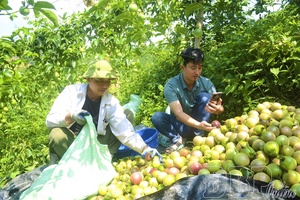
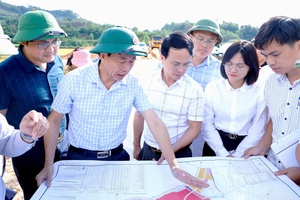
Previously, provincial Party Secretary Trần Tiến Dũng and the working delegation conducted a field inspection at the inter-level primary and junior high boarding school project in Thanh Nưa commune, the commercial service and residential area project, and the F1 spicy chili planting model in Ló village, Thanh Nưa commune.
An Chi

.jpg)
.jpg)
.jpg)
.jpg)
.jpg)
.jpg)
.jpg)
.jpg)
.jpg)
.jpg)
You have 500/500 characters left
Please enter 5 or more characters!!!