



Joining the working delegation were Members of the Standing Board of the provincial Party Committee, leaders of the provincial People’s Committee, the Vietnam Fatherland Front Committee of the province, and provincial boards, departments, and sectors.
.jpg)
.jpg)
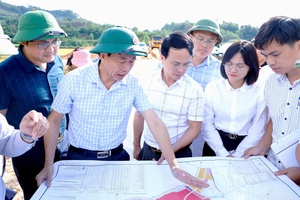
Prior to the working session, Secretary Trần Tiến Dũng and the delegation inspected the status and progress of the Nà Bủng commune Inter-level Primary and Secondary Boarding School project. Directly inspecting the construction site, Secretary Trần Tiến Dũng evaluated the implementation pace of each item and listened to the investor’s report on the project’s progress. To date, the project has completed approximately 64% of the volume based on contract value, with cumulative capital disbursement reaching nearly 55% of the assigned plan.
.jpg)
Following the field inspection, Secretary Trần Tiến Dũng required the units to complete the entire project before August 30 to promptly serve the 2026 - 2027 school year. To ensure the set plan, the Secretary requested the investor, contractors, and related units to maximize human resources, machinery, and equipment, strictly follow the critical path timeline, organize simultaneous construction across all items, and increase regular labor at the site to accelerate progress. Concurrently, they must urgently finalize dossiers, execute acceptance testing, process payments, and disburse capital in strict accordance with the plan.
.jpg)
Subsequently, Secretary Trần Tiến Dũng and the delegation held a working session with the Party Committees of the eight communes to evaluate the performance of political tasks, socio-economic development, and national defense and security maintenance in the first six months. At the meeting, the Party Secretaries of the communes reported outstanding outcomes in local socio-economic development, Party building, mass mobilization, propaganda, member development, and national defense and security safety, while reflecting on difficulties and snags arising during the operation of the two-level local government model.
.jpg)
The localities proposed that the province consider allocating investment resources to upgrade transport infrastructure, irrigation, the national grid, telecommunications, and projects to relocate populations out of areas prone to landslides. They also requested continued support for developing concentrated production zones with core crops such as macadamia, coffee, and cinnamon, alongside directing departments and sectors to accelerate projects under the “Lighting up Điện Biên” program, accompanying localities in tourism development, especially building community-based tourism villages, and effectively deploying solutions to combat child marriage and consanguineous marriage.
.jpg)
Based on the feedback from the communes, provincial departments and sectors responded to the recommendations and proposals, clarifying the timeline for resource allocation and the implementation schedule for the communes’ requests. Concurrently, provincial departments suggested several development orientations for the coming period, including stepping up agricultural restructuring, shifting toward high-economic-value crops like macadamia, coffee, and cinnamon, managing, protecting, and developing forest areas, building new-style rural areas and OCOP products, deploying national target programs, and managing minerals and land.
.jpg)
Delivering his concluding remarks, Secretary Trần Tiến Dũng acknowledged and highly appreciated the outstanding results achieved by the communes in socio-economic development and national defense and security maintenance since the beginning of the year.
Emphasizing tasks for the coming period, Secretary Trần Tiến Dũng required the commune Party Committees to continue stepping up the building of a clean and strong Party and political system, innovating mindsets, and promoting a spirit of daring to think, daring to do, and daring to take responsibility. They must robustly transform leadership methods according to the motto of “clear individuals, clear tasks, clear responsibilities, and clear results,” while materializing central and provincial guidelines into practical tasks and solutions focused on socio-economic development, job creation, and sustainable poverty reduction.
.jpg)
The Secretary required the communes to effectively carry out the rearrangement of villages to generate high public consensus, elevate responsibility in deploying national target programs - particularly agricultural development projects and crop structure conversion toward concentrated, green, smart, and sustainable models - while boosting production linkages and product consumption to raise the value of agricultural produce. Communes must proactively review and fully evaluate their potentials and advantages to formulate plans for attracting businesses and investors, efficiently exploiting development headroom, especially border area advantages, border gates, forest resources, and medicinal plant development under forest canopies. Provincial departments and sectors need to continue accompanying and supporting localities in untangling difficulties, creating conditions to efficiently exploit potentials and advantages.
.jpg)
Finally, the Secretary required the localities to closely grasp situations, firmly maintain national defense and security, and ensure social order and safety, while strengthening people-to-people diplomacy in border areas to build a border line of peace, friendship, cooperation, and development.
Phạm Trung

.jpg)
.jpg)
.jpg)
.jpg)
.jpg)
.jpg)
.jpg)
.jpg)
.jpg)
.jpg)
You have 500/500 characters left
Please enter 5 or more characters!!!