



One of the core viewpoints emphasized in Action Program No.40 of the provincial Party Executive Committee is promoting the “Điện Biên Phủ spirit” in peacetime; transforming the potentials, advantages, and attention of the Government into internal drivers, and turning traditions into new development momentum. The province determines to innovate its growth model, utilizing development for stability and stability for development. It is resolved to firmly maintain political security stability, creating a favorable environment and conditions for socio-economic development, aiming to construct Điện Biên into a province that develops toward a green, smart, and durable economy, and rises to become a well-developed locality in the region.
That strategic directive spirit is being vividly realized across various localities. In Búng Lao commune, the commune Party Committee issued an Action Program to concretize the Party’s 14th National Resolution and the provincial Party Committee’s Action Program into local development goals for the 2025 - 2030 tenure. To optimize feasibility, thematic resolutions have been enacted focusing on two spearheads: restructuring the agricultural sector linked to new-style rural building and sustainable poverty reduction; and developing the infrastructure system to create development space along the dynamic axis of National Highway 279 toward a civilized and modern direction. Each policy is backed by a specific plan, target indicators, and an implementation roadmap.
Regarding deployment methods, the locality chooses a development strategy based on maximizing available potentials and advantages. Within agriculture, it plans the development of key crops such as coffee, macadamia, and fruit trees linked to product consumption partnerships. Investment in transport infrastructure connecting production zones remains a priority. Concurrently, community-based and experiential tourism sites are step-by-step taking shape, closely tied to indigenous culture and specific coffee zoning.
Thanks to the right orientation and effective methods, many indicators of the commune have yielded positive results. The average per capita income has reached over VND 42 million per year, establishing a concentrated production zone with over 770 ha of coffee alongside hundreds of hectares of macadamia and fruit trees. By 2030, the locality aims to continue expanding the acreage of key crops toward commodity production.
.jpg)
Lò Văn Sáng, Permanent Deputy Secretary of the Búng Lao commune Party Committee, affirmed: “We are strengthening leadership and direction to execute socio-economic development tasks sustainably, effectively exploiting local potentials and advantages. We focus on boosting commodity agriculture associated with scientific and technological applications, while paying attention to developing trade, services, and tourism, and mobilizing and utilizing resources effectively to build new-style rural areas and raise the material and spiritual lives of the people.”
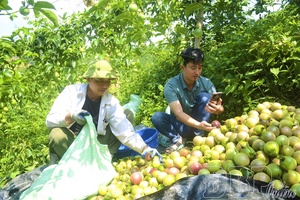
Along with Búng Lao commune, other localities are proactively concretizing development orientations tailored to their potentials, advantages, and practical conditions. For Chiềng Sinh commune, restructuring the agricultural sector toward commodity-oriented, green, smart, and sustainable production is identified as a core task. Since the beginning of 2026, the local government has boosted propaganda, mobilizing residents to convert low-efficiency rice and corn acreage into coffee and macadamia planting, generating an enthusiastic working atmosphere across many villages.
Up to now, the entire commune has around 320 ha of coffee and nearly 580 ha of macadamia. According to the 2026 plan, the locality aims to newly plant 1,000 to 1,200 ha of coffee trees and 400 ha of macadamia trees. Concurrently, the commune is coordinating with Mường Thanh Green Joint Stock Company to lead production linkages spanning from nursing seeds and technical guidance to product off-taking, helping residents feel secure in investing in production development.
Amidst the steady sound of hoes digging holes on the hillside, Lò Thị Sức in Hốc Chứn village, Chiềng Sinh commune, is busy reclaiming land to prepare for a new coffee planting season. Currently, her family’s coffee area planted in 2025 has reached over 5,000 m², growing and developing stably. This year, Lò Thị Sức is expanding and planting an additional 10,000 m² with the expectation of increasing income and step-by-step improving their living standards.
From the results of agricultural production, the spirit of action under the Party’s 14th National Resolution has spread powerfully to other socio-economic sectors. Among them, tourism is positioned as one of the three strategic breakthroughs for Điện Biên province in the new era. The target set for the 2026 - 2030 period is to turn tourism into a spearhead economic sector of the province, striving to welcome over 8 million tourist arrivals, extend the average duration of stay to 3 days, and push total tourism revenue to reach around VND 15,000 billion. To realize this strategic goal, the provincial department of culture, sports, and tourism has formulated an action plan, deploying synchronized solutions to effectively exploit the locality’s existing potentials and advantages.
A vivid testament to this orientation is the increasingly efficient development of community-based tourism across the province. Currently, Điện Biên has 14 villages qualified to welcome tourists, with over 40 operating homestay models. Among them, a prime example is Nà Sự village in Mường Chà commune, which after nearly 4 years since its debut has become an attractive destination on the journey to explore the westernmost tip of the Fatherland. Boasting beautiful natural landscapes, a well-preserved Thái ethnic cultural identity, and synchronously invested infrastructure, the Nà Sự community tourism site has welcomed over 20,000 tourist arrivals for sightseeing and experiences since 2022, contributing to creating livelihoods and raising incomes for local residents.
The family of Thùng Thị Lâm is one of the pioneering households developing a homestay in Nà Sự village. Currently, her family’s accommodation facility can serve about 10 guests simultaneously. According to Thùng Thị Lâm, in the coming time, the family will continue to invest in the landscape and upgrade services to bring a better experience to tourists.
From the reality of models deployed at the grassroots level, it is evident that when a resolution is concretized into daily life and receives public consensus, it becomes a vital resource driving socio-economic development. On the historic land of Điện Biên, the aspiration to rise up is being step-by-step realized through concrete and practical actions, opening up expectations for a new phase of faster and more sustainable development.
Phương Dung

.jpg)
.jpg)
.jpg)
.jpg)
.jpg)
.jpg)
.jpg)
.jpg)
.jpg)
.jpg)
You have 500/500 characters left
Please enter 5 or more characters!!!