



Điện Biên possesses a vast, fragmented terrain where numerous ethnic groups live together, with each village and hamlet carrying its own cultural and historical values. Therefore, for policies to enter life, cadres and party members play a pioneering, exemplary role in creating consensus and guaranteeing the arrangement process executes openly, democratically, and in accordance with regulations.
Part 1: Party members - A “bridge” connecting the Party’s guidelines with the public mind
The process of rearranging villages, hamlets, and residential groups generates more or less hesitation regarding names, geographical boundaries, travel distances, benefits, or customs and habits. However, by staying close to the people, listening to residents, explaining to citizens, and helping people resolve each specific issue, cadres and party members became core nuclei across party cells, villages, and Front Work Boards to step-by-step unblock “bottlenecks” and elevate awareness to build consensus for executing this major policy.
Unblocking “bottlenecks” from grassroots level
Under initial plans, a portion of Cà Là Pá village residents (Sín Thầu commune) was to merge into Phứ Ma village to guarantee household scale standards, encompassing 77 households with 428 residents from the suspension bridgehead area down to adjacent Phứ Ma village (Sín Thầu commune) and 24 households with 144 residents belonging to the Chí Xế area.
However, when gathering opinions, voters in Phứ Ma village raised very specific hesitations regarding boundaries and population management. Residents did not oppose the arrangement policy, yet Phứ Ma village voters agreed to receive 55 households with 331 residents - encompassing neighboring households and the Chí Xế area group - to establish a new village scaling 115 households with 553 residents.
.png)
Meanwhile, 46 households with 241 residents in the area from the suspension bridge down to adjacent Phứ Ma village requested to remain under Cà Là Pá village, because this area sits roughly 1 km from Phứ Ma village and borders Cà Là Pá village, proving more convenient for management and daily life. To build public consensus, local cadres and party members became crucial bridges between Party, government policies, and the people.
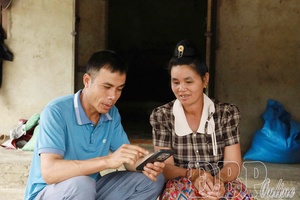
At that time, Khoàng Dè Sà, Secretary of Phứ Ma village Party Cell, was merely a party member in the cell, yet he joined local party committees and authorities to disseminate and mobilize residents to agree with the village arrangement policy.
Having served as a non-professional cadre, a member of the commune’s Fatherland Front Committee, and then returned to live in the village, Sà understood public hesitations and realized that building consensus requires allowing people to speak, ask, and receive detailed explanations.
In public gatherings and party cell meetings, Sà typically began with stories close to daily life. When villagers asked whether village names would remain post-arrangement, where the new village center would sit, whether travel would prove convenient, or how future community activities would be organized, he patiently explained each matter, researching and consulting party committees and authorities on unclear issues before informing residents back. “When our villagers do not understand, we must speak in ways that are easy to comprehend, avoiding things too distant from their daily lives,” Sà shared.
On that basis, he mobilized fellow party members to participate, with each person visiting household groups and individual hesitant families to exchange views. That patience and proximity step-by-step unblocked “bottlenecks,” helping residents comprehend guidelines accurately, realize long-term benefits, and concur with local village arrangement options.
Contributions from Khoàng Dè Sà alongside party cell members contributed significantly to helping Sín Thầu commune complete village arrangement and reorganization according to set goals, arranging 15 villages to establish 7 new villages while retaining 6 villages, reducing the total village count from 21 down to 13 villages. Following the arrangement, backed by local party committee and authority trust, Sà was appointed Secretary of the new Phứ Ma village Party Cell.
Mass mobilization from “tea tables”
While public hesitations in Sín Thầu received answers through public gatherings and party cell meetings, “residential group and village tea tables” in Mường Nhé commune became a close and practical mass mobilization method, where Fatherland Front cadres and party members sat alongside residents to hear every story and clarify unclear points right at the grassroots level.
According to Lê Hữu Thỉnh, Vice Chairman of the Mường Nhé commune’s Vietnam Fatherland Front Committee and Chairman of the Mường Nhé commune’s Veterans Association, during the arrangement process, upon noticing a section of residents feeling hesitant, Front cadres and party members did not wait for people to seek them out, but proactively visited grassroots levels, holding “tea tables” where residents met and conversed conveniently, allowing cadres to grasp thoughts through everyday stories and select suitable dissemination methods for each population group.
Facing the option to arrange Mường Nhé village with Residential Group 3, several households worried that land and contracted forest rights would be affected. Instead of relying solely on written documents for dissemination, Front cadres and party members directly visited population groups, explaining clearly which contents remained unchanged and which contents transformed, while analyzing long-term arrangement benefits to gradually ease anxious mindsets as rights were clarified.
Ethnic, language, and custom differences across areas also concerned residents. With multiple communities living together, grassroots cadres patiently analyzed matters to help villagers understand that arrangements do not erase identity, but expand exchange spaces and build conditions for communities to support each other’s development, providing children with expanded learning, exchange, and access opportunities. From “tea tables,” matters difficult to express in crowded meetings were shared candidly by residents, enabling cadres to listen to understand, understand to explain, and explain until residents felt truly enlightened.
That practical reality proved that the pioneering role of party members is reflected not only in exemplary policy compliance, but also in staying close to the people and unblocking obstacles for the public. When cadres and party members sit down with residents, speak the people’s language, and resolve issues concerning citizens, major policies no longer feel distant, but gradually become choices of high consensus and unanimity across the community.
(to be continued)
Phạm Quang
.jpg)
.jpg)
.jpg)
.jpg)
.jpg)
.jpg)
.jpg)


.jpg)
.jpg)
.jpg)
You have 500/500 characters left
Please enter 5 or more characters!!!