



As a border commune facing numerous difficulties with a high poverty rate of 46%, Nậm Kè commune identified that improving residents’ living standards and reducing the poverty rate to 15% by the end of the term requires creating stable livelihoods first. Guided by this direction, the commune concentrates on executing agricultural restructuring, efficiently exploiting land and climate potential, and gradually transitioning from small-scale production to commercial commodity development to create value right on farmers’ cultivated land.
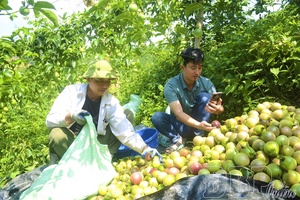
Based on guidance from party committees and local authorities, many households boldly converted to higher economic value crops. Nguyễn Văn Tình’s family in Nậm Kè village was among those responding to local orientations by introducing green gourds into production. After several crop cycles, green gourds adapted well to soil conditions, providing stable yields and economic efficiency that affirmed a suitable conversion direction.
Nguyễn Văn Tình shared that compared to planting maize or cassava, green gourds generate higher income, yielding around 80 tons per hectare across his 5 hectares and selling at 8,000 VND per kilogram to net his family nearly 3 billion VND per harvest after costs. He added that what brings enthusiasm is that products are linked with purchasing enterprises, freeing growers from reliance on small traders.
.jpg)
To date, the entire Nậm Kè commune has developed nearly 10 hectares of green gourds. Although the area remains modest, it represents a crucial initial step in shifting production structures, as many households proactively convert crops and adopt suitable production models to gradually replace inefficient farming habits.
While green gourds open up conversion avenues on inefficient cultivated land, coffee and macadamia are designated as long-term development drivers for Nậm Kè. To materialize this orientation, right from early 2026, commune party committees and authorities mobilized the entire political system to disseminate and encourage residents to prepare land funds, clear fields, dig holes, and plant new coffee and macadamia according to plans. The commune strives to plant 350 new hectares of coffee and 350 hectares of macadamia to step-by-step form concentrated raw material areas that drive sustainable economic growth.
Nguyễn Tiến Thành, Chairman of the Nậm Kè commune People’s Committee, noted that in executing poverty reduction goals, the locality identifies production development as a fundamental solution centered on restructuring agriculture, exploiting land funds efficiently, expanding high-value crops, establishing concentrated production zones, and facilitating residents’ access to science and technology to step-by-step elevate incomes and stabilize lives.
Along with crop structure conversion, Nậm Kè develops livestock breeding by leveraging indigenous advantages. Whereas buffaloes, cattle, and pigs were previously raised on a small scale for household consumption, many families now boldly expand operations toward commercial commodity breeding. Local black pigs are deemed well-suited to natural conditions and traditional breeding habits while meeting rising market demands, with the total population currently reaching around 2,000 head.
In mid-July, the commune Farmers’ Association established the Professional Farmers’ Association Branch for Commercial and Breeding Indigenous Black Pigs in Pá Mỳ village with 20 participating members. The model aims to strengthen linkages among breeding households, share experience, apply science and technology, prevent diseases, and step-by-step build an indigenous black pig brand, representing a concrete step in executing value-chain production policies to raise incomes and reduce poverty sustainably.
Nguyễn Tiến Thành, Chairman of the Nậm Kè commune People’s Committee, emphasized that sustainable poverty reduction cannot be achieved overnight but requires building production systems suited to local realities. Therefore, in the coming time, the commune will continue focusing on developing planned coffee and macadamia regions, replicating effective crop conversion models, encouraging indigenous black pig breeding alongside strength-based livestock, and efficiently exploiting forest economic potential, maintaining an overarching goal to elevate value per unit of production land, create jobs, and increase incomes so residents can step-by-step rise out of poverty through internal strength.
Quang Long

.jpg)
.jpg)
.jpg)
.jpg)
.jpg)
.jpg)
.jpg)
.jpg)
.jpg)
.jpg)
.jpg)
You have 500/500 characters left
Please enter 5 or more characters!!!