



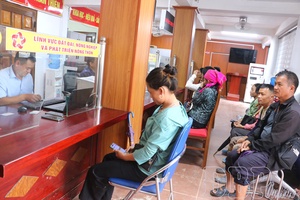
Observations at the Public Administrative Service Center of Mường Ảng commune reveal a busy and orderly working atmosphere. Citizens arriving for authentication, civil status, or land procedures are received and guided by cadres right from the start. All procedures, dossier components, and processing times are publicly posted; cases requiring additional paperwork receive specific explanations, helping citizens complete dossiers on the same day.
Cà Văn Thắng from Co En village, Mường Ảng commune, shared: “Recently, I visited the commune office for marriage registration. Prior to dossier submission, cadres gave specific guidance on required documents, resolution procedures, and result return timelines. The dossier was processed quickly, and any unclear content was explained thoroughly, saving us multiple trips. The cadres’ service attitude was enthusiastic and friendly.”
These changes stem from a shift in the service mindset among cadres and civil servants. Instead of waiting for inquiries, cadres proactively approach and assist right upon receiving dossiers. Receiving and processing procedures are reviewed, standardized, and publicized; many procedures are conducted in digital environments, helping reduce processing times, cut travel costs, and create convenience for citizens. According to announced 2025 Administrative Reform Index results, Mường Ảng commune ranked first province-wide with 100 percent of dossiers resolved ahead of deadline, completing 34 out of 34 tasks, and achieving a public satisfaction rate exceeding 90 percent.
.jpg)
Tuần Giáo commune also made its mark in administrative reform, ranking 3rd province-wide according to the 2025 Administrative Reform Index and falling into the “Good” category. This result stemmed from synchronously deploying multiple solutions, focusing on accelerating digital transformation in administrative procedure settlement. An increasing volume of dossiers is received and processed in digital environments, shortening resolution times and elevating openness and transparency; citizens can track dossier processing progress, reducing the need for repeated trips to supply information or collect results.
Quàng Văn Cương, Chairman of the Tuần Giáo commune People’s Committee, stated: “The commune identifies administrative reform as a regular task, using public satisfaction as the yardstick for service quality. Along with reviewing and simplifying administrative procedures, the commune continues to promote IT applications and digital transformation in receiving and settling dossiers, strengthening administrative discipline and order, and raising the sense of responsibility among cadres and civil servants to serve the people increasingly well.”
During the construction of the two-tier local government model, the commune level serves as the direct touchpoint resolving the majority of tasks related to citizens. Therefore, alongside simplifying procedures, applying IT, and advancing digital transformation, localities are focusing on building a dedicated and responsible team of cadres to meet public service requirements. The ultimate goal remains constructing an open, transparent, effective, and efficient administration.
Đoàn Xuân Tứ, Chairman of the Mường Toong commune People’s Committee, shared: “Characterized as a highland commune with many villages far from the center, difficult transportation, and uneven IT application levels among a segment of the population, every commune cadre and civil servant has consistently raised their sense of responsibility and patiently provided guidance so that citizens can easily access and execute administrative procedures better.”
Results achieved across localities show that despite differing conditions and methods, the common goal remains elevating service quality for citizens and constructing an open, transparent, and effective administration. This is also reflected in the province’s 2025 Administrative Reform Index evaluation results. Among the 45 evaluated communes and wards, 23 units were classified as Good, 13 units as Average, and 9 units as Low. These results reflect a comprehensive picture of administrative reform across the province while serving as a basis for localities to promote effective models, clearly identify limitations, and propose corrective solutions for the coming period.
Quang Long

.jpg)
.jpg)
.jpg)

.jpg)
.jpg)
.jpg)
.jpg)

.jpg)
.jpg)
.jpg)
.jpg)
You have 500/500 characters left
Please enter 5 or more characters!!!