



This shift meets innovation requirements and matches the current 2-tier local government model, thereby contributing to enhancing local governance capacity, narrowing development gaps, and creating a strong driving force for socio-economic development.
To effectively execute digital transformation tasks across the area, the Mường Nhé commune People’s Committee established a Steering Committee for scientific development, technology, innovation, digital transformation, and Project 06. Concurrently, the committee issued operational regulations and deployed a comprehensive digital transformation plan for 2026 to all local agencies and units.
Nguyễn Văn Úy, Chairman of the Mường Nhé commune People’s Committee, stated that this represents a foundational step to guarantee a centralized and unified management mechanism, clearly defining the responsibilities of each agency and department during implementation. From this basis, an interconnected and synchronous digital governance ecosystem is being shaped, setting the ideal stage for the complete digitalization of the local government apparatus.
Along with perfecting the governance framework, the locality prioritized investing in and upgrading digital infrastructure to meet the operational demands of the 2-tier local government model. The TD-Office document management and administration system has been deployed effectively, with over 95% of documents exchanged in a network environment with the provincial People’s Committee, departments, and sectors. Specialized digital signatures have been applied to documents within issuing authority, and specialized departments have successfully installed digital signatures to serve the digitalization of dossiers and procedures.
.jpg)
Up to now, 100% of officials and public employees in Mường Nhé commune have been granted official public service email addresses, while the internal network and specialized data transmission network operate smoothly from the provincial to the commune level. Agencies and units are fully equipped with computers, printers, scanners, and basic information technology equipment to serve their daily tasks. Within the commune, telecommunications infrastructure has successfully covered mobile networks, and LAN systems alongside internet lines continue to be upgraded to guarantee stable connection speeds and optimal data processing capabilities. Furthermore, the online conferencing system from the central to local levels runs synchronously, effectively serving guidance and administration work.
Within the digital government architecture, data is viewed as a valuable new resource and a decisive factor in governance quality. Recognizing this clearly, Mường Nhé commune focused on reviewing and cleaning data according to the “correct, sufficient, clean, live” criteria across the fields of land, population, poor households, healthcare, education, and administrative bases.
This data standardization process is carried out synchronously alongside connecting, sharing, and enriching information with relevant sectors to update the national database system. The initiative also covers standardizing party member data, deploying judicial software for permanent residency registration and temporary residency deletion, and applying the national population database, citizen identification cards, and electronic identification and authentication to local socio-economic development.
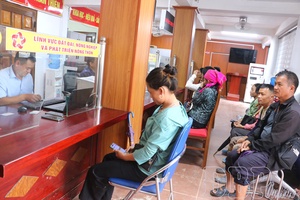
While highlanders previously had to travel multiple times and endure long waits to complete administrative procedures, the dossier resolution process in Mường Nhé is gradually transforming to become fast, convenient, and transparent. The Mường Nhé commune Public Administrative Service Center received relatively synchronous material investments to meet the requirements of processing administrative procedures in a digital environment. The center is fully equipped with transaction counters, internet-connected computers, printers, scanners, photocopiers, queue number machines, and online payment equipment, with functional areas arranged in strict compliance with guidelines from the Office of the Government and the provincial People’s Committee.
Although the number of citizens arriving for transactions at the Mường Nhé commune Public Administrative Service Center is quite large, the process of receiving and processing dossiers takes place quickly and orderly. After just a few minutes of completing declarations and verifying information, Vàng A Chư from Huổi Trạng 1 village successfully completed his business registration procedures.
“The officials provided very enthusiastic guidance, making the resolution fast and far more convenient than before,” Vàng A Chư said.
One of the solutions creating a distinct turnaround at the Mường Nhé commune Public Administrative Service Center is the authorization granted to the Deputy Director of the Center to directly execute document authentication. This solution contributes to reducing intermediary steps, shortening dossier processing times, and enhancing proactive capacity in local administration.
Phạm Thị Hoàn, Deputy Director of the Mường Nhé commune Public Administrative Service Center, noted that the authentication authorization has significantly reduced the time required to resolve administrative procedures for citizens. The workflow speed is noticeably faster, which directly improves overall efficiency and boosts satisfaction for residents, organizations, and businesses when they come to complete administrative procedures at the center.
Thanks to the synchronous implementation of multiple solutions, the rate of dossiers resolved on time and ahead of schedule in the locality is currently maintained at 100%, clearly reflecting the efficiency of transitioning from a management administration to a service administration. Within the national digital transformation flow, Mường Nhé is step-by-step turning technology into a vital tool to improve governance effectiveness, expand public service access, and forge a sustainable development foundation for the future.
Diệp Chi


.jpg)
.jpg)
.jpg)

.jpg)
.jpg)
.jpg)
.jpg)


.jpg)
.jpg)
.jpg)
You have 500/500 characters left
Please enter 5 or more characters!!!