



Realities in Điện Biên province demonstrate that from the grassroots level upward, the government apparatus has undergone numerous innovations in leadership, management, and administrative reform, resulting in distinct changes.
One of the key factors determining operational effectiveness is the role and responsibility of the leader. Upholding individual responsibility tied to the results of task implementation has become a consistent requirement in the leadership and management of many localities. Sín Thầu, a border commune facing many difficulties, has recently seen strong innovations in its methods. Given the scattered population and limited access to administrative services, the government apparatus must be closer to the people, more proactive, and provide more substantive service.
Nguyễn Văn Thắng, Chairman of the commune People’s Committee, stated that the commune identifies enhancing effectiveness and efficiency as a central and consistent task. The role of the leader is clearly demonstrated through the assignment of specific tasks, linking individual responsibility to output results. Any content that is behind schedule or fails to meet requirements is reviewed to clarify responsibility during periodic briefings. The spirit of “actions matching words” and “using service results as a measure” is not just a slogan but has become the criteria for evaluating officials. Commune officials do not only work at the headquarters but are assigned to specific areas to directly grasp the situation and promptly resolve arising issues.
.jpg)
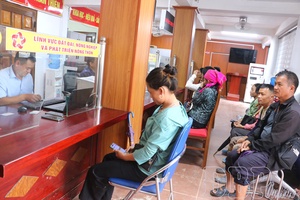
Simultaneously, administrative reform has been intensified. Procedures are simplified, processing times are shortened, and implementation processes are made public and transparent at the “one-stop shop.” Procedures directly related to citizens, such as civil status, authentication, document verification, and social policies, are prioritized for rapid and compliant resolution, reducing the need for multiple trips. The decentralization and empowerment of the grassroots level also help the locality be more proactive in handling work, reducing intermediate steps and shortening waiting times for residents, which is particularly suitable for border areas with difficult transportation. Since the implementation of the two-tier local government model on July 1, 2025, the Sín Thầu commune People’s Committee has received and resolved over 1,500 administrative dossiers, with nearly all resolved on time or ahead of schedule.
Similarly, in Búng Lao commune, enhancing the responsibility of the leader is identified as a key solution. According to Trương Hồng Bách, Chairman of the commune People’s Committee, the commune has strengthened inspection, supervision, and evaluation of officials based on specific work products. Shortcomings in handling procedures, citizen reception, or addressing petitions are identified for timely correction. The locality emphasizes direct dialogue between the head of the government and the people, allowing many difficulties to be resolved right at the base. The “citizen-centered” perspective is thoroughly applied throughout the government apparatus.
Beyond the grassroots level, administrative reform is identified as a “breakthrough” for the entire province. Điện Biên has focused on simplifying procedures and ensuring transparency. The “one-stop shop” and “inter-linked one-stop shop” systems from the provincial to the grassroots levels are increasingly perfected, allowing citizens to resolve multiple procedures at a single location. The promotion of information technology and online public services has also improved access.
Statistics show that from December 15, 2025, to March 13, 2026, specialized agencies under the Provincial People’s Committee received 9,048 dossiers, 100% of which were resolved on time or early. At the commune level, out of 36,525 dossiers received, 99.9% were resolved on time or early.
Along with process improvements, administrative agencies focus on the service attitude of officials. The spirit of “respecting, being close to, and understanding the people” is deeply instilled, helping to build a friendly and responsible government image. Evaluation results show that the satisfaction index of people toward the service of state administrative agencies in the province in 2025 reached over 81%, reflecting positive changes in service quality. Ultimately, enhancing the effectiveness of the government is not only an inevitable requirement but also a vital driver for socio-economic development.
Minh Thư

.jpg)
.jpg)
.jpg)

.jpg)
.jpg)
.jpg)
.jpg)

.jpg)
.jpg)
.jpg)
You have 500/500 characters left
Please enter 5 or more characters!!!