



However, this has not led officials to drift away from the grassroots. Here, staying close to the people begins with leaving office desks to head down to the villages, hike up to hillside fields, and visit landslide spots, ongoing construction sites, or newly introduced crop models - working alongside residents to resolve bottlenecks and find practical ways to improve daily life.
.jpg)
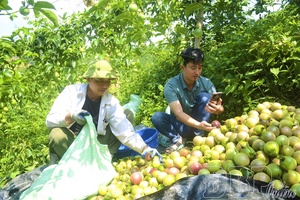
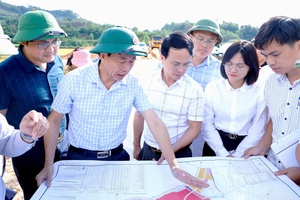
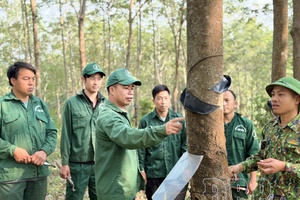
In the morning in Sín Thầu, while mountain mist still lingers, Chairman of the commune People’s Committee Nguyễn Văn Thắng and specialized cadres arrive to inspect the cardamom cultivation area in A Pa Chải village. Without conference halls or thick reports, issues needing review are addressed directly on the villagers’ production land. Cadres check crop growth, examine soil conditions, and listen to local residents discuss challenges in crop care. Practical observations allow matters concerning crops, land, and livelihoods to be discussed and settled concretely.
Leaving the cardamom area, the working mission continues onward to assess current conditions at landslide points to devise remediation plans. A landslide point might appear as merely a few lines in a report, yet behind it lies the daily route for children going to school, patients accessing medical facilities, or farmers transporting agricultural produce.
In the afternoon, work continues at the trial sugarcane plantation covering 150 hectares, newly introduced to Sín Thầu. This model represents a partnership with a Chinese sugar company where local farmers receive financial support, technical guidance, and guaranteed product off-take. From the sugarcane field, the team moves to inspect irrigation structures, checking water sources and production capacity ahead of the planting season. Shortcomings are discussed on the spot to ensure sufficient water supply for farming acreage.
.jpg)
Returning to headquarters from the field, pending administrative dossiers are processed. For cadres in Sín Thầu, daily work is continuously tied to concrete grassroots issues; every trip to a village and every field inspection helps resolve tasks in close alignment with practical conditions and public demands.
A typical day for commune leaders, civil servants, and public employees involves multifaceted assignments, all sharing a unified purpose: safeguarding livelihoods, labor, and well-being for the people.
Since July 1, 2025, the new Sín Thầu commune has been operational. Files and assets had to be handed over, cadres reassigned, and unfinished tasks from former communes resolved, even as daily administrative demands from residents continued. The commune focused on consolidating its apparatus, settling backlog files, maintaining production, ensuring social welfare, and processing public administrative procedures.
.jpg)
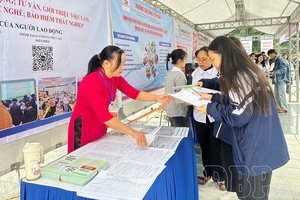
Sín Thầu commune currently employs over 230 civil servants and public employees. Under conditions of an expansive territory, dispersed population, limited infrastructure, and multiple cadres holding concurrent duties, local governance must remain close to the grassroots, especially remote villages far from the commune center. For example, during the Great National Solidarity Festive Day, commune cadres visit residents to share thoughts and listen to their aspirations. Based on public proposals, the commune has coordinated the construction of essential welfare projects while identifying suitable crop structures. Sugarcane, coffee, and macadamia have been put into trial cultivation, and expansion plans for cardamom acreage are being calculated.
Following the merger, Sín Thầu restructured its 21 original villages down to 13. Locals remember cadres through instances where landslide-hit access roads were inspected and cleared, irrigation works reviewed before planting seasons, administrative paperwork guided smoothly without repeated visits, and crop restructuring proposals adopted and piloted.
.jpg)
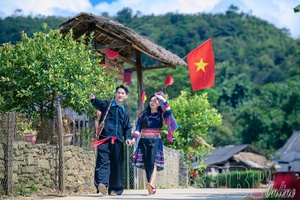
Lỳ Xuyến Phù, a reputable community figure in Sín Thầu, shared that despite a larger territory and higher workload under the two-tier local government model, commune cadres have quickly adapted, working with high responsibility and remaining close to the people. This attentive guidance has motivated local ethnic communities along the frontier to unite in firmly defending border sovereignty while proactively adapting to new production directions to develop their homeland.
In the westernmost border area of the Fatherland, the distance from commune headquarters to remote villages remains connected by winding mountain paths. Yet the distance between the local government and the people is narrowed through practical tasks resolved right at the grassroots. The spirit of serving, staying close to, and understanding the people is embodied in the presence of cadres wherever citizens need them, tackling issues directly tied to their daily lives. Those footsteps represent the shortest bridge bringing local governance closer to the hearts of the people.
Lê Dung
.jpg)
.jpg)
.jpg)
.jpg)
.jpg)
.jpg)
.jpg)
.jpg)
.jpg)
.jpg)
.jpg)
.jpg)
You have 500/500 characters left
Please enter 5 or more characters!!!