Empowering local government at grassroots level

ĐBP - Transitioning from primarily executing assigned tasks, the commune level has now become the tier that directly governs local areas, proactively addressing citizens’ affairs and resolving issues arising right at the grassroots level. These represent distinct transformations after more than one year of operating under the two-tier local government model.

Present at the Public Administrative Service Center of Chiềng Sinh commune in mid-July, citizens arriving to process document authentication, civil registration, land record verification, or social protection applications had all their needs received and resolved through a single window. Tasks that previously required reporting or transferring to higher administrative tiers are now handled proactively by the commune government within its authorized remit, significantly streamlining procedural steps.

Lò Văn Đoàn, a resident of Chiềng Sinh commune, shared that while carrying out agricultural land transfer procedures, he received enthusiastic and thorough guidance from cadastral officials without having to make multiple trips. Previously, such paperwork required traveling to the district level, but now almost all procedures are settled directly at the commune level, including the issuance of Land Use Rights Certificates. He noted that decentralizing authority to the commune level is highly practical, eliminating intermediaries and reducing both travel time and expenses for residents.

Many administrative tasks that previously forced citizens to travel to higher levels are now settled directly at commune-level public administrative service centers. After over a year of operating under the new model, the People’s Committee of Chiềng Sinh commune has processed more than 11,000 document authentications and over 700 civil status files, while promptly resolving numerous citizen petitions and feedback right at the grassroots level.

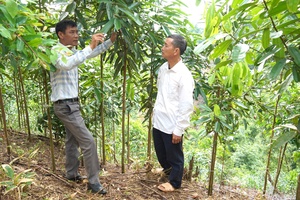
Leaders of Chiềng Sinh commune surveys afforestation in Huổi Hốc village.

The effectiveness of administrative empowerment is demonstrated clearly in practical reality. Recently, a land dispute occurred among households in Khong Tở village. Upon receiving the petition, the commune People’s Committee promptly instructed specialized civil servants to verify the situation, conduct field inspections, and organize conciliation in full compliance with procedures stipulated by the Land Law. By proactively resolving matters at the grassroots level, the entire verification and conciliation process was completed swiftly, preventing prolonged disputes and petitions.

As an official directly providing counsel on land affairs, Lò Văn Thanh, a specialist at the Economic Office of Chiềng Sinh commune, stated that in cadastral and land management, the office not only processes dossiers but also directly advises the commune People’s Committee on appraisals, verifications, land dispute conciliations, cadastral record management, and the settlement of numerous authorized matters right at the grassroots level.

Đỗ Văn Sơn, Chairman of the People’s Committee of Chiềng Sinh commune, stated that under the two-tier local government model, the most notable improvement is that grassroots administrations have gained enhanced initiative in management and administration. Decentralization and delegation of authority not only assign more tasks but also establish higher demands regarding the responsibility of leaders and the contingent of cadres and civil servants.

Previously, several matters related to cadre management, social security policy execution, or specific administrative procedures required submission to higher echelons for approval. Currently, for matters within its authority, the commune People’s Committee directly reviews, processes, and issues decisions in accordance with regulations. In social protection, for example, applications for monthly allowances formerly required district appraisal and decision-making; now, citizens need only submit their dossiers at the commune public administrative service center, and upon appraisal by specialized units, the Chairman of the commune People’s Committee holds full authority to issue decisions, shortening processing cycles and facilitating faster policy access for residents.

To fulfill these new operational requirements, the People’s Committee of Chiềng Sinh commune has restructured its administrative methods. Tasks are assigned following the “six clears” principle, information technology applications are strengthened, and commune leaders routinely convene briefings and inspect progress. Expanded authority naturally entails greater demands regarding professional capacity, sense of responsibility, and public service ethics among civil servants.

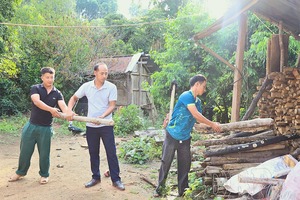
Leaders of Chiềng Sinh commune listen to the thoughts and aspirations of residents in Hua Sát village.

Nguyễn Tiến Đạt, Director of the provincial Department of Home Affairs, stated that decentralization and administrative authorization have been deployed synchronously and decisively across multiple domains. To date, the provincial People’s Committee has issued 24 decentralization decisions covering a total of 144 tasks, including 70 tasks decentralized to the commune level, alongside 22 authorization documents covering 316 tasks. Comprehensive decentralization across home affairs, finance, agriculture and environment, science and technology, and industry and trade has created favorable conditions for grassroots administrations to proactively execute tasks and handle administrative procedures.

Moving forward, the provincial People’s Committee will continue empowering grassroots administrations with tasks directly related to citizens and enterprises under the principle of “clear personnel, clear duties, clear responsibilities, clear authority, clear resources, and clear outcomes.” Decentralization must be accompanied by resource allocation, enhanced cadre training, finalized information technology infrastructure, and reinforced inspection and supervision to ensure substantive effectiveness.

The most transformative outcome of the two-tier local government model lies not merely in the volume of transferred tasks, but in the paradigm shift of local governance. Commune-level administration does not simply execute administrative orders from above; it has become the direct governing tier closest to the people and the primary point of contact for resolving their concerns. Stronger administrative empowerment for the commune level is steadily narrowing the distance between the government and the people.

Anh Nguyễn
Comment

You have 500/500 characters left

Please enter 5 or more characters!!!

Recent news

  • '“Reclaiming” youth for teenagers (Part 2)

    “Reclaiming” youth for teenagers (Part 2)

    NEWS - POLITICS -
    ĐBP - Child marriage leaves severe consequences not only for parents, but also forces children into disadvantages right from the beginning of life. Some grow up in deprivation; some cannot take their father’s surname, leaving the father’s information blank on birth certificates; and some lose the opportunity to draw their first breath before ever being born. These “voids” illustrate that the repercussions of child marriage do not stop at a single marriage, but extend across future generations, impacting population quality, poverty reduction efforts, and social development.
  • 'Beneath graves, a call to name the fallen

    Beneath graves, a call to name the fallen

    NEWS - POLITICS -
    ĐBP - In the early morning of a late August day, as the streets of central Điện Biên Phủ were still veiled in thin mist, officers and soldiers of the Điện Biên provincial Military Command gathered in full force at the Độc Lập National Martyrs’ Cemetery.
  • 'Tuần Giáo shifts agriculture toward higher value

    Tuần Giáo shifts agriculture toward higher value

    ECONOMY -
    ĐBP - Leveraging its land resources and strategic location as a “gateway” to the province, Tuần Giáo commune is restructuring agricultural production toward large-scale, market-oriented farming and higher added value. A key focus is developing concentrated raw-material zones and strengthening value-chain linkages among farmers, cooperatives and businesses.
  • 'Điện Biên leaders pay tribute to heroic martyrs

    Điện Biên leaders pay tribute to heroic martyrs

    NEWS - POLITICS -
    ĐBP - On August 28, the Điện Biên provincial Party Committee, People’s Council, People’s Committee, and Việt Nam Fatherland Front Committee of the province held an incense offering ceremony to pay tribute to heroic martyrs on the occasion of the 81st anniversary of National Day of the Socialist Republic of Việt Nam (September 2, 1945 - 2026).
  • 'From terrace fields to digital stalls

    From terrace fields to digital stalls

    ECONOMY -
    ĐBP - From terrace hills and highland kitchens, agricultural produce and specialties of Điện Biên are progressively stepping into cyberspace through livestream sessions and promotional videos.
  • 'Mường Tùng lays groundwork for sustainable growth

    Mường Tùng lays groundwork for sustainable growth

    NEWS - POLITICS -
    ĐBP - Building on a spirit of solidarity, initiative and creativity, during the first eight months of 2026, the Mường Tùng commune Party Committee, authorities and people from different ethnic groups have worked to carry out tasks in Party building, socio-economic development, national defense and security.
  • '“Reclaiming” youth for teenagers (Part 1)

    “Reclaiming” youth for teenagers (Part 1)

    NEWS - POLITICS -
    ĐBP - Nearly 7,000 cases of child marriage over the past 5 years, accounting for about 28% of total married individuals - a figure alarming enough to sound a warning bell about the scourge of child marriage in Điện Biên, one of the provinces with the highest rates nationwide.
  • 'Translating resolution on tourism development into reality

    Translating resolution on tourism development into reality

    TRAVEL -
    ĐBP - Following the promulgation of Resolution No.12-NQ/TU on tourism development in Điện Biên province for the 2026-2030 period, with orientations toward 2035, the province has progressively concretized it through plans, mechanisms, policies, and practical tasks.
  • 'Soldiers accompanies green harvest seasons

    Soldiers accompanies green harvest seasons

    NEWS - POLITICS -
    ĐBP - Alongside successfully fulfilling local military and defense tasks, the armed forces of Điện Biên province have actively partnered with local Party committees, authorities, and the people to promote socioeconomic development.
  • 'Militia force builds “the people’s heart posture”

    Militia force builds “the people’s heart posture”

    NEWS - POLITICS -
    ĐBP - Upholding their core role in maintaining security and order, combat readiness, actively engaging in natural disaster prevention and mitigation, search and rescue, new rural construction, and assisting the people in economic development, the militia force of Điện Biên province has made vital contributions to consolidating “the people’s heart posture” and building a solid all-people national defense system right from the grassroots.
  • 'Điện Biên promotes cooperation with Korean Chamber of Commerce in Vietnam

    Điện Biên promotes cooperation with Korean Chamber of Commerce in Vietnam

    NEWS - POLITICS -
    ĐBP - On August 24, in Hà Nội, Secretary of the Điện Biên provincial Party Committee Trần Tiến Dũng, alongside a delegation from Điện Biên province, held a working session with the Korean Chamber of Commerce in Vietnam (KOCHAM) to expand cooperation between Điện Biên and the Korean business community. Receiving and working with the delegation was Ko Tae Yeon, Chairman of the association.
  • 'Young people keep tradition alive in Điện Biên

    Young people keep tradition alive in Điện Biên

    CULTURE - SPORTS -
    ĐBP- The needles continue to move steadily across the embroidered cloth shoes of the Xạ Phang people, while Thai folk songs still resonate amid the rhythms of modern life. In Điện Biên, young people are playing their part in preserving ethnic cultural traditions through approaches that are familiar, creative and suited to contemporary life. As a result, traditional values continue to be practiced and passed down naturally, creating a strong connection between generations.