



Mounting responsibilities
From July 1, 2025, Điện Biên streamlined its administrative units from 129 down to 45 commune-level administrative divisions. Alongside organizational streamlining, various responsibilities previously managed at the district level are now executed directly by communes and wards, ranging from land management, construction, finance, and public investment to education, healthcare, and administrative procedure resolution.
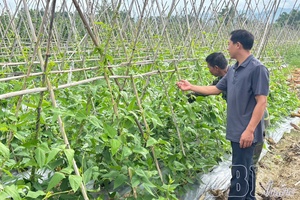
In Na Sang commune, the grassroots administration not only performs administrative management but also directly partners with residents in economic development. With around 378 hectares of existing pineapple cultivation, the locality aims to expand its raw material production zone to over 500 hectares by 2030, aligning expansion with planning, market demand, and consumption capacity.
To achieve this goal, commune leaders and officials routinely visit grassroots communities, engage in dialogues with residents, conduct field surveys, and grasp production bottlenecks. This enables them to progressively guide planting area expansion, shape scenic landscapes along National Highway 12, and build a distinctive local brand identity.
.jpg)
Notably, in early 2026, Na Sang Pineapple Cooperative boldly invested over VND 6.4 billion to purchase 7 transport trucks. No longer dependent on intermediaries, the cooperative purchases pineapples directly from farmers and transports them to processing facilities. Consequently, the harvest is sold immediately upon gathering at higher prices.
Trần Hồng Quân, Chairman of the People’s Committee of Na Sang commune, stated that when pineapples become the livelihood of hundreds of households, the government must master planning, land, infrastructure, production needs, and market dynamics. Establishing a centralized, synchronized production area will facilitate better utilization of potential, enhance product marketing, and steadily establish the Na Sang pineapple brand.
The transition where pineapple cultivation gradually replaces low-yield corn and cassava areas, expands production scales, and fosters consumption linkages in Na Sang illustrates how the role of grassroots government is increasingly tied to economic orientation, production organization, and resource networking. This transformation demands higher management competence from grassroots authorities.
After one year of operating under the two-tier local government model, the organizational apparatus has been progressively streamlined toward greater efficiency and effectiveness. Grassroots authorities have drawn closer to the people, steadily improving service quality for citizens and businesses. Nonetheless, surging workloads combined with shortages in personnel, especially those with specialized expertise, have created significant pressure on grassroots officials.
According to Lù Thị Mai Sinh, an officer at the Socio-Cultural Office of Mường Pồn commune, her workload has nearly doubled. Previously, the commune level was only responsible for screening and reviewing welfare beneficiaries while policy execution remained with the district. Currently, the commune level directly conducts beneficiary reviews and simultaneously administers policies.
Lù Thị Mai Sinh noted that officials must handle both existing duties and new responsibilities concurrently, learning on the job while adapting gradually, which creates an immense workload and requires everyone to undertake further training to fulfill their current roles.
In Mường Nhé commune, several fields lack specialized civil servants, notably in healthcare and education. Data digitization encounters difficulties due to uneven technology infrastructure and digital skills among staff. Many domains have been decentralized with additional duties assigned to the commune level without corresponding financial and human resources.
Sharing similar obstacles, Nậm Kè commune was assigned 39 officials and civil servants along with 3 public employees following administrative mergers. Initial operations revealed mismatches between personnel assignments and specialized expertise in certain fields. For instance, a land management civil servant was tasked with education, a law graduate oversaw healthcare, and ethnic culture specialists handled science, technology, and digital transformation.
Beyond staffing mismatches, physical infrastructure poses another major bottleneck. Several communes face insufficient and unsynchronized equipment; aging and deteriorated offices, along with shortages of official duty housing and auxiliary structures, negatively impact daily operational execution.
Shouldering major tasks requires strong shoulders
Recognizing that enhancing the effectiveness and operational efficiency of two-tier local governance is a long-term undertaking, the province has deployed numerous solutions to supplement personnel and upgrade grassroots capacity.
Addressing human resource pressures, the province seconded and dispatched 124 civil servants and public employees from provincial departments and sectors to communes and wards. Within the healthcare sector alone, leadership and management personnel were reinforced across all 45 commune health stations. Commune and ward people’s committees also seconded 17 public employees from affiliated schools to work in civil service positions under commune-level administration. Concurrently, more than 11,800 officer, civil servant, and employee participations were recorded in training programs to meet the operational demands of the new model.
To make the two-tier local government model function even more smoothly from a grassroots perspective, Nguyễn Tiến Thành, Chairman of the People’s Committee of Nậm Kè commune, suggested considering increased staffing quotas or introducing labor contract mechanisms for specialized positions experiencing intense work pressure following decentralization. Concurrently, resources should be allocated to complete transport infrastructure, domestic water supply and irrigation systems, and office facilities with appropriate equipment.
Commune leaders of Mường Nhé commune recommended that, alongside reviewing and aligning job positions with specialized qualifications for commune personnel, specialized in-depth training policies should be provided for commune-level staff, especially specialized officers in remote areas. In addition, accelerating digital transformation and applying information technology are vital to overcoming current operational bottlenecks.
For the commune level to genuinely shoulder major tasks, the decisive factor is not merely the volume of responsibilities placed upon grassroots shoulders, but ensuring those shoulders are strong enough, capable enough, and well-resourced enough to translate decentralized authority into tangible outcomes for people’s lives. When the commune level is staffed with competent personnel, supported by clear mechanisms, powered by adequate resources, and equipped with modern tools, major policies can be integrated much faster into daily reality.
Thu Hằng
.jpg)

.jpg)
.jpg)
.jpg)
.jpg)
.jpg)
.jpg)
.jpg)
.jpg)
.jpg)
.jpg)
.jpg)
.jpg)
.jpg)
.jpg)
You have 500/500 characters left
Please enter 5 or more characters!!!