



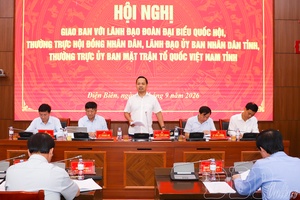
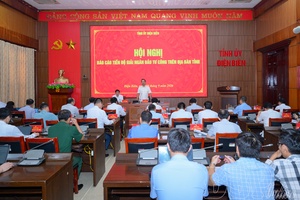
Trần Tiến Dũng, Member of the Party Central Committee, Secretary of the provincial Party Committee, and Head of the provincial National Assembly Deputy Delegation, alongside members in the Standing Board of the provincial Party Committee, co-chaired the working session, which was attended by members of the Standing Board of the provincial Party Committee, leaders of the provincial People’s Council, and leaders of provincial boards, departments, and sectors.
.jpg)
According to a report by the Department of Education and Training, the entire sector basically completed core tasks for the 2025-2026 academic year following 10 task groups defined by the Ministry of Education and Training, with most key targets meeting or exceeding set plans. Apparatus streamlining and rearrangement were executed methodically, cautiously, following correct processes and Central orientations, thereby reducing over 60% of organizational focal points and substantially surpassing assigned targets.
Regarding the construction and operation of multi-level schools in border communes, to date, 1 school has commenced operations, while the remaining 9 schools are scheduled for completion and handover prior to August 30 to guarantee service conditions for the new school year. The Education and Training sector also proactively deployed tasks following the provincial growth scenario, boosting digital transformation and administrative reform to step-by-step elevate administrative efficiency and service quality.
.jpg)
On the basis of achieved outcomes, the Department of Education and Training defined 12 core tasks to complete political objectives in the remaining months of 2026, focusing on preparing adequate conditions for the 2026-2027 school year, finalizing educational institution network arrangements, stabilizing apparatus organization, and deploying staff based on job positions, alongside completing student enrollment, mobilization, and attendance maintenance. The sector also strives to complete and commission multi-level boarding schools in border communes, effectively execute growth scenarios, accelerate 2026 public investment capital disbursement, and intensify digital transformation and administrative reform to elevate data-driven governance efficiency.
The Department of Education and Training recommended that the province attend to adding payroll quotas, prioritize allocating resources for facilities and teaching equipment, and guarantee timely funding for full implementation of regimes and policies for local teachers and students.
.jpg)
Discussing at the conference, delegates analyzed difficulties and proposed solutions for the Education and Training sector to fulfill late-year tasks, focusing on effectively executing the Politburo’s Resolution No.71-NQ/TW on breakthroughs in education and training development, operating multi-level schools in border communes effectively, preparing thoroughly for the new school year, and deploying synchronous solutions to fulfill sectoral growth scenarios.
Concluding the working session, provincial Party Committee Secretary Trần Tiến Dũng acknowledged and praised outcomes achieved by the Education and Training sector, while requesting the entire sector to execute tasks synchronously to generate distinct shifts in educational quality in the coming period.
.jpg)
The provincial Party Committee Secretary requested the Education and Training sector to formulate concrete roadmaps and plans to execute targets and tasks under the provincial Party Congress Resolution alongside Central and provincial resolutions and programs, particularly the Politburo’s Resolution No.71-NQ/TW and Plan No.05 of the Standing Board of the provincial Party Committee.
Regarding educational quality, he emphasized looking straight at practical reality, especially literacy eradication results and elevating standard national language proficiency among ethnic minority students and residents. Alongside imparting knowledge, the sector must emphasize comprehensive education in ethics, intellect, physique, and aesthetics, strengthening life skills, healthcare, gender equality education, and love for the homeland.
.jpg)
The Education and Training sector needs to coordinate closely with families, party committees, and local authorities to intensify legal dissemination, education on marriage and family, and reproductive health, while preventing child marriage and consanguineous marriage, particularly in ethnic minority areas. Concurrently, attention must be paid to vocational training to elevate labor force quality and competitiveness, meeting development demands amid the province’s large labor requirements.
.jpg)
The provincial Party Committee Secretary stressed that digital transformation in education must genuinely serve governance and teaching without being formalistic, requiring the sector to build databases satisfying “accurate, adequate, clean, and live” criteria to serve student scale forecasting, teacher coordination, financial management, facilities oversight, and decision-making quality. Alongside this, continuous attention must be paid to investing in school infrastructure, especially guaranteeing clean domestic water and environmental sanitation. Food safety at school kitchens must be placed as a top priority with strict controls over food origins and quality from input stages, giving preference to safe, transparently sourced local products.
.jpg)
For teaching staff, training and retraining must be intensified to enhance professional qualifications while focusing on management skills, delivery methods, and educational activity organization. The sector must proactively resolve payroll shortages, especially for specialized subject teachers, guaranteeing adequate personnel for teaching and learning demands.
The provincial Party Committee Secretary also requested the Education and Training sector to grasp and execute apparatus streamlining effectively, organizing and operating school systems suited to the two-tier local governance model, while reviewing and formulating arrangements for redundant personnel or settling policies for eligible cases under regulations. Furthermore, the sector should expand international cooperation in education to leverage resources, experience, and advanced educational models, contributing to elevating training quality and step-by-step enabling Điện Biên education to satisfy development requirements in the new era.
Phạm Trung
.jpg)
.jpg)
.jpg)
.jpg)
.jpg)
.jpg)
.jpg)

.jpg)
.jpg)

You have 500/500 characters left
Please enter 5 or more characters!!!