



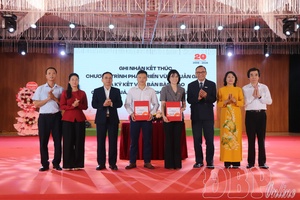
Lê Văn Lương, Deputy Secretary of the provincial Party Committee and Chairman of the provincial People’s Committee, alongside Lò Văn Cương, Permanent Vice Chairman of the provincial People’s Committee, Major General Vũ Văn Đấu, Director of the provincial Police, and Lê Xuân Cảnh, Director of the Department of Agriculture and Environment, co-chaired the conference.
.jpg)
According to a report by the Department of Agriculture and Environment, the entire province has roughly 1,684,196 land plots requiring surveying and cadastral record compilation, among which 818,616 plots corresponding to 656,318.64 hectares have been surveyed. Currently, the province still has 865,580 land plots with 204,606.5 hectares not yet surveyed for cadastral mapping. Across the province, 8 out of 45 communes and wards with 171,371 land plots have constructed cadastral databases, encompassing 122,761 plots (71.6%) meeting “accurate - adequate - clean - live” criteria, 25,609 plots (14.9%) requiring enrichment and cleaning, and 23,001 plots (13.4%) lacking spatial data.
Deploying tasks of surveying, cadastral mapping, cadastral record compilation, and land database construction, Điện Biên province needs to continue enriching and cleaning data for 25,609 land plots, constructing land databases for 675,678 land plots, and conducting surveys and constructing new databases for 865,580 land plots.
.jpg)
To accomplish the set objectives, the provincial People’s Committee assigned specific tasks to departments, sectors, and localities, requiring highly concentrated resources and close progress tracking to ensure the workload is completed according to schedule. Units must prioritize timely funding allocations and maximize resource mobilization for effective task execution, while enhancing coordination among the Department of Agriculture and Environment, the provincial Police, and commune-level People’s Committees to ensure synchronous, tight, and on-schedule deployment.
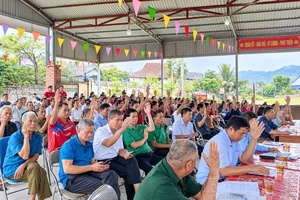
At the conference, leaders of communes and wards assessed current realities and implementation outcomes while pointing out difficulties and obstacles encountered during execution, on which basis they proposed appropriate solutions and approaches with determination to fulfill tasks of surveying, cadastral mapping, cadastral record compilation, and land database construction in 2026 to enhance state management efficacy and efficiency in land administration linked to digital transformation and administrative procedure reform across the province.
Concluding the conference, Chairman of the provincial People’s Committee Lê Văn Lương requested agencies, units, and localities to unify execution principles under an integrated, phased approach ensuring solid completion step-by-step, linking surveying and cadastral mapping with land declaration, registration, record compilation, and database construction, integration, and operation, requiring that completed localities and stages undergo immediate inspection, acceptance, handover, and commissioning for use.
.jpg)
The Department of Agriculture and Environment must maximize its role as the unifying focal coordination agency, proactively advising, guiding processes, controlling progress, quality, and workload volume, while promptly synthesizing and reporting difficulties and obstacles exceeding authority to the Provincial People’s Committee.
Commune-level People’s Committees must engage directly rather than leaving everything to contractors, boosting propaganda, organizing declarations, verifying land origins and current usage statuses, and coordinating the resolution of dispute cases, absent parties, or incomplete dossiers strictly within designated competence and responsibility. The Land Registration Office and its branches must enhance inspection, cross-checking, integration, and data operations to guarantee that post-acceptance data is complete, accurate, exploitable, and updatable.
For construction and supervision units, adequate manpower, equipment, and professional competency must be ensured, strictly following design, schedule, and quality standards while enhancing inspection across each stage and product to prevent formalistic acceptance. Concurrently, relevant departments and sectors must proactively coordinate regarding funding, population data, technological infrastructure, information security, planning, projects, and necessary information to guarantee synchronous and effective implementation.
Phạm Trung

.jpg)
.jpg)
.jpg)
.jpg)
.jpg)
.jpg)
.jpg)
.png)
.jpg)
.jpg)

.png)
You have 500/500 characters left
Please enter 5 or more characters!!!