



Part 3: The resolution takes deep root
When policies align with the people’s will, the resolution does not merely enter life; it takes deep root, driving a sustained developmental journey.
When Party will meets public consensus
Historically, numerous agricultural development initiatives faced difficulties due to a lack of community consensus. Recognizing this, immediately upon issuing Resolution 11, the Executive Board of the provincial Party Committee identified that for the policy to succeed, it was essential to build trust so that farmers clearly see tangible benefits, participate voluntarily, and become the true actors in shifting production mindsets and restructuring crop patterns.
A pivotal milestone was the launching campaign to plant coffee and macadamia while piloting low-altitude economic development models in Mường Ảng commune on April 3, 2026. The image of provincial Party Secretary Trần Tiến Dũng and local leaders joining soldiers, youth union members, and residents to dig the very first planting holes conveyed a message far beyond a ceremonial launch. It demonstrated local leadership standing side by side with the people, embodying the principle of matching words with concrete actions to move policies from meeting halls into fields.
That enthusiasm quickly spread across localities. Party committees and authorities identified expanding coffee and macadamia cultivation as a core task, mobilizing the entire political apparatus. Several emulation movements emerged, such as “Exemplary hole-digging soldiers - Exemplary hole-digging households - Communes finishing early with assured quality” and “Skilled tree-care households with beautiful orchards - Communes with vast acreage and premium quality.” Working groups were formed, assigning cadres and party members to oversee specific villages and household clusters, while socio-political organizations, armed forces, and youth volunteers assisted with digging holes, transporting seedlings, and providing technical guidance.
.jpg)
In Chiềng Sinh commune, upon receiving targets to develop 718 hectares of coffee and 400 hectares of macadamia in 2026, local leadership formulated a detailed execution plan assigning personnel to every village and household group. Cadres visited grassroots communities directly to deliver technical guidance and resolve questions regarding seedlings, capital investment, economic returns, and market outlets. Arising challenges were promptly resolved at the grassroots level, reassuring farmers during their production transition.
Đỗ Văn Sơn, Chairman of the People’s Committee of Chiềng Sinh commune, stated that the greatest advantage was that residents directly observed the efficiency of productive coffee and macadamia orchards across the province. When officials worked alongside farmers and tackled obstacles together, the gap between policy and reality narrowed. From initial hesitation, residents proactively registered to join raw material zones, enabling the commune to complete its 2026 planting plan.
That spirit was equally evident in Sáng Nhè commune. Initially assigned a target of roughly 70 hectares of coffee intercropped with macadamia, extensive outreach, dialogues, and field visits to effective farming models prompted residents to voluntarily register around 354 hectares by July 3, more than five times the initial plan. According to Phạm Ngọc Điện, Chairman of the People’s Committee of Sáng Nhè commune, this result stemmed not from administrative orders, but from public trust fostered by successful production models under Party guidance.
Creative grassroots approaches allowed the movement to expand statewide. After just over three months of executing Plan No.1850/KH-UBND, by July 3, 2026, the entire province had dug over 40.4 million planting holes with the participation of nearly 50,000 officers, soldiers, and citizens. Nearly 26,000 participants directly planted over 23 million coffee and macadamia trees. To date, total provincial coffee acreage is estimated at 10,859 hectares, while macadamia covers 13,860 hectares, demonstrating the alignment between Party policies and public aspirations.
Steadfast trust in the Party
Executing Resolution 11 has driven not only expanding cultivation areas but also a profound transformation in farmer awareness. Moving past uncertainty, many households have boldly repurposed land, invested in farming, and embraced coffee and macadamia as long-term livelihoods. This confidence was cultivated through real, successful models within their own communities. Witnessing tangible returns, farmers found the motivation to embrace change.
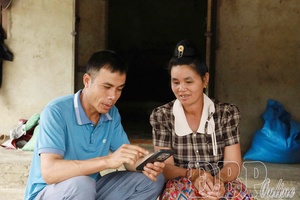
The household of Lầu Chồng Lử in Na Luông village, Mường Ảng commune, offers a clear example. Cultivating coffee since 1998, he navigated numerous volatile cycles marked by unstable market prices and limited technical expertise. In recent years, by applying standardized farming processes, focusing on quality enhancement, and establishing corporate partnerships, his 3-hectare coffee farm yielded over 40 tons of fresh cherries in the latest harvest, generating revenue exceeding VND 1 billion.
According to Lầu Chồng Lử, the greatest value brought by coffee lies not only in income but in shifting the local production mindset. Previously hesitant farmers, upon seeing well-managed orchards thrive, recognized that sustainable prosperity requires commodity-oriented production that prioritizes quality over sheer volume. This perceptual shift created strong momentum across the Mường Ảng coffee zone and neighboring areas.
Alongside coffee, macadamia has steadily asserted its standing across Điện Biên. From initial trial plots, numerous commercial orchards now generate stable revenue, paving the way for a high-value agricultural sector.
The family of Lò Văn Lả in Chá village, Tuần Giáo commune, represents another success story. Over a decade ago, choosing to plant macadamia exposed him to considerable skepticism regarding the unfamiliar crop. Through diligent care and strict adherence to technical standards, his 1-hectare macadamia orchard yielded approximately 1.5 to 2 tons of nuts by 2025, generating hundreds of millions of VND in revenue. This outcome improved his household finances and inspired neighboring families to restructure their crop patterns.
From pioneering households, the macadamia expansion rapidly extended across other communes. According to Quàng Văn Cương, Chairman of the People’s Committee of Tuần Giáo commune, between 2023 and 2025, the locality carried out 30 macadamia partnership projects spanning nearly 900 hectares with over 2,200 participating households. Currently, the entire commune hosts over 2,396 hectares of macadamia, with roughly 364 hectares already yielding commercial harvests. These initial results confirm macadamia’s role as a key crop that provides sustainable livelihoods and advances agricultural restructuring.
Trust from individual households has fueled the entire movement. Consequently, the goal of developing 12,000 hectares of new raw material zones under Plan No.1850/KH-UBND was not only met but far exceeded. By early July 2026, total newly registered areas for coffee and macadamia planting reached 21,294.84 hectares, nearly doubling the initial target, including 13,313 hectares for coffee and 7,982.22 hectares for macadamia. These figures demonstrate both effective execution and deep public endorsement of Party directives.
Quang Long - Ngọc Huyền
.jpg)

.jpg)
.jpg)
.jpg)
.jpg)
.png)
.jpg)
.jpg)
.jpg)
.jpg)
.jpg)
You have 500/500 characters left
Please enter 5 or more characters!!!