



This decision demonstrates strategic vision, breakthrough thinking, and the leading role of the Party in properly identifying potential, choosing correct development drivers, and paving the way for a “revolution” in restructuring provincial agriculture.
Part 1: “Revolution” in agricultural restructuring
It was not by chance that coffee and macadamia were identified as two strategic crops in Resolution No.11-NQ/TU of the Executive Board of the provincial Party Committee (Resolution 11). That outcome crystallized from a process of thorough research alongside a comprehensive evaluation of potential, advantages, and bottlenecks within agriculture to issue a strategic decision, thereby opening a restructuring process that step-by-step transitions Điện Biên’s agriculture from small-scale production to concentrated, green, smart, and sustainable commodity development.
Dissatisfied with the present
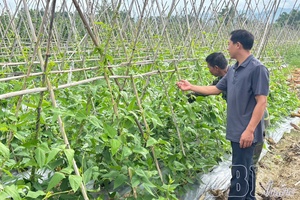
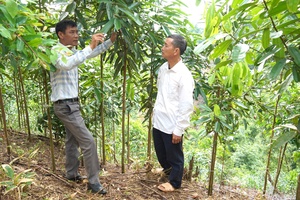
Across the sprawling hillsides of Điện Biên, coffee and macadamia trees took root years ago, step-by-step affirming their positions as key crops yielding high economic value. Following five years of executing Resolution No.09-NQ/TU dated July 29, 2021, of the Executive Board of the provincial Party Committee on developing agricultural and forestry production linked with new-style rural construction for the 2021-2025 period, acreages of both crops expanded. Coffee grew from an initial 3,220 hectares to roughly 10,859 hectares, while macadamia expanded from 265 hectares to approximately 13,860 hectares, turning Điện Biên into the province with the second-largest macadamia area and the third-largest Arabica coffee area nationwide. That achievement stemmed from crop structure shifts under the decisive leadership and guidance of the provincial Party Committee. However, the provincial Party Committee did not look at growth figures to feel satisfied with achieved results.
.jpg)
While many localities regard expanding crop acreage as the yardstick of success, Resolution 11 addresses existing shortcomings directly. Most acreage continues to develop on a household scale, fragmented and lacking linkages, with farmers mainly selling fresh fruit or primary processed products, resulting in low added value and heavy dependence on traders and market fluctuations. Processing industries remain limited, while linkage chains extending from production to consumption have yet to take clear shape. That practical reality indicated that if development mindsets remain unchanged while merely expanding acreage, coffee and macadamia can hardly become growth drivers for the agricultural sector.
Fully and objectively identifying limitations served not to deny achieved results, but to establish a crucial foundation for the provincial Party Committee to chart a new development strategy with a long-term vision. From that practical reality, the provincial Party Committee determined that a sustainably developing agriculture cannot rely solely on expanding crop acreage. More importantly, it requires selecting correct sectors possessing competitive advantages and reorganizing large-scale production linked to enterprises, markets, and processing industries. Only when closed linkage chains from production, purchasing, and processing to consumption take shape can agricultural products generate high added value and become drivers propelling economic growth.
At the conference gathering feedback to finalize the draft of Resolution 11 organized by the provincial People’s Committee on December 24, 2025, deputys candidly pointed out existing limitations in developing the two key sectors. Numerous opinions noted that coffee and macadamia development over recent years focused mainly on expanding acreage, whereas raw material zone planning lacked true synchronization, production and processing infrastructure remained deficient, and linkages among residents, cooperatives, and enterprises lacked firmness. Consequently, a thematic resolution featuring sufficiently strong goals and solutions is needed to create a breakthrough, driving the two sectors to develop along value chains, elevating competitiveness, and increasing public income.
Resolution 11 issued by the Executive Board of the provincial Party Committee answers not only the question of what to plant, but also defines how to plant, who participates, to whom products are sold, and where value is created. Therefore, this represents not merely a resolution on agricultural development, but a decision initiating a “revolution” in agricultural restructuring that drives provincial growth.
Choosing strategic vision
Every epochal decision originates from a far-reaching vision and a correct choice. With Resolution 11, the provincial Party Committee aimed not only at agricultural restructuring, but also designated coffee and macadamia as two strategic sectors capable of leading long-term growth. This choice was built on careful evaluations of natural conditions, soil, climate, climate change adaptability, and development trends across modern agricultural markets.
Lê Xuân Cảnh, Director of the Department of Agriculture and Environment, noted that Điện Biên possesses ecological zones suited to developing high-quality coffee, with practical reality proving Điện Biên coffee beans carry a distinct flavor that step-by-step builds a brand across domestic and international markets. Meanwhile, macadamia is evaluated as a high-economic-value crop suited to many local hill slopes, possessing sustainable development capabilities and opening major headroom for processing industries in the future.
The core essence of Resolution 11 lies in regarding coffee and macadamia not as simple crops, but as vital links within modern agricultural value chains. Planning concentrated raw material zones, attracting enterprise investment, developing processing industries, building brands, and expanding consumption markets are all calculated synchronously within a unified strategy. Shifting from an acreage-based development mindset to a value-chain development mindset, Resolution 11 transitions from yield increase goals to added value elevation goals, moving from small-scale production toward a large-scale commodity agriculture.
Selecting coffee and macadamia reflects the strategic vision and new development mindset of the provincial Party Committee: taking advantages as the foundation, markets as the orientation, and value chains as the driving force. Coffee generates stable mid-term income streams while macadamia opens long-term economic value, combining a sector with a solid foundation alongside a sector holding immense breakthrough potential. When planned synchronously, developed through linkage chains, and integrated with science and technology, these two sectors will complement each other to create large-scale raw material zones, forming a modern agricultural ecosystem and step-by-step positioning Điện Biên’s agricultural brands on national and international maps.
That constitutes the distinct value of Resolution 11. Beyond selecting correct crops, it chooses the correct path for development, as within that strategy, coffee and macadamia serve not merely as wealth-generating plants, but as leverage to comprehensively restructure the agricultural sector, generating spillover momentum into processing, trade, services, and tourism while elevating public income. It stands as a decision that resolves immediate growth challenges while laying the foundation for the face of Điện Biên’s agriculture for many years to come.
Quang Long - Ngọc Huyền
.jpg)

.jpg)
.jpg)
.jpg)
.jpg)
.jpg)
.jpg)
.jpg)
.jpg)
.jpg)
.jpg)
.jpg)
.jpg)
.jpg)
.jpg)
You have 500/500 characters left
Please enter 5 or more characters!!!