



This positive transformation is evident in the renewal of organizational models, scale expansion, and the diversification of training occupations centered around the needs of businesses and the market. This is an inevitable trend to upgrade the quality of human resources, meeting development requirements in the new phase.
During the first three months of 2026, the entire province estimated to have over 357,200 employed workers, an increase of 2.28% over the same period last year. Among them, 2,788 workers were newly employed, up nearly 7%, reaching nearly 30% of the annual plan. The labor structure shifted towards reducing the proportion in agriculture and forestry while increasing in construction and services, driving a huge demand for basic skilled labor.
Seizing this societal shift, the provincial Department of Education and Training has deployed numerous innovations in vocational education. The Department proactively advised on mechanisms and policies in a practical, accessible direction tied to labor market demands, while planning the network of training institutions by region to facilitate learners. Vocational education goals have also been integrated into local annual socio-economic development plans.
After nearly a year of operating the two-level local government model and reorganizing vocational education - continuing education (VE-CE) centers by region, despite encountering difficulties in handovers and apparatus arrangements, training institutions are maintaining enrollment and deploying synchronized training plans. The centers proactively bring classrooms down to the grassroots, choosing occupations closely linked to production realities and labor market needs.
.jpg)
Closely following the province’s policy on coffee and macadamia development, last April, VE-CE Center No.2 coordinated with the People’s Committees of Mường Ảng, Chiềng Sinh, Búng Lao, Mường Lạn, Pú Nhung, Mường Mùn, Tủa Chùa, and Sáng Nhè communes to organize 12 vocational training classes for rural workers. The training content centered on cultivation, care, harvesting, and processing techniques for coffee, along with macadamia cultivation techniques, while supplementing several occupations based on market demands, such as welding techniques, livestock farming, and disease prevention for pigs.
Alongside short-term vocational training, training linkage work has closely followed the practical demands of the labor market. After two years of studying intermediate office informatics - organized through a linkage between VE-CE Center No.2 and Điện Biên College - Mùa A Dài graduated with excellent academic standing in late April.
Mùa A Dài shared: “The fact that the school links and organizes on-site training has opened up opportunities for professional learning and catching up with market trends. For instance, with the Informatics major I am studying, I am confident that I have more opportunities to seek and choose a suitable job.”
According to Lê Sỹ Tường, Director of VE-CE Center No.2, the results of the linked training course between the Center and Điện Biên College recently serve as a foundation for units to continue evaluating and reviewing reality, thereby adjusting and expanding training courses to align more closely with labor market demands, contributing to upgrading the quality of local human resources.
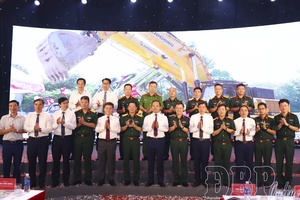
The efficiency of vocational training is also evidenced by a large-scale recruitment wave from Vingroup. The enterprise aims to recruit around 7,000 workers for positions such as bricklayers, formwork carpenters, mechanics, welders, and concrete workers, with incomes ranging from VND 14 - 33 million per month, while team leader positions can reach from VND 32 - 41 million per month. This attractive income has drawn thousands of workers in the province to seek information and submit applications for job positions.
Lò Văn Quỳnh from Sam Mứn village, Thanh An commune, shared that using knowledge from a construction vocational class and practical work experience, he applied to VinCons. Being accepted, he was received into a level-2 formwork carpenter position with an expected salary of around VND 22 million per month. This income is significantly higher than working far away, while allowing him to work near his family and enjoy full insurance benefits.
However, looking directly at reality, the province’s vocational education still has several limitations that need to be overcome. Through assessments, many VE-CE centers after reorganization still lack facilities, teaching equipment, and teacher staff quotas. Enrollment in some majors and occupations has not reached targets, the management of dispersed facilities causes difficulties in funding and organizing activities, and several policies related to vocational education have changed, leading to some confusion during implementation.
Director of the Department of Education and Training Hoàng Tuyết Ban stated that the sector has clearly identified solutions to overcome current limitations. The focus is to closely follow labor market demands to select appropriate training occupations, enhance linkages with enterprises to attach training to production and job placement, improve the quality of the teaching staff, and boost practical training. Concurrently, the sector will promote the proactivity of institutions to effectively exploit existing resources and expand practically suitable vocational training classes, aiming to upgrade the quality of human resources and meet local socio-economic development requirements in the new phase.
Hà Linh



.jpg)
.jpg)
.jpg)
.jpg)
.jpg)
.jpg)
.png)
.jpg)
.jpg)
.jpg)


.jpg)
You have 500/500 characters left
Please enter 5 or more characters!!!