



More importantly, that support is step-by-step awakening self-reliance wills and proactive spirits to rise up, helping residents change mindsets and methods toward sustainable poverty reduction.
Mentioning Hồ Chang Páo in Mường Toong village, Mường Toong commune, many people know him for his diligence. Years ago, his family faced hardships as primary income depended on agricultural production, making accumulation and economic development investment far from easy.
.jpg)
Disseminated and mobilized by farmers’ organizations at all levels and commune authorities to join livestock technique training classes covering breed selection, care, and disease prevention for cattle, those pieces of knowledge helped Páo find economic development directions suited to family conditions.
Rather than waiting for support, Páo borrowed additional capital from relatives to invest in fattening buffaloes, currently maintaining around 5 to 7 heads per batch, selling them after care periods and revolving capital for new batches to raise an average of 10 to 14 heads annually that yield net revenues of 70 to 100 million VND after costs.
Despite lingering life hardships, with a strong will and aspiration to rise up, in 2025, Lường Văn Piến in Hin hamlet, Na Sang commune, proactively submitted a voluntary petition to escape poverty. His family counts 4 members, previously engaging primarily in hill farming with low economic efficiency, but in 2024, he and his wife applied as rubber workers with a more stable monthly income exceeding VND 10 million, leading him to apply voluntarily to exit poverty as family economic conditions gradually improved.
.jpg)
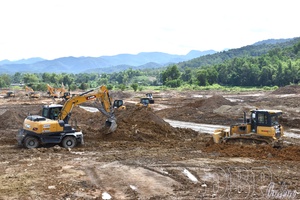
Piến shared that ever since both spouses worked as rubber workers, life became less arduous, prompting him to voluntarily apply to exit poverty, adding that for over 1,000 square meters of previously low-efficiency hill land, he plans to switch to planting pineapples under commune orientations as pineapples prove easy to tend and yield good income if diligent, taking step-by-step actions and continuing investment upon seeing results rather than relying solely on the State.
Not limited to Lường Văn Piến’s family, from 2025 to date, Na Sang commune counts 3 households voluntarily submitting petitions to escape poverty and near-poverty, bringing the commune’s poor household ratio down to 23.76% toward targets to reduce below 10% by 2030.
Trần Hồng Quân, Chairman of the Na Sang commune People’s Committee, emphasized that residents voluntarily submitting petitions to escape poverty demonstrates awareness, responsibility, and self-respect, standing as a result of Party, State, party committee, and local authority care while reflecting dissemination and mobilization efficiency that generates positive awareness shifts and awakens public aspirations to master life, adding that in the coming period, the commune will continue focusing on livelihood support and guiding residents to select suitable production models to promote internal strength and achieve sustainable poverty reduction.
.jpg)
Alongside support from local party committees and authorities, numerous livelihood support programs and projects build additional conditions for highland residents to secure production means, access knowledge, and gradually gain autonomy in economic development.
In the Mường Ảng area, the Mường Ảng Area Program has been deploying effective support activities for disadvantaged households across 4 communes of Mường Lạn, Búng Lao, Mường Ảng, and Nà Tấu, handing over nearly 350 breeding cows to households since 2022 under the breeding cow support model alone, while guiding livestock care and disease prevention techniques to elevate knowledge for proactive livelihood maintenance.
Nguyễn Xuân An, a representative of the Mường Ảng Area Program, noted that livelihood support must aim toward helping residents gain autonomy to create stable household income streams step-by-step, prompting the program to emphasize technical guidance, knowledge elevation, and encouraging proactive public participation alongside supplying breeds and materials so that supported resources maximize long-term efficiency as residents master care techniques, calculation methods, and development mindsets.
.jpg)
Beside handing over fishing rods, support programs step-by-step build conditions for residents to secure additional resources, knowledge, and self-organized production opportunities to elevate income, where social policy credit capital holds a crucial role in helping households invest in economic development, create livelihoods, and rise out of poverty step-by-step.
Executing national target programs on new rural construction, sustainable poverty reduction, and socio-economic development in ethnic minority areas during the 2021-2025 period, the provincial Bank for Social Policies extended loans exceeding VND 6,600 billion to nearly 60,000 beneficiary turns, building additional resources for residents to invest in production, livestock breeding, and income elevation, through which public living standards improved step-by-step and the multidimensional poverty rate across the province dropped to 17.66%, decreasing by an annual average of 3.97%.
Quang Long
.jpg)

.jpg)
.jpg)

.jpg)
.jpg)
.jpg)
.jpg)
.jpg)
You have 500/500 characters left
Please enter 5 or more characters!!!