



In 2018, the provincial People’s Council issued Resolution No.05/2018/NQ-HĐND on policies supporting agricultural and forestry production development, establishing an important foundation for the province’s agricultural restructuring process. During the 2019-2025 period, the entire province deployed 86 linkage projects for agricultural production and consumption, while numerous support policies covering seeds, materials, machinery, processing, OCOP, and high-tech application contributed to forming value chains, elevating agricultural product value, and raising public income, yet after over 7 years of implementation, many policies no longer suited new development requirements due to limited resources and insufficiently attractive support levels that hindered effective execution across several contents.
For the 2026-2030 period, Điện Biên province determined to develop a smart, modern, and value-added agriculture. At the recent 4th Session, the provincial People’s Council issued Resolution 23, expected to unblock institutional bottlenecks, encourage investment in value chain production development, form raw material zones, boost science and technology application alongside digital transformation, and materialize the targets of Resolution No.11-NQ/TU of the provincial Party Committee on agricultural restructuring toward concentrated, green, smart, and sustainable commodity production for 2026-2030 with orientations toward 2035.
A prominent feature of the resolution involves inheriting suitable policies while adding numerous preferential mechanisms to develop large-scale commodity agriculture, attract business investment, and enhance agricultural product value-added and competitiveness. Resolution 23 stipulates prominent support policies - such as supporting up to 30% of investment costs for agricultural processing and preservation facilities, funding 50% of expenses for smart agricultural development, providing VND 15 to 20 million per hectare to convert rice land to high-value crops, covering 100% of costs for granting planting area codes and packing facility codes, offering VND 500 million per product to build national brands, and granting VND 150 million per OCOP product showroom.
.jpg)
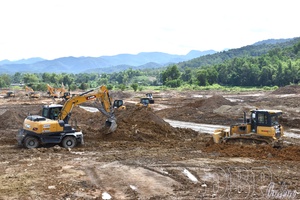
Chiềng Sinh commune stands as a key locality for coffee and macadamia development. In 2026, the commune planted 1,000 new hectares of coffee and roughly 400 hectares of macadamia, raising total acreage to over 1,300 hectares of coffee and nearly 1,000 hectares of macadamia. By 2030, the locality strives to develop roughly 2,000 hectares of coffee and 3,700 hectares of macadamia (encompassing a 2,400-hectare core zone invested by TH Group) toward production linkage combined with processing, leading Chiềng Sinh commune to expect that Resolution 23 with suitable mechanisms and policies will drive concentrated raw material zone development, attract business investment, and elevate public income.
Hà Cầm Hồng, Party Cell Secretary of Chiềng Sinh commune, noted that the issuance of the resolution by the Provincial People’s Council is extremely necessary and satisfies practical requirements in the current period, expressing hope that new support mechanisms will resolve resource difficulties, motivate residents, cooperatives, and enterprises to invest boldly in developing concentrated material zones, and see rapid, synchronous deployment so policies quickly enter life to drive agricultural restructuring and raise production values and resident income.
Beyond localities, the business community and cooperatives also anticipate that the new resolution will build additional resources to expand production, apply technology, and enhance competitiveness.
Cara Farm Viet Nam Co., Ltd. currently cultivates nearly 4 hectares of red-fleshed oranges and green-skinned pomelos in Mường Thanh ward, where as a pioneering unit applying technology in production and processing, Director Nguyễn Thị Lan Hương shared that Resolution 23 creates opportunities for enterprises and cooperatives to access mechanisms and resources to invest in technical infrastructure serving production and processing, expressing special interest in policies supporting the issuance and management of planting area and packing facility codes under Article 9 of the Resolution to assist product origin tracing, pest control, and quality verification as passports for formal domestic consumption and exports to major markets.
Notably, for the first time, the province issued support mechanisms for agricultural promotion on digital platforms such as YouTube, TikTok, and other digital media channels, demonstrating an agricultural development orientation that balances production with branding, trade promotion, and digital transformation to help Điện Biên agricultural products access markets through modern methods.
To bring the resolution into practice swiftly alongside local, cooperative, and enterprise proactivity, the agricultural sector is formulating synchronous deployment plans and detailing each policy to guarantee correct target subjects, proper regulations, and efficient support resource maximization.
Chu Thị Thanh Xuân, Deputy Director of the Department of Agriculture and Environment, stated that immediately following resolution issuance, the sector’s crucial task involves bringing guidelines and policies into life for residents and businesses, focusing on guiding and organizing execution while resolving difficulties and obstacles promptly, alongside intensifying attraction to call on enterprises and investors to join production linkages, construct value chains, and consume products so the resolution maximizes practical efficiency.
Phạm Trung
.jpg)
.jpg)
.jpg)
.jpg)
.jpg)
.jpg)
.jpg)
.jpg)
You have 500/500 characters left
Please enter 5 or more characters!!!