Preventing wastefulness after apparatus rearrangement

ĐBP - After nearly one year of operating the two-tier local government model, Điện Biên has completed reviewing, arranging, transferring, and putting into operation the system of public headquarters post-merger.

Many headquarters and offices are utilized effectively, limiting vacancies and the wastefulness of State resources while securing operational conditions for the grassroots-level government and better meeting public service demands.

Na Sang commune was established on the basis of consolidating Ma Thì Hồ, Sa Lông, and Na Sang communes alongside the old Mường Chà town. Post-merger, Na Sang commune took over the entire infrastructure and headquarters of the former Mường Chà district. Regarding the old communal headquarters, they were handed over to the Education and Training sector. Many office rooms were renovated into classrooms, administrative blocks, and functional rooms, while several other items had their utilities converted into boarding houses.

Trần Hồng Quân, Chairman of the Na Sang commune People’s Committee, stated: “Converting and reusing public headquarters for educational purposes is a plan that aligns with practical realities. Many previously cramped school sites now have the conditions to expand, enabling students to study in more spacious and safer environments. Concurrently, State assets are effectively exploited to serve the people in the long run. For the communal administrative center, receiving and utilizing the headquarters system synchronously also facilitates the locality to deploy a modern administrative management model, closely linked to the effective operation of the electronic one-stop system and the population database.”

Búng Lao commune center viewed from above.

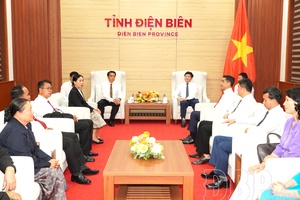
In Búng Lao commune, the puzzle of utilizing public headquarters was carefully calculated immediately after the provincial policy was issued. Trương Hồng Bách, Chairman of the commune People’s Committee, noted that with three former communal headquarters including Ẳng Tở and Búng Lao from the old Mường Ảng district alongside Chiềng Đông from the old Tuần Giáo district, the locality relied on practical conditions and usage demands to arrange them appropriately.

Accordingly, the old Búng Lao headquarters was selected as the administrative center, serving as the workplace for the Party Committee, People’s Council, People’s Committee, and key specialized departments. The Ẳng Tở headquarters was rearranged for the commune Military Command, while the Chiềng Đông communal headquarters was assigned to mass organizations and certain sections under the Inspection Committee and the commune People’s Council.

Trương Hồng Bách added that this layout helps maximize the utility of the structures, limits wastefulness, and creates favorable conditions for mass organizations and specialized units to maintain operations close to the grassroots level to serve citizens better. For remote villages, retaining community meeting locations for associations and unions right within the area also helps minimize travel distances and effectively maintain public movements.

Not uniquely to Na Sang and Búng Lao, prior to executing the rearrangement, district-level and commune-level People’s Committees completed handing over the current state of assets - including houses, land, structures attached to land, and equipment for general operations - to receiving units in accordance with regulations. On that basis, the provincial People’s Committee enacted comprehensive plans regarding the arrangement, layout, and processing of public assets, ensuring compliance with the requirements of apparatus reorganization. Up to now, the restructuring and handling of public headquarters and assets after implementing the two-tier local government model have been basically finalized.

The entire province has processed 2,612 housing and land facilities. The vast majority were allocated to serve as educational facilities or cultural and sports institutions, while some continue to be utilized as workplaces, career operation facilities, official residences, or to serve the healthcare sector. The deployment process was executed synchronously, publicly, and transparently in accordance with regulations, thereby not only limiting loss and wastefulness but also contributing to ensuring that the operations of local governments take place smoothly and continuously.

Following the restructuring, the housing and land facilities have been allocated and exploited in a direction tailored to practical demands. Specifically, 1,902 facilities are utilized as schools, 423 units serve cultural and sports institutions, 210 locations continue to function as working office headquarters, and 58 facilities support career activities. A number of sites were also flexibly converted into official residences or medical facilities, contributing to upgrading the general utilization efficiency of public assets.

Evidently, the restructuring and transfer of public headquarters post-merger have been deployed methodically and realistically. This approach does not only save the budget and prevent wastefulness but also ensures that the value of State assets is promoted to serve the public practically, contributing to building a streamlined, valid, and effective local administration.

Quang Long
Comment

You have 500/500 characters left

Please enter 5 or more characters!!!

Recent news

  • 'Crop diversification opens new economic opportunities in ethnic minority areas

    Crop diversification opens new economic opportunities in ethnic minority areas

    ECONOMY -
    ĐBP - Converting low-yield farmland into high-value perennial industrial crops and fruit trees has become a key strategy in Điện Biên province’s agricultural restructuring. Across mountainous and border areas, selecting crops suited to local soil and climate conditions while promoting value chain production has delivered encouraging results. The approach is gradually transforming traditional farming practices, increasing household incomes and creating sustainable livelihood opportunities for ethnic minority communities.
  • 'Helping people in disaster-prone areas settle down early - Part 2: More drastic involvement needed

    Helping people in disaster-prone areas settle down early - Part 2: More drastic involvement needed

    SOCIAL AFFAIRS -
    ĐBP - Resettlement areas only truly realize their significance when residents are relocated to stable, safe places with conditions to develop long-term livelihoods. Therefore, alongside completing basic infrastructure, untangling difficulties regarding capital and procedures, and elevating the responsibility of related units stand as urgent requirements for the public to achieve early settlement.
  • 'Heritage - the engine of Điện Biên’s new growth

    Heritage - the engine of Điện Biên’s new growth

    CULTURE - SPORTS -
    ĐBP - Intangible cultural heritage is not only the crystallization of history and identity but also a vital endogenous resource that can help Điện Biên realize its ambitions for growth in a new era. As the province targets double-digit economic growth, tourism development is no longer simply about preserving heritage or promoting destinations; it is about awakening the unique cultural values embedded in local traditions and transforming them into a sustainable engine of economic development.
  • 'Symbol of sovereignty amidst borderlands

    Symbol of sovereignty amidst borderlands

    TRAVEL -
    ĐBP - In the westernmost region of the country, the A Pa Chải flagpole on the Khoan La San mountain range in Sín Thầu commune stands as a sacred symbol of national sovereignty and ethnic pride.
  • 'Điện Biên cooperatives: Adapting for breakthrough

    Điện Biên cooperatives: Adapting for breakthrough

    ECONOMY -
    ĐBP - Cooperatives in Điện Biên are step-by-step affirming their role as vital bridges connecting production with the market. Many units have proactively modernized their production methods, boldly invested in technology, and expanded their business sectors and operational scales.
  • 'Lotus fragrance at Leng Su Sìn Border Post

    Lotus fragrance at Leng Su Sìn Border Post

    TRAVEL -
    ĐBP - Amidst the borderlands of Sín Thầu, a small lotus pond quietly shows off its colors, preserving the historical story of Heroic Martyr Trần Văn Thọ - the border guard soldier who dedicated his entire heart to the local people and the westernmost land of the Fatherland.
  • 'A meaningful playground for senior citizens

    A meaningful playground for senior citizens

    CULTURE - SPORTS -
    ĐBP - Vibrant, exciting, and filled with laughter, the 7th Điện Biên provincial Sports Competition for Senior Citizens in 2026 was successfully co-organized by the provincial Association of Senior Citizens and the Department of Culture, Sports and Tourism. Far from being just an occasion for exchanges and talent showcases, the competition has truly become a useful playground, contributing to upgrading the health and spiritual lives of the elderly while spreading the physical training movement among senior citizens.
  • 'The man who reclaims broken lives

    The man who reclaims broken lives

    SOCIAL AFFAIRS -
    ĐBP - Early morning in Búng Lao, mist still lingers on the hillsides. Inside a farm nestled at the foot of the mountain, a man diligently writes in a worn-cornered notebook. Occasionally, he looks up toward the rows of houses behind the barns, where several people have just woken up after a long night. They are individuals undergoing drug rehabilitation.
  • 'Each family is a cell of the society

    Each family is a cell of the society

    SOCIAL AFFAIRS -
    ĐBP - June 28 every year - Vietnam Family Day - is not only an occasion to honor fine traditional cultural values but also a time for each individual to look back at their role and responsibility in building and preserving the hearth. In the flow of industrialization, modernization, and international integration, the family further asserts its foundational position as a healthy “cell” that determines the sustainable development of society.
  • 'Keeping flame of love alive in every family in modern life

    Keeping flame of love alive in every family in modern life

    SOCIAL AFFAIRS -
    ĐBP - Modern life brings numerous opportunities for development, but it also presents significant challenges to maintaining family happiness. Work pressures, academic demands, and the rapid expansion of digital technology have left people with less and less time for their loved ones. Nevertheless, through different approaches, many families across the province are making efforts to nurture love and preserve the cherished values of family life in today’s world.
  • 'Gradually pushing back child marriage issue

    Gradually pushing back child marriage issue

    SOCIAL AFFAIRS -
    ĐBP - In recent years, although dissemination and mobilization work have been deployed through various forms, the child marriage situation in Điện Biên province remains complex, especially in deep and remote areas. Diversifying communication methods and upgrading public awareness are identified as vital solutions to gradually eliminate outdated customs, elevate population quality, and improve local human resources.
  • 'Accelerating to meet back-to-school season

    Accelerating to meet back-to-school season

    SOCIAL AFFAIRS -
    ĐBP - With just over two months left until the new 2026 - 2027 school year begins, the construction atmosphere at multi-level Primary and Secondary boarding schools across border communes in the province is growing more urgent than ever. Thousands of engineers and workers are racing against time to complete each component, aiming to bring the projects to the finish line before August 30, ensuring students can step into the new school year within spacious, modern schools.
  • 'Unlocking rural potential through new-style cooperatives

    Unlocking rural potential through new-style cooperatives

    ECONOMY -
    ĐBP - Amid the restructuring of the rural economy and the implementation of new rural development programs, the new-style cooperative model under the 2023 Cooperative Law is increasingly affirming its important role in promoting the collective economy across the province. No longer operating in a fragmented manner as in the past, cooperatives are gradually renewing their management mindset, proactively strengthening production linkages, and applying science and technology to enhance product value, create jobs, and increase incomes for local people.