



What sticks with me is not the content of that lesson, but the image of a man with decades in the profession still patiently sitting and studying like a first-year student. Upon reflection, that is perhaps one of the most beautiful images of journalism. People often see the fruits of a journalist’s labor: a widely shared article, an emotional reportage, an investigation that alters social awareness, or a news bulletin just hitting the airwaves right before broadcast time. Yet, behind those products are countless hours of reading documents, searching for information, exploring completely new fields, and quietly accumulating knowledge day by day.
.jpg)
The work of journalism possesses a very distinct characteristic. Seldom is there a profession where going to work every day feels like stepping into a new classroom. Today it is a story about a cultural beauty of border residents, tomorrow a construction site, next week perhaps administrative reform of the public apparatus, or a global geopolitical issue.
Topics always change, realities constantly evolve, and human understanding is never fully complete. Therefore, the more journalists travel, the more they realize they need to learn. That might be the moment sitting in front of a farmer and realizing that one’s knowledge of crops and livestock turns out to be shallower than previously thought. It could be when approaching a thick economic dossier filled with specialized terminology that seems familiar but is actually not understood down to its roots. Or it might simply be a conversation with a character, only to realize that behind an ordinary story hides layers of meaning never known before. Such moments often make journalists understand that this profession does not allow anyone to be complacent with their existing fund of knowledge.
.jpg)
Lê Lan, Head of the Nhân Dân Newspaper Representative Office in Điện Biên, believes that self-learning is an indispensable part of journalism. “Whenever writing about a certain land or people, I usually find books, local history, and previously written articles to read, then meet knowledgeable people to listen to their stories. Once, when writing about Tủa Chùa, I looked up the History of the District Party Committee and listened to elders tell stories about the land and people here. From those pages of history and life stories, the writing naturally gains more depth and emotion,” she shared.
According to her, journalism is a profession of self-learning. The more one reads, listens, and explores, the more the writer is capable of connecting the past with the present, ensuring that each work contains not only information but also the soul of the land and people being reflected.
.jpg)
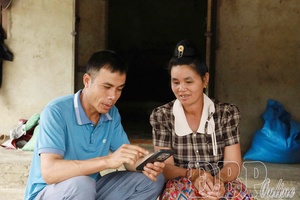
Similarly, Nguyễn Thị Dung from the Điện Biên Press, Radio, and Television shared that self-learning is a constant requirement for journalists. She learns from colleagues how to exploit information from an event or a report, and how to verify, filter, and evaluate the reliability of a news source. When encountering a difficult topic without a clear deployment path, feedback from colleagues helps her see the core issue and the appropriate approach. From constructing interview scripts and organizing question systems to seemingly tiny technological operations, she learns all of it from predecessors and surrounding colleagues. Those lessons not only make the work more efficient but also become valuable tools on the professional journey.
In the past, a reporter could carry a notebook, a voice recorder, and a pen to practice the craft. Today, alongside those familiar tools are smartphones, editing software, data platforms, and an increasing number of artificial intelligence applications. Within a short period, the methods of producing and distributing information have changed so rapidly that people sometimes feel that just as they have finished learning something, reality has already turned to a new page. However, change has never been the scariest thing. What is scarier is when people stop learning. Self-learning is not due to the pressure of achievements; it is to practice the craft better than yesterday.
.jpg)
Nguyễn Tiến Thế, also from the Điện Biên Press, Radio, and Television, noted that when switching from traditional television production to content on digital platforms, the greatest challenge is changing the journalistic mindset and the presentation of works. From duration and information pacing to the presentation format, everything must be adjusted to fit the fast-reception habits of the public in the digital environment. Therefore, he had to self-learn through the internet, exploring everything from filming to post-production. The difficulty lies not only in the equipment when switching from a horizontal frame to a vertical frame, but also in getting used to the mindset of editing short videos, using images, sounds, and effects to attract viewers. He self-learns and applies software while investing in suitable equipment to upgrade product quality.
According to him, every journalist must constantly self-learn, update technology and new trends, and hone skills through practice. Supporting this view, Đào Ngọc Thượng from the Điện Biên Press, Radio, and Television affirmed that in the face of the strong development of technology and the digital transformation process, self-learning for journalists today is no longer a choice but has become a mandatory requirement.
Sometimes, it is that very spirit that creates the gap between journalists. It is not necessarily professional age, nor the quantity of past works, and certainly not the number of award-winning pieces, but rather the ability to keep a spirit of self-learning before life and the requirements of professional innovation.
.jpg)
Someone once said that journalism is a profession of people seeking answers. But perhaps first of all, it is a profession of people constantly questioning themselves. Each completed article opens up things yet unknown. Each concluded trip leads to a new journey of exploration. And the longer one works in the profession, the more one realizes that knowledge is not like a vessel that can be filled to the brim. Therefore, among the many qualities required of a journalist - from courage, responsibility, sharpness, to observational capability - the spirit of self-learning always holds a special position. It is not easily seen, but it silently nurtures all other qualities.
The precious quality of a writer is the acceptance of starting all over again with a new task. And it is perhaps thanks to that very quality that journalists, after many years of passing through the shifts of the times, still retain for themselves an eagerness before each story of life, as if tomorrow is still the first day entering the profession.
Kông Thao


.jpg)
.jpg)
.jpg)
.jpg)
.jpg)
.jpg)
.png)
.jpg)
.jpg)
.jpg)


.jpg)
You have 500/500 characters left
Please enter 5 or more characters!!!