



Obstacles in project progress and field coordination
Post-disaster recovery projects face slow deployment progress and have not been executed in the true spirit of “urgency,” causing the relocation of citizens to new residences to fall short of set plans. According to the Ethnic Minorities Board of the Provincial People’s Council, one of the primary pointed-out causes is that coordination between investors and grassroots-level authorities has not been truly tight.
.jpg)
In many resettlement areas, design dossiers, plot maps, and land allocation profiles have not been fully handed over, preventing localities from organizing public meetings, drawing lots for land distribution, or completing land recovery procedures for old residences. Alongside this, the execution capacity of certain construction units remains limited.
A prime example is the construction of a new bridge to replace the suspension bridge into Bắng Chộc village, Na Son commune, which experiences slow implementation, currently reaching only 35% of the total workload. Furthermore, several items within resettlement zones exhibit subsidence and erosion, with soil and rocks spilling onto the leveled ground yet left completely unresolved, which acts as a major factor causing public hesitation when moving to new places.
Livelihood concerns and terrain challenges in Pa Xa Xá
At the Pá Chuông - Pá Dên resettlement sites in Na Son commune or Pa Xa Xá in Thanh Yên commune, numerous households remain highly anxious about production conditions, livelihoods, and their general capability to stabilize life in the long run.
.jpg)
Quàng Văn Tiến, Head of Pa Xa Xá village in Thanh Yên commune, stated that the village records 63 households residing within zones prone to flash floods, torrents, and landslides, yet up to now, not a single household has been relocated to the new resettlement area. He added that at their old residences, the rainy season is drawing increasingly closer, and the severe threat of rolling boulders makes them extremely worried.
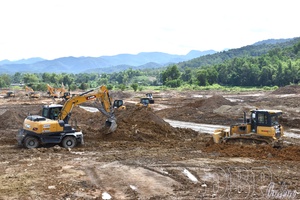
Currently, the Pa Xa Xá resettlement area has received investments for multiple essential items, including the leveling of a 3.8-ha residential ground, internal transport systems, electricity and domestic water supply, drainage networks, anti-landslide embankments, and stream alignment. However, to guarantee long-term stability, it remains vital to continue pouring supplementary investments into necessary items such as anti-landslide revetments, community houses, and disaster prevention structures.
Beyond technical and scheduling difficulties, the steep, heavily dissected mountainous terrain makes finding a land fund eligible for long-term resettlement arrangement far from easy. Meanwhile, investment capital from the state budget, support funds, and socialized sources remains limited compared to actual field demands.
Financial demands and strategic recommendations for sustainable settlement
Nguyễn Ngọc Tuấn, Chairman of the Thanh Yên Commune People’s Committee, stated that to swiftly bring resettlement zones into operation and use, promote investment efficiency, secure the long-term stability of the public’s lives, and prevent the waste of State budget capital, Thanh Yên commune has requested the Provincial People’s Committee and the Department of Finance to consider allocating an investment capital source to finalize the missing items at Pa Xa Xá resettlement area with a total budget of VND 14.2 billion. This funding targets adding anti-landslide embankments and community houses, alongside covering relocation support, life stabilization, boundary marking, map measurement, and cadastral profiling costs to serve land allocation and resettlement work.
.jpg)
Immediately following the recent inspection and survey drive, the Ethnic Minorities Board requested the provincial People’s Committee to continue allocating capital to finalize disaster recovery structures and projects to swiftly relocate residents to safe new residences before the rainy and stormy season. Specifically, the board emphasized concentrating supplementary funding on projects in Pa Xa Xá and Huổi Moi, alongside the bridge construction into Bắng Chộc village, while completing items like anti-landslide revetments, community houses, relocation assistance, life stabilization, boundary staking, map surveying, and cadastral profiling to support resettlement land allocation. Concurrently, it recommended strengthening the inspection and supervision of the responsibilities of investors, contractors, and related units, while promptly untying difficulties right from the grassroots level to guarantee project progress and quality, avoiding the waste of investment resources.
Mùa Thanh Sơn, Head of the Ethnic Minorities Board of the provincial People’s Council, emphasized that localities must urgently finalize land procedures and recover land in areas identified with dangerous risks of flash floods, torrents, and landslides, while coordinating tightly with investors, contractors, and related departments or sectors to guarantee full readiness prior to evacuating citizens to new residences. For poor households and policy-beneficiary families facing hardships when rebuilding their homes in resettlement areas, it remains necessary to continue mobilizing community hands through support and donation activities to help citizens stabilize their lives early on.
For disaster-hit residents to secure early settlement, it demands a more drastic involvement from all levels, sectors, and localities. Once the people achieve safe settlement, it will serve as a vivid yardstick for the efficiency of disaster recovery efforts and the goal of ensuring sustainable settlement across the province.
Mai Phương
.jpg)




.jpg)
.jpg)
.jpg)

.jpg)
.jpg)
.jpg)
You have 500/500 characters left
Please enter 5 or more characters!!!