



Many residential arrangement projects in disaster-prone areas have been and are being invested in with the expectation of bringing safe housing to residents. However, some projects still face “bottlenecks” that need to be unraveled early so that resettlement areas can truly become safe havens for people in disaster-affected regions.
Part 1: Resettlement areas waiting for residents to return
Recently, many resettlement areas dedicated to households situated in zones prone to flash floods and landslides across the province have been basically completed. Nevertheless, to date, quite a few households have not been able to relocate to their new places of residence due to numerous difficulties and snags, while the rainy season is drawing near and safety anxieties still linger.
.jpg)
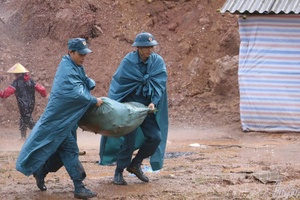
In recent years, natural disasters have developed in an increasingly extreme manner, inflicting severe losses on humans and assets. Across multiple local communes, hundreds of households have been affected by rains, floods, and landslides, living in dangerous zones that require relocation, among which many households have received support to move to new residences.
Mường Luân is one of the communes heavily impacted by natural disasters. Characterized by deep, remote, and complexly dissected terrain, the locality frequently confronts torrents, flash floods, landslides, and droughts. Particularly, the natural disaster spell in late July and early August 2025 inflicted major damage on assets and crops, directly affecting lives, production, and residential stability.
Nguyễn Trọng Huế, Chairman of the Mường Luân commune People’s Committee, stated: “The locality has deployed multiple solutions to overcome the consequences of natural disasters and support residents in stabilizing their lives. The commune completed reviewing, compiling dossiers, issuing approval decisions, and executing support for many affected households, encompassing assistance for new construction, housing repairs, and the relocation of households located in high-risk landslide zones. The remaining households continue to receive guidance to execute tasks according to the approved plan.”
.jpg)
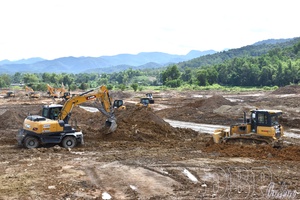
To ensure public safety, the Project on arranging and stabilizing the population in landslide-prone zones for 41 households in Phiêng Muông village, Mường Luân commune, was deployed across an area of 2 ha, with a total investment of over VND 25 billion sourced from central and local capital for rain and flood consequence recovery. According to the design, each resettled household is allocated 200 square meters of residential land and supported with VND 30 million for relocation costs. To date, core items have basically reached 97% completion.
Similarly, in Na Son commune, the Project on stabilizing the population in landslide-prone zones for 35 households in Pá Chuông - Pá Dên village, with a total investment of VND 16.5 billion, has reached 95% completion.
Being one of the 41 households subject to relocation under the Phiêng Muông village residential arrangement and stabilization project, village head Lò Văn Thực shared: “Along with the local authority, I frequently disseminate and mobilize residents to agree on moving to the new residence. However, because many households still hold concerns regarding living and production conditions after relocation, only 21 out of 41 households have agreed to move to the resettlement area.”
.jpg)
The reason causing the residents of Phiêng Muông and Pá Chuông - Pá Dên villages to feel anxious and hesitant about moving to the new residence is that the master plan design dossiers and the land lot division maps of the resettlement areas have not yet been handed over to Mường Luân and Na Son by the investor of the two projects. Consequently, the organization of lotteries to receive residential land has not been executed, and land recovery procedures at the old residences within the landslide-risk zones have not been deployed either.
Accompanying the inspection and survey delegation of the Provincial People’s Council recently at the communes, we observed that multiple shortcomings still exist and need early rectification. For instance, at the Phiêng Muông resettlement area, some drainage ditch items along the access road have been eroded, posing risks of affecting the structure. At the Pá Chuông - Pá Dên resettlement area, the downward slopes (negative taluy) have not been built with protective embankments, leading to a high risk of landslides.
Difficulties also stem from investment resources. The Phiêng Muông resettlement project has only been allocated VND 19.8 billion, reaching 78%, leaving more than VND 5.5 billion unallocated.
.jpg)
Meanwhile, Pa Xa Xá village in Thanh Yên commune has 63 households situated in an area frequently facing threats of torrents, flash floods, and landslides. The residential arrangement and stabilization project for this disaster-prone area, with an investment cost of VND 36.7 billion, passed acceptance testing in December 2024, yet to date, not a single household has been relocated to the new residence.
Through field surveys, numerous inadequacies have been exposed, such as the arrangement of certain land lots not aligning well with the master plan and road elevation, the area adjacent to the stream lacking anti-landslide and flood-prevention embankments, the embankment system exhibiting multiple elongated cracks, and certain filled foundation locations presenting risks of subsidence when residents construct their houses.
Resettlement areas expected to be safe havens for people in disaster-prone zones are gradually taking shape. However, while snags remain unresolved definitively, residents must continue living in dangerous zones, feeling anxious before every rain and flood season.
(to be continued)
Mai Phương

.jpg)



.jpg)
.jpg)
.jpg)

.jpg)
.jpg)
.jpg)
You have 500/500 characters left
Please enter 5 or more characters!!!