



However, the turnout rate of residents in many localities has yet to meet requirements. Therefore, to fulfill the goal of each citizen receiving a health check-up at least once in 2026, alongside the efforts of the health sector, the synchronous and drastic involvement of local party committees and authorities is highly essential.
.jpg)
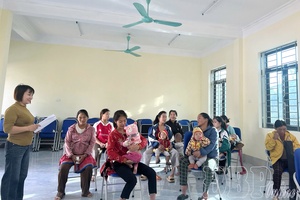
Implementing Plan No.4765/KH-UBND dated June 9, 2026, of the provincial People’s Committee on organizing periodic health examinations or free screening for the public, from April 25 to June 28, the entire province organized eight examination drives on Saturdays and Sundays, mobilizing hundreds of turns of medical staff to take turns supporting grassroots medical stations. More than 69,000 turns of residents across various age groups received health examinations, medical consultations, and disease screening right in their localities.
The people received quite comprehensive examinations, encompassing general check-ups, blood pressure measurements, electrocardiograms, ultrasounds, nutritional counseling, and the early detection of non-communicable conditions such as hypertension, diabetes, cardiovascular diseases, and many other common illnesses. In parallel, the health sector also supported residents in integrating Electronic Health Records into the VNeID application, contributing to step-by-step building electronic health profiles to serve long-term management and healthcare.
Although the health sector prepared human resources and equipment and proactively organized mobile check-up drives down to villages and hamlets, the number of residents turning up for examinations in many localities was not as expected. In some places, the participation rate remained low due to superficial dissemination work, omissions in reviewing and listing unchecked individuals, and a lack of full awareness among many residents regarding the significance of periodic health check-ups, or a lingering mindset of only going for a check-up when falling ill.
.jpg)
At the provincial People’s Committee meeting in June 2026, Phạm Giang Nam, Director of the Department of Health, emphasized that slackness still persisted in several localities. This led to ineffective dissemination work, low participation rates of residents in health check-ups, and a failure to create a widespread impact within the community.
On June 21, 2026, the provincial People’s Committee issued Document No.5228/UBND-KGVX requesting localities to strengthen the deployment of the free health examination program. Accordingly, communes and wards must mobilize the entire political system into action, striving by July 15, 2026, to have at least 50% of residents undergo health checks. Concurrently, 100% of cadres, civil servants, and public employees must set exemplary models by participating in health examinations before August 30, 2026, to spread the spirit throughout the community.
Following 20 days of implementation from June 5 to June 25, the free health examination program for residents in Na Sang commune recorded a participation rate of over 30% of the population. However, the execution process still faced numerous difficulties, particularly in dissemination and mobilization work for residents in some remote and isolated villages; the review of target groups, the update of checked individuals’ data, and the integration of electronic health records on the VNeID application encountered many snags. To untie these difficulties, the Na Sang commune People’s Committee deployed synchronous solutions to accelerate implementation progress.
Trần Hồng Quân, Chairman of the Na Sang commune People’s Committee, stated: “We request villages and hamlets to continue reviewing and compiling full lists of residents who have not participated in examinations, and build specific plans regarding appropriate check-up times and locations for each area. For the elderly and individuals with underlying conditions, priority will be given to mobilizing them to visit Health Centers for comprehensive, specialized examinations. Concurrently, we will step up dissemination through multiple formats, mobilizing mass organizations and prestigious individuals in the community to participate in mobilization, ensuring no target groups are left out.”
.jpg)
To elevate the free medical examination rate for the public, several localities deployed mobile health check-up models. During the two days of June 20 and 21, medical stations across Quài Tở commune coordinated with the Tuần Giáo Health Center to mobilize 50 medical staff to organize free examinations for around 1,200 turns of residents. Notably, the locality established 17 mobile examination teams to visit villages far from the center directly, helping the elderly, the poor, people with disabilities, and households facing travel difficulties access medical services right at their places of residence.
To fulfill the goal of each resident receiving a health check-up at least once a year, besides the efforts of the health sector, the role of grassroots party committees and authorities carries a decisive significance. Wherever there is direction and assignment of cadres in charge of each village and hamlet, and where village heads, residential group leaders, and mass organizations actively disseminate and mobilize, the turn-out rate of residents increases distinctly. Conversely, in places lacking drastic direction, the implementation progress is slow and fails to meet requirements.
To ensure the successful completion of the goal that by the end of 2026, each citizen receives a periodic health examination or free screening at least once, localities must treat this as a core political task. From there, they must mobilize the strength of the entire political system into action so that the healthcare policies of the Party and State truly reach each resident, contributing to upgrading the quality of life and building a healthy, sustainably developing community.
Phạm Quang
.jpg)


.jpg)
.jpg)
.jpg)

.jpg)
.jpg)
.jpg)
You have 500/500 characters left
Please enter 5 or more characters!!!