



Thousands of headquarters, vehicles, and equipment have been reviewed and transferred, limiting vacancy and waste. Many old headquarters have been converted into schools, cultural houses... Rearranging working facilities for the new apparatus helps public assets be exploited more effectively, contributing to improving local governance.
As of before July 1, 2025, the whole province had 2,416 housing and land facilities managed by agencies and organizations. After reorganizing administrative units and the apparatus under the 2-tier local government model, the volume of assets requiring review, arrangement, and processing was massive. However, instead of leaving them vacant or overlapping in use, the province proactively regulated, transferred, and processed public assets in accordance with reality and with a roadmap. The plans not only addressed immediate needs but also considered long-term usage goals, avoiding scattered investment and limiting the generation of surplus assets.
After nearly 1 year, the entire province has completed processing 2,622 housing and land facilities (including assets transferred from the Central Government to the locality for management). Among them, up to 2,579 facilities were internally regulated and transferred; 21 facilities were transferred to ministries and branches; only 1 facility had to be recovered... This shows the plan prioritizes reusing and re-exploiting existing assets instead of making new investments. After the reorganization, 1,902 facilities were arranged as schools, 423 facilities to serve cultural and sports institutions, 210 facilities to continue as working headquarters, and 58 facilities to serve public service activities. Some facilities were converted into official residences or medical facilities.
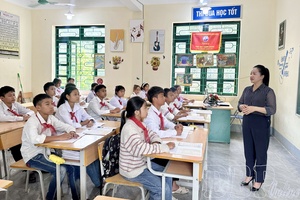
In the context of the province still facing many resource difficulties, effectively utilizing public assets is of great significance. Many headquarters after the merger were not “mothballed” but renovated into schools, cultural houses... Typically, after merging Mường Pồn and Mường Mươn communes to establish the new Mường Pồn commune, the administrative headquarters was located in the old Mường Mươn area. To avoid waste, the old Mường Pồn commune headquarters was handed over to Mường Pồn Kindergarten No.1 for management and use. This helps the school have more classrooms, work areas, and spaces to organize activities for children, contributing to reducing the pressure of classroom shortages.
.jpg)
In the field of public vehicles, the review and arrangement of automobiles were implemented synchronously. The whole province currently has 265 public cars, including 3 title-serving cars, 175 general-purpose cars, and 87 specialized cars. After the arrangement, communes were allocated general-purpose cars; of which 35 communes were granted 1 car, and 10 communes were allocated 2 cars. This is an important condition for the new grassroots authorities to maintain operations, especially in vast mountainous areas with difficult traffic. Along with that, the handover of assets was carried out following the cadres, civil servants, and public employees, helping to limit disruptions when changing work locations.
According to the assessment of the Department of Finance, after implementing the 2-tier local government model, the arrangement and use of headquarters and public assets have basically been carried out in accordance with Government regulations. The process of arranging, allocating, and processing assets was carried out openly and transparently, ensuring compliance with regulations, and contributing to the smooth and continuous operation of the local government during the reorganization. 100% of assets, including housing and land headquarters, automobiles, and equipment, were handed over to agencies, organizations, and units for management and use, ensuring compliance with regulations.
However, after the merger, many units had to receive a large number of cadres and records while the facilities were not synchronous. Many computers and printers that have been fully depreciated still have to be used; many devices were damaged and degraded after the transportation process. Desks, chairs, and filing cabinets, although sufficient in quantity, are of limited quality, affecting work efficiency at the grassroots level. Nậm Kè commune, with an area of 228.05 km2, was established on the basis of merging the old Nậm Kè and Pá Mỳ communes. After the merger, the vast area and difficult traffic conditions, coupled with unsynchronous facilities, posed great pressure on the new commune government in the process of stabilizing the organizational apparatus and improving the quality of service for the people.
Nguyễn Tiến Thành, Chairman of the Nậm Kè commune People’s Committee, shared: After the merger, the commune’s workload increased significantly due to the large area and scattered population, while the working facilities did not fully meet actual requirements. Some offices are cramped, information technology equipment is unsynchronous, and many machines are old, so errors frequently occur during work processing. Particularly, moving between residential areas far from the commune center faces many difficulties, especially during the rainy season, making the demand for vehicles and equipment to serve grassroots work increasingly large.
This is an easily seen problem in the process of streamlining the apparatus in many localities, but for Điện Biên, the pressure is even greater due to limited budget conditions. Synchronously investing in new equipment for all communes and wards after the merger is difficult to achieve in a short time. Therefore, many places still have to “cut their coat according to their cloth,” making the most of old assets. In addition, in the early stage of the model transition, coordination between agencies in asset management was sometimes awkward. The work of handing over, receiving records, and cross-checking data took a lot of time...
Although to date there are no longer housing and land facilities needing further processing, the actual operation process may continue to generate new inadequacies when the population scale, apparatus, or functions and tasks change. Lacking long-term usage plans, some works can easily fall into a state of inefficient use.
Facing the requirement to tighten management and effectively use public assets, on May 15, the Provincial Inspectorate announced the decision to inspect the management and use of surplus housing and land in several communes and wards. The content focuses on evaluating the current status of the management and use of public assets after the reorganization; thereby promptly detecting violations, removing obstacles, and recommending handling solutions to prevent waste and improve asset exploitation efficiency.
After nearly 1 year of operating the 2-tier local government model, Điện Biên has step by step solved the problem of arranging and using public assets in a flexible and effective direction, minimizing waste. When each headquarters, vehicle, or piece of equipment is exploited for its correct function, the efficiency of the apparatus is not only reflected in its leanness but also in the quality of service for the people. For Điện Biên, the road ahead still has much pressure, but the initial steps show the determination to build an economical, transparent, and practically operating administration.
Quốc Huy
.jpg)
.jpg)
.jpg)
.jpg)
.jpg)
.png)
.jpg)
.jpg)
.jpg)
.jpg)
.jpg)

You have 500/500 characters left
Please enter 5 or more characters!!!