



Improved teaching and learning conditions are helping teachers and students in disadvantaged communities feel more secure and motivated to stay in school, contributing to better educational quality across the province.
.jpg)
At Huổi Quang 1 satellite campus under Ma Thì Hồ Semi-Boarding Primary School for Ethnic Minority Students in Na Sang commune, challenges are visible in every aging classroom tucked deep within the mountains. It is considered the school’s most disadvantaged campus, where inadequate facilities become especially harsh during the freezing winter months.
According to Principal Trần Trung Nhân, the classrooms have seriously deteriorated, with damaged roofs and numerous gaps in the walls. “During winter, even when doors are fully closed, cold winds still sweep into the classrooms, directly affecting students’ health and learning conditions”, he said.
Despite the hardships, teachers at the campus continue to stay committed to ensuring education for 39 students, all children of the Hmong ethnic minority community. For these students, having solid classrooms that can keep them warm during winter has been a long-held dream.
.jpg)
Thanks to community support, Huổi Quang 1 campus is currently being rebuilt with two new classrooms, two teacher housing units, a kitchen, and two restroom facilities. The project, worth more than VND 800 million, is funded through cooperation between the provincial chapter of the Vietnam Fatherland Front, the online newspaper Dân trí, and donors.
Na Sang is not the only locality benefiting from such efforts. Across many remote and border communities in Điện Biên, schools are gradually being repaired and upgraded to improve teaching and learning conditions.
At Háng Sông Trên Kindergarten Campus under Phì Nhừ Kindergarten in Xa Dung commune, severe landslides had previously left the school in unsafe condition, making childcare and education extremely difficult. With funding from Military Commercial Joint Stock Bank (MB), a new campus was constructed, including two classrooms, sleeping rooms, a kitchen, teacher housing, and storage facilities. The completed project now provides teachers and children with a safer and more stable learning environment.
Teacher Lường Thị Thanh shared: “At the old campus, we faced many difficulties because the learning environment was neither clean nor well-ventilated. Since the new school was built, teachers feel more secure at work, and the children now have a much safer place to study.”
.jpg)
Hạng A Dế, a resident of Háng Sông Trên village in Xa Dung commune, added: “The old school was badly deteriorated, and parents constantly worried about their children whenever heavy rain came. Now that there is a new and spacious school, everyone in the village feels relieved and happy to send their children to class.”
Alongside investment in classrooms, boarding facilities, and teacher housing, the provincial education sector has also been modernizing educational infrastructure and teaching equipment, especially in remote schools.
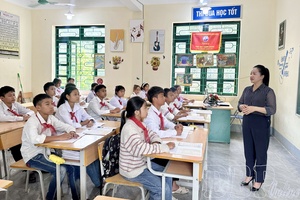
Trần Văn Thọ Semi-Boarding Primary School for Ethnic Minority Students in Mường Nhé commune has received synchronized investment in classrooms, a library, computer and foreign language rooms, boarding facilities, and teacher housing. With improved facilities, the school has actively expanded the application of information technology in teaching.
Principal Phạm Văn Khiêm said the school now uses electronic report cards and increasingly integrates digital platforms and educational software into teaching activities to improve lesson quality. As a result, students’ learning outcomes have gradually improved, particularly in listening, speaking, reading, writing, and numeracy skills.
.jpg)
Currently, 100% of educational management agencies and schools across the province are connected to high-speed fiber-optic internet. Remote campuses are also supported with 3G and 4G networks to maintain communications and facilitate online learning when necessary. The education sector has intensified online training for teachers while maximizing digital platforms for instruction.
Province-wide, Điện Biên now has 7,446 classrooms, with more than 78% built to permanent standards. The province also has 3,878 student dormitory rooms and 1,684 teacher housing units. Authorities are continuing to invest in inter-level boarding schools for ethnic minority students in border communes, while accelerating multiple construction projects to improve learning and living conditions for students in frontier areas.
Although challenges remain, continued investment in school infrastructure is creating visible changes in education across Điện Biên’s mountainous and border regions. Beyond improving teaching and learning conditions, these efforts help maintain student attendance, raise educational quality, and encourage teachers to remain committed to remote communities. This serves as an important foundation for narrowing the education gap between mountainous and more developed areas, moving toward more equitable and sustainable education development in the years ahead.
Lan Phương
.jpg)


.jpg)
.jpg)
.jpg)
.jpg)
.png)
.jpg)
.jpg)
.jpg)
.jpg)
.jpg)

You have 500/500 characters left
Please enter 5 or more characters!!!