



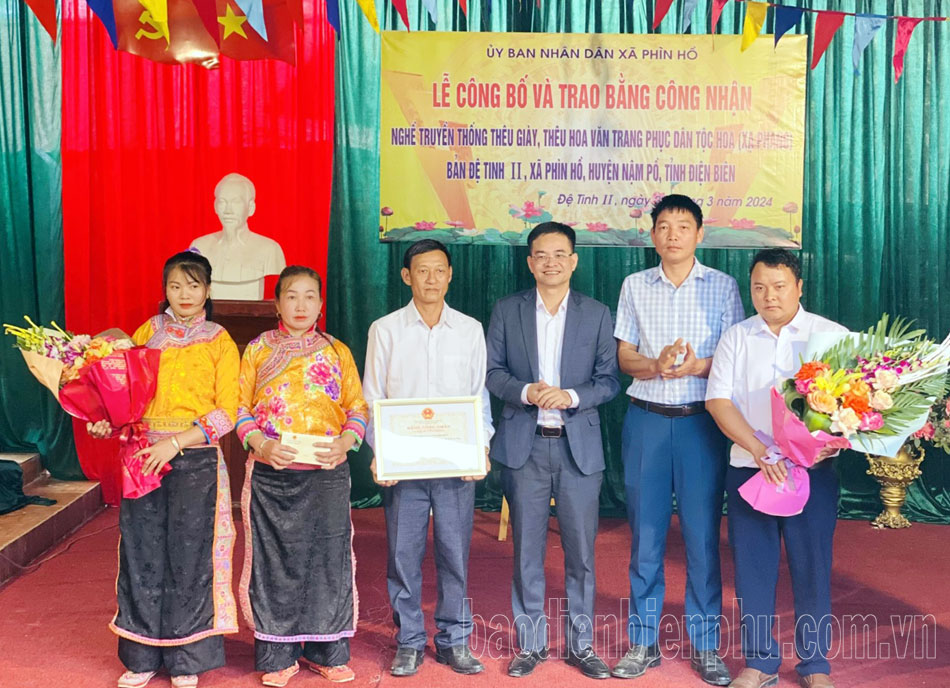
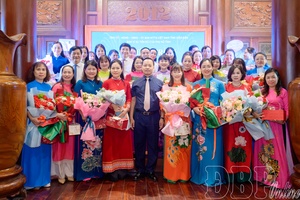
Residents of Đệ Tinh 2 village receive the Certificate of Recognition for the traditional craft of Hoa ethnic shoe embroidery from the Điện Biên Provincial People's Committee.
In Phìn Hồ Commune, Nậm Pồ District, the traditional craft of shoe embroidery has become a cultural symbol and an indispensable part of the Hoa (also known as Xạ Phang) ethnic group’s heritage. This craft has been maintained and passed down through generations.
The Xạ Phang people in Điện Biên Province live in villages across the districts of Mường Chà, Nậm Pồ, and Tủa Chùa. In the border district of Nậm Pồ, the Xạ Phang make up over 1.5 per cent of the population, primarily residing in Phìn Hồ Commune. Local women embroider and sew shoes for their families, as well as special shoes for weddings.
During the agricultural off-season or on holidays and festivals, Xạ Phang women gather in groups to embroider patterns on shoes, setting aside their farming tasks. They continue to make their own shoes and proudly display them during festivals, at the market, and in traditional ceremonies.
Ngải Mù Dính is one of the most skilled shoe embroiderers in Đệ Tinh 2 village, Phìn Hồ Commune. Although it is not her primary occupation, she is deeply passionate about this craft. Dính said Hoa girls are taught from a young age by their grandmothers, mothers, and older sisters to sew, embroider, and create household items and personal clothing.
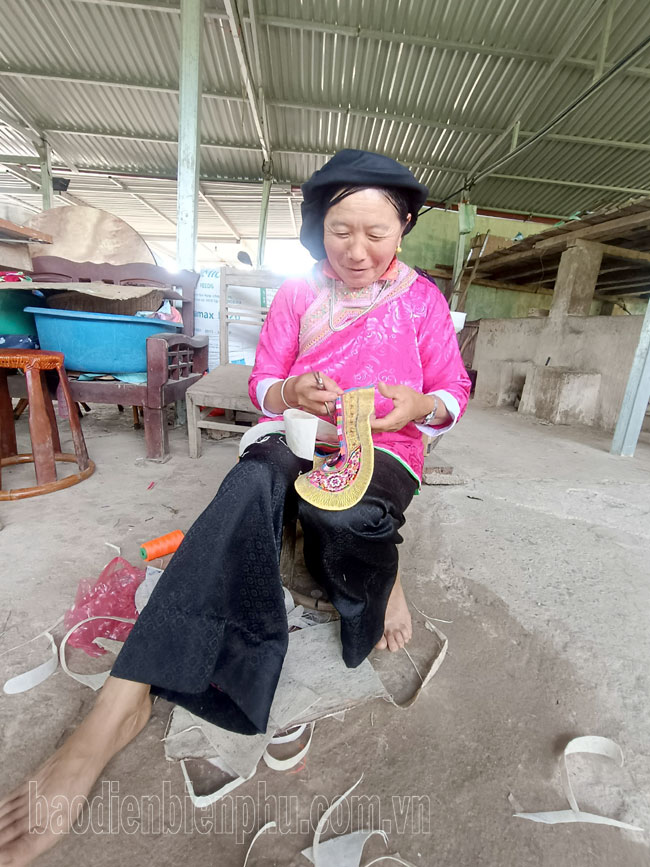
A Xạ Phang woman embroiders vibrant traditional shoes.
Making a quality embroidered shoe involves several steps, including preparing materials, selecting the appropriate shoe style for the user, cutting and sewing the sole, designing and embroidering patterns on the shoe body, and assembling the parts to complete the shoe.
The main materials for making shoes include fabric, bamboo sheath, sewing thread, embroidery thread, glue, traditional paper, and various tools. The fabric for the sole and shoe body must be thick, durable, and strong, often using handwoven fabric from the Thái people. The sewing thread, made from flax bark, is known for its strength, flexibility, and water resistance.
The Xạ Phang people strip the bark from harvested flax plants, discard the core, and pound the outer layer to soften it. The bark is then boiled, dried, shredded into thin fibres, joined together, twisted into threads, and wrapped around spindles for use when needed. To ensure the sewing thread is smooth, shiny, unbreakable, and water-resistant, the Xạ Phang people rub it with a block of dry beeswax before stitching shoes.
The adhesive for the shoe soles is made from the tubers of a forest plant called "mùa rỉ." These tubers are dug up, cleaned, peeled, and the inner part is mashed, mixed with water, and strained. The resulting mixture is then cooked to form a thick, glue-like paste. For the shoe soles, mature, dry bamboo sheaths are flattened, cut into foot shapes, and sewn together. Each sole typically consists of five layers of bamboo sheath, each wrapped in a layer of thick, durable fabric to create a strong, sturdy base.
The underside of the sole is lined with white fabric, while the inside is lined with coloured fabric according to the maker's preference and securely stitched to the sole. This makes Xạ Phang embroidered shoes durable and long-lasting. Women's shoes feature a curved fabric piece that wraps around the sole, fully enclosing the foot. The embroidery typically includes a prominent flower surrounded by smaller ones, making the main design stand out. These shoes are closed-toe, compact, elegant, and discreet.
Men's shoes, on the other hand, have open sections at the front and sides, with a solid heel and back, giving a robust, dynamic appearance suitable for active use. The embroidery on men's shoes is spread evenly across the surface without a central focal point. The main attraction is the contrasting embroidery sections around the heel and across the top and sides of the foot.
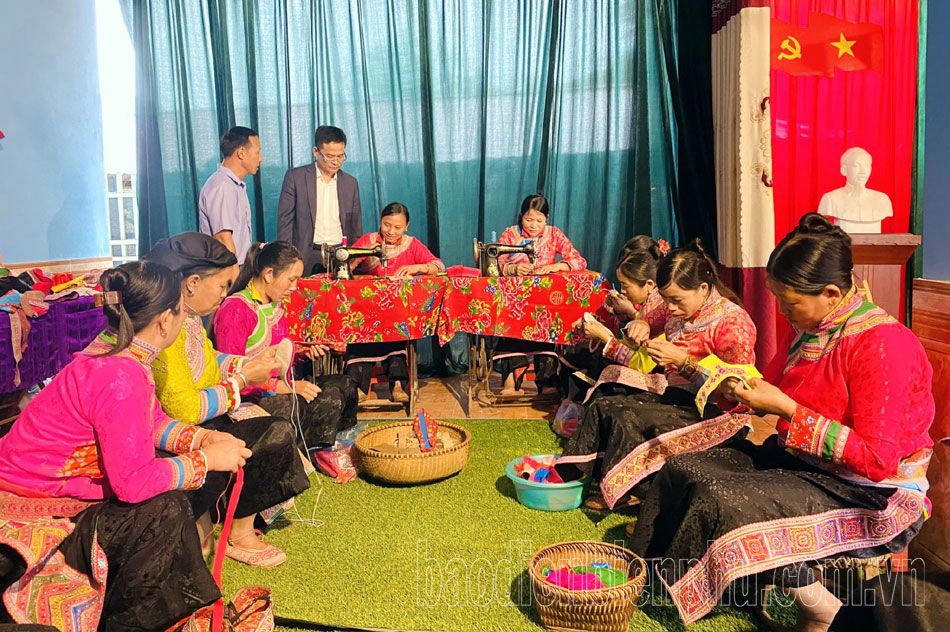
Nậm Pồ district leaders visit Đệ Tinh 2 village women as they embroider shoes.
Ly Sì Tống from Đệ Tinh 2 village said: "From a young age, my grandmothers and mothers taught me how to embroider and make complete shoes. I find our traditional shoes very beautiful, and I strive to learn the craft well to preserve our cultural heritage."
Recognising its cultural significance, the embroidered shoe-making craft of the Xạ Phang people was listed as a national intangible cultural heritage by the Ministry of Culture, Sports, and Tourism on 9 March 2021.
In Nậm Pồ District, many households still practice embroidery and create vibrant shoes. In Đệ Tinh 2 village, 69 households, accounting for 46.38 percent of the village, engage in traditional embroidery.
In March, the craft of shoe embroidery and Xạ Phang ethnic clothing embroidery in Đệ Tinh 2 village was officially recognised as a traditional craft by the People's Committee of Điện Biên Province on 23 November 2023.
"The recognition of this traditional craft will help develop shoe and ethnic clothing embroidery as a recognised brand. This provides a foundation for locals to build and expand it into a widespread commercial trade, creating jobs and increasing income for the community," said Quàng Văn Thảnh, deputy head of the Agriculture and Rural Development Department of Nậm Pồ District.
Sầm Phúc
.jpg)
.jpg)
.jpg)
.jpg)

.jpg)
.jpg)
.jpg)

.jpg)
.jpg)
.jpg)
You have 500/500 characters left
Please enter 5 or more characters!!!