



Arriving at the Public Administrative Service Center of Mường Phăng commune to carry out administrative procedures, Lò Thị Thanh in Cang village was guided by cadres to look up information, check dossier components, and carry out steps on the system. With the support of look-up kiosks and AI assistants, necessary information was found rapidly, helping her proactively prepare documents and limiting the need to make multiple trips to supplement paperwork.
.jpg)
This was also the first time Lò Thị Thanh used an AI assistant to look up information and carry out online public services. From initial unfamiliar operations, she was given specific instructions by cadres, allowing her to complete the necessary steps quickly.
Lò Thị Thanh shared that cadres provided guidance on everything from looking up procedures and preparing dossiers to online execution. Having an AI assistant support information searches made things easier to understand and more convenient. Unclear contents were explained immediately by cadres, making procedural execution faster than before.
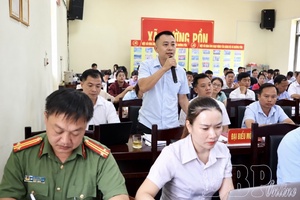
Tân Phong village in Tủa Chùa commune has more than 170 households. While many matters previously had to be announced directly at meetings or via cadres visiting each individual household, the village leadership can now rapidly transmit information on village activities, meeting schedules, commune notices, and Party and State guidelines and policies through a Zalo group.
.jpg)
Điêu Chính Dĩnh, Head of Tân Phong village in Tủa Chùa commune, shared that the Zalo group makes grassroots communication work more convenient. Whenever there is content requiring implementation, the village posts it to the group for residents to follow; matters related to administrative procedures are also guided so that people can proactively learn and carry them out. Concurrently, the village coordinates communication efforts to help people select information carefully, prioritizing official sources and avoiding receiving or sharing unverified content. To date, over 90% of households in the village have representatives participating in the Zalo group.
While technology helps information transmission to residents become faster in Tân Phong village, in Hón Sáng village of Mường Ảng commune, since joining the “Digital Family - Digital Association Branch” model, many female members have gradually become accustomed to smartphones, learning how to tap digital utilities to serve daily life. Notably, this process has been driven by mutual guidance and sharing among members active within the branch.
Cầm Thị Phương, Head of the Women’s Union Branch of Hón Sáng village in Mường Ảng commune, stated that the digital association branch model in their village operates very effectively. The branch assigned experienced young individuals to guide older members. Once members understand and master the skills, they guide their families to use services better and more effectively.
.jpg)
The “Digital Family - Digital Association Branch” model in Hón village, Mường Ảng commune was established in mid-April 2026, initially with 35 members participating out of a total of 166 branch members. To date, the model has supported dozens of households in accessing technological utilities; over 80% of participating members proficiently use multiple applications.
Lò Thị Minh, Chairwoman of the Women’s Union of Mường Ảng commune, stated that through implementation, they found the model very effective. Previously, many women were hesitant when using smartphones, but now they know how to use applications to search for information, exchange work, use Zalo, look up information online, carry out certain transactions and payments, and acquire knowledge serving production and daily life. In the coming time, the Union will continue to maintain the model while replicating and spreading it to other branches.
Results from grassroots models indicate that digital transformation is becoming increasingly practical and effective when tied to specific needs. For digital utilities to be widely utilized, Điện Biên province continues to invest in, expand telecommunications infrastructure, and perfect shared digital platforms.
.jpg)
Currently, the entire province has 1,239 BTS stations; 4G networks cover 100% of the commune level and 96.4% of residential areas. Approximately 3,580km of fiber-optic cables connect to 100% of commune centers and nearly 90% of hamlets and villages. 5G networks are being accelerated with 242 stations, an increase of 204 stations compared to 2025; the province strives to raise the 5G coverage rate to 60% in 2026, continuing to eliminate mobile signal blind spots.
With infrastructure invested in, digital services are progressively demonstrating efficacy in handling work. From July 1, 2025 to date, the entire province has received more than 131,000 administrative procedure dossiers; nearly 100% of dossiers were resolved on time and ahead of schedule. More than 1,080 comprehensive end-to-end online public services are being provided. At the same time, the province supported activating 99% of VNeID electronic identification accounts; more than 50% of the population possesses electronic payment accounts.
The network of community digital technology teams continues to promote its support role at the grassroots, with more than 80% of households directly accessed and instructed. Through this, digital skills are progressively formed, helping people become more proactive in accessing information, using services, and handling work in the digital environment.
Quang Long
.jpg)
.jpg)
.jpg)
.jpg)

.jpg)
.jpg)
.jpg)


.jpg)
.jpg)
.jpg)

.jpg)
You have 500/500 characters left
Please enter 5 or more characters!!!