



In the 2026-2027 school year, 406 schools and satellite campuses across the province are providing meals on campus for 144,550 students. Given the scale of these operations across different educational levels and localities, management and oversight must be coordinated, consistent and ongoing, with clear responsibilities assigned to each educational institution.
The provincial Department of Education and Training has issued guidelines for operating collective kitchens in educational institutions. It has also instructed commune- and ward-level People’s Committees and affiliated units to review all schools providing meals for boarding and semi-boarding students, covering both arrangements. The review must identify food suppliers, existing shortcomings and potential risks, corrective measures, and the individuals responsible at each school.
Schools have also been instructed to assign administrators and healthcare staff to directly supervise food deliveries and meal portions; check quantities and quality; maintain complete delivery records; reject food of unknown origin; retain food samples for testing; and ensure that students eligible for support policies receive meals meeting their prescribed allowances.
This school year, 7/5 Kindergarten in Điện Biên Phủ ward has more than 1,350 children enrolled. Committed to providing quality meals and adequate rest while safeguarding the children’s health, the school places particular emphasis on food safety and meal quality.
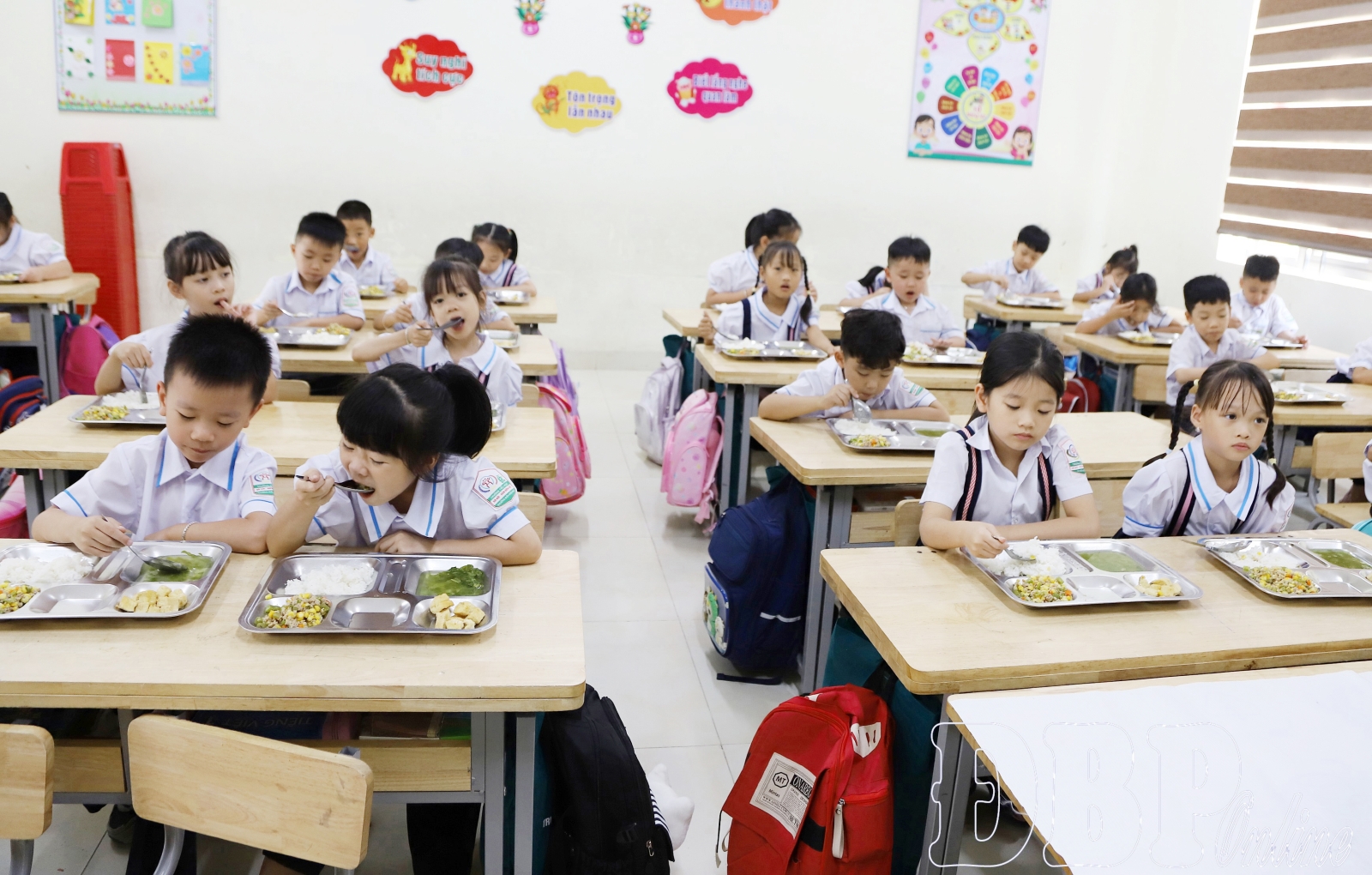
Principal Kiều Thanh Huyền said the school pays special attention to inspecting incoming ingredients. All ingredients are delivered each morning, and any food that fails to meet quality requirements is returned to the supplier. This is a crucial first step in reducing food safety risks and ensuring that ingredients are fresh and traceable.
Food is prepared in accordance with the one-way workflow principle to prevent cross-contamination. Menus are changed daily to suit the children’s tastes. Kitchen staff strictly follow food hygiene and safety requirements, including wearing head coverings, specialized gloves, aprons and masks. Dining areas are kept clean and well ventilated, and food samples are retained daily.
The school’s management board, healthcare staff and parent representatives regularly monitor and inspect portion sizes, food preparation procedures and ingredient quality to ensure students’ safety.
At Điện Biên Phủ Primary School, 3,734 students are enrolled in the 2026-2027 school year, with approximately 2,500 eating lunch on campus.
Principal Lê Thị Nga said the school receives fresh ingredients daily from contracted suppliers and does not use frozen food. Food preparation areas are cleaned regularly and equipped with the necessary utensils and equipment. Meals are prepared, portioned and delivered to individual classrooms in accordance with established requirements.
The school also makes information about food sources, menus and photographs of students’ actual meal trays publicly available to parents through noticeboards and online communication groups. This transparency enables the parent representative board to participate in monitoring food supplies, meal portioning and meal quality.
At schools with large numbers of semi-boarding students, meal provision is closely linked to student care, health protection and the maintenance of regular learning routines.
Na Sang Semi-Boarding Primary School has more than 2,550 students this school year, including 1,100 who eat at school under the semi-boarding arrangement. The school proactively developed a food safety and hygiene plan at the beginning of the academic year. All ingredients used in meal preparation must be safe and traceable. Its spacious cooking and preparation areas are cleaned regularly and equipped with adequate facilities and utensils. Students have a separate dining area with tables, chairs, meal trays and fans, providing a clean and comfortable place to eat.
To ensure the quality of school meals, the provincial Department of Education and Training has coordinated with the Department of Health to provide guidance on designing menus and portion sizes appropriate to students’ ages, local conditions and meal budgets. The aim is to provide sufficient energy, balanced nutrition and a varied range of foods.
The education sector has also introduced a “School meals” section on the school information portal, allowing schools to update information on the number of boarding and semi-boarding students, meal budgets, food suppliers, support policies and daily photographs of actual meals.
As of October 12, 2026, a total of 299 schools and satellite campuses had uploaded 4,890 photographs of students’ actual meals. Schools also publish menus, supplier details and food sources on noticeboards and in parent communication groups, helping make meal provision more transparent.
In addition, the education sector is coordinating interagency inspections of boarding and semi-boarding meal services and food safety practices to ensure the safety and quality of school meals and protect students’ health.
Đức Linh



You have 500/500 characters left
Please enter 5 or more characters!!!