



Differences in language, customs, and beliefs, if lacking mutual understanding, can easily create invisible divides, hindering unity and development. More concerningly, such gaps could be deepened, becoming loopholes for distorted information and rhetoric aimed at dividing the great national solidarity bloc. Therefore, the problem is not to eliminate differences, but how to enable communities to understand each other better, respect differences, and find a common voice together.
Part 1: Invisible divides
Living within the same village, each ethnic community nevertheless maintains distinct ways of thinking, codes of conduct, and customs. Variations extending from spoken language, traditional attire, rituals, and beliefs to ways of organizing daily life and production mean that the process of integration does not always unfold naturally. Following the restructuring of hamlets and villages, as multiple ethnic groups share a single living space, these differences manifest more visibly in everyday activities. Over time, such divides can become obstacles preventing guidelines of the Party, policies and laws of the State, and local development tasks from taking root in life.
Sharing a village, differing in ways of living
As a border province adjoining Laos and China, Điện Biên is home to 19 ethnic groups living together, including the Hmông, Thái, Kinh, Khơ Mú, Sán Chay, Hà Nhì, and Phù Lá. Each ethnic group possesses its own language, customs, and habits. The Hmông people are attached to high mountain peaks, the Thái settle along streams and rivers, and the Dao maintain customs and beliefs tied to fire. That ethnic diversity creates the cultural richness of Điện Biên, yet simultaneously demands deeper mutual understanding when communities coexist within the same space.
.png)
Huổi Lèng village in Mường Tùng commune was established through the merger of the former Huổi Lèng village and Ma Lù Thàng village, comprising 194 households. Prior to the consolidation, Huổi Lèng village had 48 households primarily composed of Xạ Phang people, while Ma Lù Thàng village had 146 households entirely of Hmông ethnicity. Following the merger, the two ethnic groups share the same village and roads, yet each community preserves distinct traits regarding language, customs, and practices. These variations manifest in daily life through family and community rituals.
Typically, during funeral rites, the Hmông people observe relatively complex ceremonies tied to concepts of the soul and ancestors. Relatives place beside the deceased items such as a knife to clear the path, a crossbow to defend the soul, and a rooster to crow and signal ancestral recognition. Ritual masters perform rites using panpipes and drums to guide the soul back to the ancestors. Meanwhile, among the Xạ Phang people, following burial, the family carries fire from the kitchen hearth out to the grave for three consecutive days; only after one year do they perform the rite to welcome the soul to the ancestral altar and end mourning. During the initial three days, descendants abstain from eating fat meat. If the family is dissatisfied with the burial location, the grave may be moved to another site, though no more than three times.
Such customs hold deep meaning for each individual community. Yet when residing in a shared space, these differences require population groups to understand and respect one another; conversely, a lack of sharing and understanding easily spawns misunderstandings. Vừ A Sàng of Hmông ethnicity, Head of the Front Work Board of Huổi Lèng village, stated that when merging, their concern went beyond changing village names or administrative boundaries to ensuring that ethnic communities live in harmony. Cultural and customary differences, if not understood, can easily generate differing viewpoints. Therefore, local cadres regularly conduct outreach and explanations so that residents comprehend and respect one another’s customs.
.png)
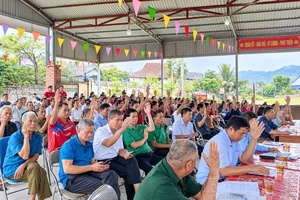
Divides between communities do not appear exclusively in highland areas. Tà Lèng village in Điện Biên Phủ ward, the provincial center ward, comprises 138 households spanning 4 ethnic groups: Kinh, Thái, Hmông, and Khơ Mú. Each community preserves its own culture, customs, and lifestyle. In private matters, residents usually turn to relatives and fellow community members for sharing and assistance, while interactions in collective affairs remain limited. For example, during the Great National Solidarity Festival, differences remain evident. Some groups actively mingle and engage in communal activities, while others remain hesitant, participating little in community events or even choosing not to attend.
Lò Văn Mấng of Khơ Mú ethnicity, Secretary of the Party Cell of Tà Lèng village, considered that each ethnic group maintains its own customs, traditions, and ways of life, which are values that must be preserved. The critical goal is preventing differences from turning into gaps within the community. However, in practical life, variations in language, communication styles, and customs still generate certain divides. Things considered appropriate by one community may appear difficult to understand or assimilate for another.
Beyond Huổi Lèng and Tà Lèng, having multiple ethnic groups living together in one village is not entirely new in Điện Biên. However, from July 1, 2026, when the province carried out reorganization, reducing from 1,446 to 888 hamlets, villages, and residential quarters - a reduction of 558 units - the size of residential units expanded, meaning population composition also became more diverse. Realities across many localities show that villages housing two or more ethnic groups constitute the majority, with some villages bringing together 7 to 8 ethnic groups.
It must be affirmed that merging hamlets and villages represents a sound policy of the Party and State aimed at streamlining organization, improving governance validity and efficiency, and concentrating resources to serve the people. However, organizational and boundary adjustments represent merely the first step. Behind the reduction of administrative units lies the task of harmonizing differences in language, customs, habits, and lifestyles; ranging from formulating village conventions and organizing festivals to setting community regulations on weddings, funerals, and the protection of forests and water sources.
Language barriers
While culture, customs, and traditions are distinct traits that define each ethnic identity, the national standard language serves as the bridge for communities to understand each other and draw closer. But when that bridge is not wide enough, language differences can create additional distance.
.jpg)
Across 19 ethnic groups, Điện Biên features 6 language groups out of the 8 present nationwide, comprising Tày - Thái, Hmông - Dao, Mon - Khmer, Tibeto-Burman, Viet - Mường, and Sino-Tibetan. Each language is tied to a distinct cultural space and community life formed and transmitted through generations. In highland villages, mother tongues remain the primary languages of communication, whereas the ability of a segment of residents to use the national standard language remains limited. In 2020, nearly 20% of the provincial population aged 15 to 60 was illiterate at level 2; by 2025, this rate remained over 10%. The proportion of the population aged 15 to 18 attending upper secondary school or its equivalent is also not high, reaching 70.7% in 2021 and 77.9% by 2024.
These numbers demonstrate that language barriers not only affect information reception, but also constrain opportunities to communicate and understand customs and habits of other communities. That situation is clearly visible in Phìn Hồ village, Si Pa Phìn commune. The village counts 178 households with over 1,000 residents, primarily belonging to the Hmông ethnic group. Within that community, nearly 300 individuals cannot speak the national standard language, and almost every family has members who are not proficient in listening to or understanding it. This serves as an obstacle to conveying information to each household and resident, as well as reaching consensus in communal undertakings.
Cháng A Dung, Secretary of the Party Cell of Phìn Hồ village, shared that within the village, many residents, especially women, have limited capacity in using the national standard language. If communication is conducted solely in the national standard language, there are contents that residents hear but fail to grasp fully. Language limitations also make communicating, sharing, and exploring customs and practices of other ethnic groups difficult. When ways of speaking and behaving are not understood, cultural variations are easily perceived through the familiar lens of each community, giving rise to misunderstandings and curbing interaction and empathy among resident groups.
Lọong Ngua in Mường Nhà commune is a village bordering Laos. Following the merger, the village counts more than 50 households, mainly of Hmông and Khơ Mú ethnicities. Life remains fraught with hardship, with most households classified as poor. In communal life, differences in speech also constitute an impediment. The Hmông belong to the Hmông - Dao language group, while the Khơ Mú belong to the Mon - Khmer group. Despite coexisting within one community, not everyone knows each other’s tongue. Therefore, when discussing matters relating to collective work, relying on only one language inevitably leads to limitations in conveying and receiving information.
.jpg)
Thào A Cá Súa, Head of Lọong Ngua village, stated that because each ethnic group in the village has its own spoken language, daily communication between families and communities is at times restricted. There are matters that the Hmông understand in their own manner, while the Khơ Mú also maintain their own comprehension and forms of expression. Thus, whenever the village conducts dissemination on guidelines and orientations of the Party, and policies and laws of the State, conveying information to all residents is not always smooth. Those proficient in multiple ethnic languages often have to assist in explaining and discussing again to help villagers comprehend matters more fully.
Realities in Phìn Hồ and Lọong Ngua demonstrate that without proactively removing language barriers, a segment of the populace can easily end up sidelined from collective activities. This requirement did not emerge only after difficulties arose. During the formulation of plans to arrange hamlets, villages, and residential quarters, Điện Biên identified ethnicity, customs, habits, development levels, and residential conditions as factors requiring calculation. In Official Document No.4343/UBND-NC dated May 28, 2026 on deploying and guiding contents for rearranging hamlets, villages, and residential quarters, Chairman of the provincial People’s Committee Lê Văn Lương instructed localities to review areas with specific factors, particularly locations featuring differences in customs, practices, ethnic composition, and religion.
Differences in culture, customs, and language are not elements to be eradicated, but rather understood and respected. If left unaddressed, such differences may gradually turn into prejudices and divides, affecting trust and consensus within the community. When invisible divides produce visible consequences, the issue ceases to belong solely to individual communities, directly impacting daily life, development, and the great solidarity of ethnic groups.
Văn Tâm
.jpg)
.jpg)
.jpg)
.jpg)
.jpg)
.jpg)
.jpg)
.jpg)
.png)
.jpg)
.jpg)
You have 500/500 characters left
Please enter 5 or more characters!!!