



This is an important step toward increasing the added value of agricultural products, creating sustainable livelihoods and raising incomes for local people.
To implement Resolution No.11-NQ/TU, dated December 31, 2025, of the provincial Party Committee on restructuring agriculture toward concentrated, green, smart and sustainable commodity production for 2026-2030, with a vision to 2035, Điện Biên is focusing on establishing and expanding key raw-material production areas, gradually laying a solid foundation for large-scale agricultural production.
Key crops continue to be maintained and expanded on a large scale. Rice currently covers 27,178.76 hectares, tea 633.99 hectares, pineapple 1,181.96 hectares, and coffee, in particular, 8,715.43 hectares.
In 2026 alone, following the provincial People’s Committee’s plan, local communities have launched large-scale campaigns to plant new coffee and macadamia trees. Newly planted coffee and macadamia areas totaled 18,780.53 hectares, equivalent to 156.5% of the target. Of this, coffee accounted for 12,126.35 hectares and macadamia 6,654.18 hectares, bringing the province’s total macadamia area to more than 19,015 hectares.
In 2026, local farmers also took the initiative to raise approximately 22.7 million seedlings, enough to plant nearly 6,500 hectares, helping save more than VND 30 billion in public funds.
Alongside expanding raw-material areas, Điện Biên is proactively improving product quality and developing production processes that meet increasingly stringent market requirements.
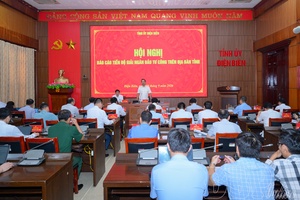
At the forum “Developing sustainable agriculture through green transformation and enhancing the value chain of key products in Điện Biên,” organized by the Department of Agriculture and Environment in collaboration with the Vietnam Gardeners’ Association and the Agriculture and Environment Newspaper, experts spoke highly of Điện Biên’s shift in crop structure.
.jpg)
The development of concentrated commodity crop-growing areas is considered an appropriate direction, creating a foundation for increasing the value of agricultural products and building sustainable value chains.
Experts, however, advised Điện Biên to avoid pursuing growth based solely on output. Instead, the province should focus on improving productivity and quality, promoting deep processing and meeting traceability requirements, including the European Union’s regulations on combating deforestation.
This requires Điện Biên to continue improving product quality, adopting advanced production standards and promoting deep-processing technologies locally, rather than relying primarily on the sale of agricultural products as raw materials or minimally processed goods.
The province currently has 19.75 hectares of organic agricultural production, including vegetables, tea and fruit trees in Búng Lao, Mường Ảng and Si Pa Phìn communes.
Standards such as VietGAP and HACCP are gradually being applied in agricultural production and processing. A total of 33.05 hectares of crops, including wax gourd, macadamia, rice and grapes, have received VietGAP certification, while five major processing and trading establishments have obtained HACCP certification for key products such as coffee, tea, macadamia and rice.
In the key coffee-growing area of Mường Ảng, attracting investment in deep processing is opening up opportunities to increase the value of locally grown coffee.
The Detech Coffee Factory project in Na Luông village, Mường Ảng commune, with a planned area of 13 hectares, is currently being implemented. Once operational, the factory is expected to link the local raw-material area with deep processing, helping increase product value, expand markets and gradually establish an integrated value chain from production to processing and sales.
For coffee growers, having a processing factory located directly in the raw-material area is expected to bring tangible benefits.
Lường Văn Thành, a resident of Na Luông village, Mường Ảng commune, said: “Having the factory invested in here will help us reduce transportation costs and increase the value of our agricultural products, while also creating more jobs and raising incomes.”
Alongside deep processing, science, technology and digital transformation are becoming key drivers of innovation in agricultural production in Điện Biên.
Lê Xuân Cảnh, Director of the Department of Agriculture and Environment, said: “The sector is focusing on digitizing entire raw-material areas and using digital maps and the Open Foris Ground tool to build databases of growing areas, meet traceability requirements and comply with international market regulations, particularly the European Union’s regulations on combating deforestation.”
High-tech agricultural models are also gradually being researched and adopted. These include smart water-saving irrigation systems integrated with IoT sensors, artificial intelligence (AI), unmanned aerial vehicles (UAVs) for managing and caring for growing areas, and virtual assistant software providing information on weather, markets and crop diseases.
These technologies are helping gradually transform farmers’ traditional production methods.
However, the transition faces numerous difficulties and challenges. Agricultural production in Điện Biên remains largely small-scale, while the province’s mountainous terrain is fragmented and complex. Local people, particularly those in remote and isolated areas, have limited access to technology, while initial investment costs are high and the resources available to farming households and cooperatives remain limited.
To address these bottlenecks, Điện Biên is implementing a range of coordinated measures, including intensifying communication and mobilizing public support for site clearance to facilitate major processing projects; promoting the role of businesses and cooperatives in leading and linking production and product sales; and effectively integrating funding for production development from national target programs.
Developing the agricultural economy through concentrated commodity production linked with green transformation, organic farming and deep processing is gradually becoming the main direction of Điện Biên’s agricultural sector.
With the determination of Party committees and authorities at all levels, together with the participation of businesses, cooperatives and farmers and the stronger application of science and technology, Điện Biên is gradually increasing the value of its agricultural products, expanding markets and raising local incomes.
Anh Nguyễn
.jpg)
.jpg)
.jpg)
.jpg)
.jpg)
.jpg)
.jpg)
.jpg)
.jpg)
You have 500/500 characters left
Please enter 5 or more characters!!!