



The villages of the Dao ethnic people seem to have donned a new, vibrant coat, yet they maintain the characteristic peace of a highland community nestled quietly in the morning mist.
.jpg)
Huổi Lóng village in tủa thàng commune sits at the foot of rocky mountains, tucked beside the winding Đà river. This is the ancestral home of the Dao Làn Tẻn people. As the year draws to a close, the curving road leading into the village becomes more animated with the sounds of motorbikes and the chatter of residents heading to early morning markets to prepare for the Lunar New Year. In front of the houses, kitchen smoke mingles with the fog while Dao women meticulously embroider and sew new garments for their families.
For the people of Huổi Lóng village, preparations for the festival begin nearly a month in advance. Each family member takes on different responsibilities; while women handle the cleaning, sewing, and shopping, the men turn to the forests and rivers, weaving bamboo and catching fish to earn extra income for the holiday. Phàn A Cỏng, the village head, noted that although life has become more comfortable than in the past, the traditional habits of preparation remain unchanged. The men handle the heavy lifting and financial needs while the women meticulously care for the household, a balance that ensures a joyful and warm celebration.
.jpg)
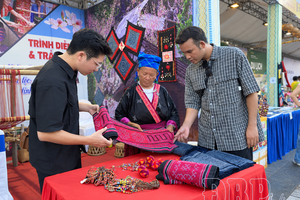
The process of creating new clothes for the family is an arduous one that often spans an entire year. Every piece of fabric and every stitch is done by hand, starting from growing and harvesting cotton to spinning, weaving, indigo dyeing, and finally tailoring. During the final days before the new year, when the harvest on the fields is finished, the women gather on low-roofed porches to sew. Their laughter and stories revolve around the coming holiday, who has finished their shopping, what they bought, and when the children will return home.
Phàn Thị Hiệp, a resident of the village, shared that in a modern world where youth often work far away, the lunar new year is the one occasion everyone looks forward to for a family reunion. Consequently, every household strives to have clean, decent new clothes for everyone to welcome the year properly. Crafting a single outfit can take anywhere from three days to a full week. The Dao Làn Tẻn follow strict traditional rules for their attire; men’s clothing is typically plain indigo without colorful patterns, while women’s clothing features vibrant borders and embroidery.
.jpg)
The most distinctive feature lies in the silver buttons. On men’s clothing, single buttons are used to represent strength, health, and the role of the family pillar. Conversely, women’s clothing features double buttons, symbolizing fertility and growth. Among the Dao, a higher number of buttons signifies a wealthier family, and wearing these new clothes for the new year is believed to bring luck and health.
While the women are busy with domestic care, the Dao men find their rhythm on the water and at the forest’s edge. From the break of dawn, the hum of engines echoes as boats glide across the Đà river. As the sun rises, boats of all sizes dock at Huổi Lóng village with hulls full of fish and shrimp to be sold to traders. On average, each boat earns between VND 400,000 and VND 600,000 per day. The joy in the eyes of these fishermen as they collect their earnings reflects their hard work in providing for the upcoming festivities.
.jpg)
When the sun is out, the men take advantage of the light to weave bamboo trays and baskets for sale or personal use. These handcrafted trays are meticulously made and hung over the kitchen hearth to ensure durability. When the lunar new year arrives, the bamboo tray is brought down and washed clean to hold offerings and the holiday feast. Replacing an old tray during this time is seen as a prayer for new beginnings and abundant luck.
As evening falls over Huổi Lóng village and kitchen smoke drifts over the rooftops, children play in the yards while adults sit on porches sharing daily stories. Spring here is not defined by loud festivities or boisterous crowds. Instead, it arrives through the new clothes sewn by a mother, the handcrafted tools made by a father, and the eager anticipation of a family gathering. It is a rhythm of life that has persisted for generations, quiet, resilient, and peaceful amidst the clouds and waters of the Đà river.
Trần Nhâm
.jpg)
.jpg)
.jpg)
.jpg)

.jpg)
.jpg)
.jpg)

.jpg)
.jpg)
.jpg)
You have 500/500 characters left
Please enter 5 or more characters!!!