



Alongside rapid technological advancements, the pressure regarding information speed has intensified. In quite a few instances, simply chasing speed and views has led to information being published without complete verification, resulting in errors and public misunderstanding.
As a long-time reporter for the Voice of Vietnam (VOV) in the Northwest region, Vũ Tất Lợi shared his perspective: “In a multi-dimensional information environment, journalists face many different sources, both official and unofficial. The pressure is to be fast, but what matters more is to be right. If information is incorrect, the consequences go beyond a single article; it damages public trust. Therefore, I always remind myself to verify thoroughly, even if it makes me a bit slower.”
Studying and following Uncle Hồ’s teachings begins with maintaining the pure “heart” of a journalist. This means honesty in every word, caution in every piece of information, and objectivity in viewing issues. Journalists do not merely reflect reality; they also contribute to orienting public opinion. Therefore, all published information must be cross-checked across multiple sources and placed within its specific context to avoid a biased, one-sided perspective.
With nearly 15 years of service at the Điện Biên Newspaper, Radio, and Television, Phạm Quang Trung, a reporter from the News Department, believes that journalism in the current context goes beyond merely reporting; it is a meticulous process of filtering, verifying, and orienting information. In his view, the rapid growth of social networks has made the flow of information faster, more abundant, and more complex, featuring considerable unverified or even distorted content.
.jpg)
“At times, highly sensational information surfaces on social media, drawing massive public attention. If journalists are not clear-headed and do not verify carefully, they can easily get swept away, leading to inaccurate and one-sided reporting,” Trung shared.
Professional ethics are manifest not only in field operations but also in deep editorial work. As a direct information gatekeeper, Phạm Ngọc Dương, an editor from the Secretariat and Editorial Department at the Điện Biên Newspaper, Radio, and Television, noted:
“Editors must keep the rhythm, ensuring that published information is both accurate and correctly oriented. There are tiny details that can easily cause misunderstandings if we are careless. Therefore, we always require reporters to supplement and re-verify whenever information feels less than certain.”
In a multi-dimensional information environment, journalists must constantly confront conflicting narratives, including fake news and fabrications. Without political mettle, it is incredibly easy to get pulled into these negative currents. Consequently, political stance, professional ethics, and a deep sense of responsibility serve as the ultimate shields that help journalists maintain their ground.
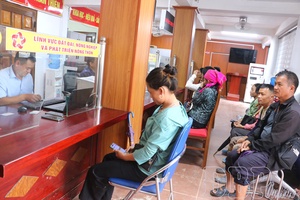
Following the implementation of the two-tier local government model, the entire province has established General Service Centers across 45 communes and wards to directly handle various tasks, including grassroots-level information and dissemination work. From field experience, Nguyễn Văn Hoàn, Director of the Búng Lao commune General Service Center, stated: “Information at the grassroots level directly touches the people. Any inaccurate or incomplete reporting immediately impacts public perception and opinion. Therefore, we always stick close to reality, report truthfully, and coordinate tightly with press agencies to guarantee the accuracy of information.”
In today’s multi-dimensional information environment, every stage of the journalistic workflow - from data collection and field reporting to editing and publishing - demands utmost caution and a high sense of responsibility. Journalism reflects reality while anchoring public opinion, contributing to social consensus. This requires every journalist to continuously train and upgrade their professional capacity, political stance, and vocational ethics. Learning and following Uncle Hồ’s path begins with practical deeds: upholding professional principles, respecting the truth, and writing for the benefit of the people.
During his lifetime, President Hồ Chí Minh always instructed journalists to be honest, objective, and truthful, urging them to “write accurately, write beautifully, so that the masses can understand.” These teachings remain profoundly relevant today, particularly in a multi-dimensional information landscape where the boundary between official and unverified information grows increasingly fragile.
Preserving journalistic ethics in such an environment is no easy task, yet it is an absolute necessity. By practicing continuous self-reflection, self-correction, and professional refinement, each journalist will contribute to building a revolutionary press that is increasingly professional, humane, and entirely worthy of the trust of the Party, the State, and the People.
Quang Long

.jpg)
.jpg)
.jpg)
.jpg)
.jpg)
.jpg)
.jpg)

.jpg)
.jpg)
.jpg)
You have 500/500 characters left
Please enter 5 or more characters!!!