



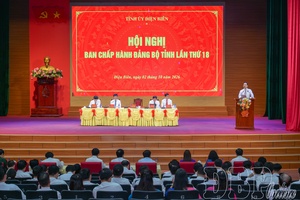
Trần Tiến Dũng, Member of the Party Central Committee, Secretary of the provincial Party Committee, and Head of the provincial National Assembly Deputy Delegation, alongside comrades of the Standing Board of the provincial Party Committee, co-chaired the session.
.jpg)
Attending the conference were comrades from the Standing Board of the provincial Party Committee, the Standing Board of the provincial People’s Council, leaders of the provincial People’s Committee, leaders of provincial departments, boards, and sectors, as well as several communes and wards across the province.
During the first seven months of 2026, the leadership of the Department of Finance focused on directing specialized divisions to proactively coordinate with relevant departments, boards, sectors, localities, and units to synchronously implement tasks and solutions, ensuring the progress and quality of assigned work.
.jpg)
Alongside achieved results, advisory and management work of the Department of Finance still revealed certain shortcomings requiring prompt resolution. Advising on and managing economic growth scenarios have not fully met requirements, while monitoring, analyzing, and forecasting budget revenue developments have not been truly close to practical conditions. Solutions for tapping and expanding new revenue streams, especially land-related revenues, have not achieved high efficiency.
.jpg)
In public investment, the capital allocation progress and the effectiveness and efficiency of state management in certain areas have fallen short of expectations. Formulating and executing the medium-term public investment plan still face inadequacies, with a large number of transitional projects accounting for a high proportion of total capital resources, limiting funding allocations for newly started projects, particularly pivotal works that drive socioeconomic development. Several investment projects have not generated expected efficiency.
In addition, lingering bottlenecks regarding project final accounts, public asset management, and financial discipline compliance have not been thoroughly resolved, impacting the efficiency of state resource management and utilization. Regarding private economic development, transformations have not been distinctly clear, as the number of enterprises remains low, mostly small in scale with limited competitiveness, and their contributions to growth and the state budget remain disproportionate to potential.
.jpg)
In the remaining months of 2026, the Department of Finance focuses on synchronously implementing solutions, striving to fulfill assigned tasks to the highest degree. Key priorities include reviewing and effectively exploiting remaining revenue sources, preventing budget loss, particularly in land-related collections, accelerating revenue-generating projects, finalizing investment, auction, and bidding procedures, and urging full compliance with financial obligations to the State.
Regarding growth scenarios, the Department regularly monitors and urges sectors and localities to adhere closely to each target, analyzes causes of achieved and unachieved indicators, and proposes concrete solutions tied to implementation timelines to promptly advise competent authorities. Concurrently, it continues urging agencies, units, and investors to strive to disburse 100% of public investment capital in 2026, generating momentum for economic growth in the final months of the year.
.jpg)
The Department of Finance proposed that the Standing Board of the provincial Party Committee consider and approve the policy on recruiting and supplementing missing staff quotas to meet task requirements, while soon consolidating the position of Deputy Director of the Department. The Department also requested the Standing Board of the provincial Party Committee and the Party Committee of the provincial People’s Committee to continue providing leadership and direction to departments, boards, sectors, localities, and relevant units to enhance coordination responsibility, strictly adhering to deadlines for processing and commenting on dossiers, thereby shortening work resolution time, improving coordination efficiency, and enabling the Department of Finance to fulfill its assigned tasks well.
.jpg)
Concluding the working session, provincial Party Secretary Trần Tiến Dũng requested the financial sector to continue innovating mindsets and leadership methods, improving advisory capacity, and enhancing task implementation efficiency. The Department of Finance must focus on drafting action programs and plans to implement the Resolution of the 14th National Party Congress, resolutions, conclusions, and directives of the Party Central Committee, and thematic resolutions of the province, ensuring guidelines and policies promptly enter life with citizens and enterprises placed at the center of service.
The provincial Party Secretary required the Department of Finance to shift its leadership methods strongly toward the principle of “clear personnel, clear duties, clear responsibilities, clear timelines, and clear deliverables,” moving from a management mindset to development enablement, while promoting the role of advisory and leading bodies in socioeconomic development tasks.
.jpg)
Regarding growth tasks, the financial sector must maximize its role as a “conductor,” proactively advising, monitoring, urging, and coordinating the execution of growth scenarios, while strengthening coordination with departments, sectors, and localities to promptly identify bottlenecks, adjust solutions, transition from a passive to an active posture, and create momentum to boost economic growth. Concurrently, the sector must clear bottlenecks and effectively mobilize all resources from public investment, non-budget investments, enterprises, household businesses, and citizens, generating combined strength for economic development.
The sector must continue accelerating decentralization and authorization, reviewing and innovating coordination procedures, improving the operational efficiency of divisions and sections, and elevating task execution quality. Simultaneously, it must focus on untying knots, speeding up the settlement of finalized accounts for completed projects, and ensuring strict management and effective utilization of investment capital resources.
Phạm Trung


.jpg)
.jpg)
.jpg)
.jpg)


.jpg)
.jpg)
.jpg)
.jpg)
.jpg)
.jpg)
You have 500/500 characters left
Please enter 5 or more characters!!!