



From dissemination and awareness raising among employers and employees to intensified inspections and supervision at construction sites and production and business establishments, accident prevention solutions have progressively proved effective. The continuous decline in occupational accidents demonstrates the efforts of all levels and sectors in building a safe working environment and minimizing losses of human life and property.
.jpg)
A review of the occupational accident situation over the past 3 years reveals a clear downward trend. In the formal labor sector with employment relationships, the entire province recorded 4 occupational accidents in 2024, causing 5 casualties, including 4 fatalities. In 2025, the number of occupational accidents dropped to 1 incident, casualties fell to 2 persons, and fatalities decreased to 2 individuals (representing a 75% reduction in cases, a 60% decline in victims, and a 50% decrease in deaths). Moving into the first 6 months of 2026, the province recorded 1 occupational accident resulting in 1 injured victim.
For the informal labor sector without employment contracts, results showed even more positive changes. In 2024, the province logged 11 incidents resulting in 11 casualties, including 6 fatalities and 5 serious injuries. In 2025, the incident count fell to 10 cases, with no fatalities recorded. Notably, the first 6 months of 2026 saw only 1 occupational accident, down 90% in both incident count and casualty numbers compared to the same period last year. Compared to 2024, occupational accidents dropped by over 90%. Several enterprises stand as typical role models in workplace safety assurance, such as Điện Biên Rubber Joint Stock Company, Điện Biên Power Company, and the Water Supply Joint Stock Company.
Although occupational accidents have fallen substantially, each incident that occurs leaves severe consequences behind. A prime example is the occupational accident on January 10, 2026, in Chiềng Sinh commune. During the construction of a concrete road and drainage ditch in the area, a roadside perimeter wall suddenly collapsed, burying 2 working laborers and causing 2 on-the-spot fatalities. The incident serves as a stern warning regarding the safety hazards constantly lurking in construction activities if surveying, risk assessment, and construction supervision are not carried out rigorously.
.jpg)
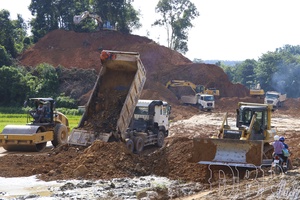
At numerous civil residential construction sites and small-scale projects across the province, compliance with occupational safety and hygiene regulations still exhibits certain limitations. Owing to small scales, short construction periods, seasonal labor usage, and a lack of specialized supervision, many project owners pay insufficient attention to occupational safety assurance. Equipping personal protective gear such as helmets, boots, and safety gloves is not fully enforced. Practice shows that the civil construction sector and individual building sites remain high-risk domains that are difficult to supervise due to dispersion, small operational sizes, and high labor turnover.
Occupational accidents not only inflict human loss but also entail substantial economic damage. In 2025, compensation and allowance expenditures for occupational accidents in the formal sector reached VND 646 million. Meanwhile, during the first 6 months of 2026, recorded damage expenses from occupational accidents stood at around VND 290 million, proving that accident fallout extends beyond the grief of victims’ families to directly hit the production and business activities of enterprises.
The reduction in occupational accidents stems from multiple factors. Legal dissemination and education on occupational safety and health are organized regularly; functional authorities have tightened inspections and audits across high-risk sectors such as construction, transportation, electric power, mineral extraction, and building material manufacturing. Enterprises increasingly pay closer attention to occupational safety training, personal protective equipment provision, formulating safe operating protocols, and proactively controlling workplace hazards.
.jpg)
As a bright spot in occupational safety assurance, the Điện Biên Rubber Joint Stock Company currently employs nearly 900 workers, predominantly ethnic minorities. The nature of regular outdoor work on hillsides across expansive terrains poses persistent safety hazards. Therefore, the company determines that accident prevention and worker health protection must be executed regularly, down to the smallest links in the production process.
According to Nguyễn Công Tám, Chairman of the Board of Directors of the Điện Biên Rubber Joint Stock Company, alongside legal dissemination on occupational safety and health regulations, the company regularly organizes training sessions and inspects compliance with working procedures and protective equipment use; it also proactively reviews and identifies safety hazards to implement preventive measures. Through this, workers’ awareness of protecting themselves and colleagues is heightened, contributing to building a safe, stable working environment.
Alongside strict compliance by businesses and laborers, state management over occupational safety must be tightened. The actual proportion of enterprises fulfilling occupational accident reporting regimes remains low, reaching only about 8% in 2025 and roughly 9% in the first 6 months of 2026. This hampers the comprehensive compilation and evaluation of the provincial accident situation. Realities across agencies, units, and enterprises show that ensuring workplace safety cannot stop at periodic dissemination campaigns, but must become a regular task tied to the responsibility of agency heads and individual workers.
.jpeg)
At the launch ceremony of the Action Month for Occupational Safety and Health and the Workers’ Month in Điện Biên province in 2026, Vice Chairman of the provincial People’s Committee Nguyễn Văn Đoạt emphasized that occupational safety and hygiene work not only protects workers’ lives and health, but also constitutes a prerequisite for sustainable development. Therefore, occupational safety must become a mandatory requirement and one of the criteria evaluating task completion levels for agencies, units, and enterprises. Leaders must bear direct accountability for workplace safety, while stepping up inspections and audits - especially in high-risk sectors and trades - to detect and address hazards promptly right at the grassroots.
Occupational accident risks remain ever-present, particularly across private construction sites, hazardous production domains, and the informal labor sector. Thus, alongside the intervention of state management agencies, each enterprise, employer, and laborer must heighten compliance awareness, proactively prevent risks, and contribute to sustaining the downward trend of accidents while establishing a safe, sustainable working environment.
Thu Phương
.jpg)
.jpg)
.jpg)
.jpg)
.jpg)
.jpg)
.jpg)

.jpg)



.jpg)
.jpg)

You have 500/500 characters left
Please enter 5 or more characters!!!