



Trần Tiến Dũng, Member of the Party Central Committee, Secretary of the Điện Biên provincial Party Committee, Head of the provincial National Assembly Deputy Delegation, and Head of the Steering Committee, chaired the session.
Attending the meeting were members of the Standing Board of the provincial Party Committee, leaders of the provincial People’s Committee, and members of the provincial Steering Committee.
.jpg)
In the first six months of 2026, the provincial Steering Committee focused on leading and directing party committees, party organizations, and authorities to step up dissemination, dissemination, and the timely materialization and execution of resolutions, directives, conclusions, and regulations of the Party and laws of the State regarding prevention and control work. During this period, the provincial Party Committee and its Standing Committee issued 36 documents, the provincial Steering Committee issued 9 documents, and party committees and organizations at all levels issued 1,373 documents to materialize and deploy tasks within their authority.
Prevention work was deployed synchronously, tied closely to the process of rearranging the organizational apparatus and implementing the two-level local government model. Local agencies and units reviewed and finalized mechanisms, policies, and internal management regulations, while enhancing openness and transparency by organizing 25 inspections and examinations at 74 agencies and units. Furthermore, they issued 60 new documents and amended, supplemented, or annulled 26 documents concerning regimes, norms, and standards, while conducting 50 checks on compliance with codes of conduct at 16 units and rotating positions for 28 cadres and civil servants in accordance with regulations.
The declaration and public disclosure of assets and income were implemented strictly and properly, with functional agencies currently verifying the assets and income of 257 cases according to the plan.
.jpg)
Inspection, supervision, examination, and the settlement of complaints and denunciations related to corruption, wastefulness, and negativity continued to be strengthened. Since the beginning of the year, the Provincial Inspectorate has deployed 13 inspections on the responsibility to execute the Law on Complaints, the Law on Denunciations, and the Law on Anti-Corruption at 61 units, issuing 8 inspection conclusions. Party committees, agencies, and units also carried out 13 inspections and 1 specialized supervision session on prevention and control work.
Legal proceedings agencies continued to coordinate closely in the investigation, prosecution, adjudication, and judgment execution of corruption and negative cases. In the first six months, investigative agencies handled 4 cases involving 6 defendants, while exercising prosecutorial rights and supervising investigations for 4 cases and 6 defendants. The two-level People’s Courts handled 2 cases with 4 defendants, finalizing the trial for 1 case involving 1 defendant, while another case with 3 defendants is currently being processed.
During the period, the Standing body of the Steering Committee advised the Standing Board of the provincial Party Committee to establish a Working Group to review difficult, snag-ridden, and long-delayed projects according to Decision No.885-QĐ/TU dated May 5, 2026. On this basis, the Internal Affairs Commission of the provincial Party Committee advised on issuing documents, preparing dossiers, and arranging materials to serve the Working Group’s operations, while proposing inspections and examinations for 11 troubled, snag-ridden, and long-delayed structures and projects.
For the final six months of 2026, the provincial Steering Committee determined to continue focusing on leading and directing party committees, party organizations, agencies, and units to promptly and effectively grasp and deploy the guidelines and regulations of the Government and the province. The committee aims to elevate proactiveness and responsibility, maximizing the role of its members and member agencies to ensure substantive and effective operations.
To achieve these goals, specific assignments were directed to various departments. The Dissemination, Education, and Mass Mobilization Commissions of the provincial Party Committee will continue to proactively grasp situations, promptly orient public opinion, and advise the Steering Committee to effectively handle arising issues of public concern. The Organizing Commission of the provincial Party Committee will boost advice on executing power control and preventing deviations during the rearrangement of the organizational apparatus and personnel work, while promptly reviewing and replacing cadres who evade or shift responsibilities and fail to fulfill their tasks. In tandem, the Inspection Commission of the provincial Party Committee will continue to advise on adjusting and supplementing inspection and supervision programs to suit task requirements.
.jpg)
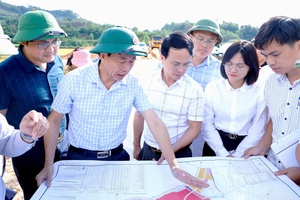
Meanwhile, the provincial People’s Committee will direct departments, sectors, and localities to strictly implement the conclusions of the Central and provincial Steering Committees. This involves continuing to review and handle delayed, backlogged, and long-standing structures and projects, as well as projects at risk of causing loss and wastefulness, alongside checking the actual land-use status of state-owned enterprises after equitization.
The provincial People’s Committee will also direct the provincial Inspectorate to accelerate the pace of inspecting redundant housing and land assets following rearrangement, alongside troubled structures and projects, ensuring quality and progress as required. Concurrently, the provincial Police, People’s Procuracy, and People’s Court will enhance coordination to accelerate the pace of investigating, prosecuting, and adjudicating corruption and negative cases in the locality.
The province will continue to upgrade the quality of citizen receptions and the settlement of complaints, denunciations, petitions, and reflections right at the grassroots level to limit the occurrence of petitions bypassing administrative echelons. It will maximize the oversight role of the provincial National Assembly Deputy Delegation, People’s Councils at all levels, the Fatherland Front, political-social organizations, press agencies, and the People.
At the session, the Steering Committee gave opinions on the draft 2026 Work Program (amended and supplemented), the report on reviewing, classifying, and handling delayed, backlogged, and long-standing structures and projects at risk of causing loss and wastefulness, and reviewed the report evaluating state management over land and assets of state-owned enterprises after equitization in the province to upgrade wastefulness prevention efficiency.
Phạm Trung

.jpg)
.jpg)
.jpg)
.jpg)
.jpg)
.jpg)
.jpg)
.jpg)
.jpg)
.jpg)
You have 500/500 characters left
Please enter 5 or more characters!!!