



Following the implementation of the two-tier local government model, the role of the commune level has been increasingly elevated. Far from being just the administrative tier closest to the people, communes and wards have also become the places directly receiving, processing, and resolving many tasks that previously fell under district-level competence. This change is creating distinct movements in the operations of the grassroots-level government apparatus in Điện Biên province.
At the Culture and Social Affairs Office of Mường Pồn commune, most cadres and civil servants concurrently assume multiple fields of work at the same time. Despite having nine civil servants, each person must be in charge of five to six tasks, or even more. Lù Thị Mai Sinh currently oversees a series of fields such as labor-employment, social insurance, health insurance, occupational safety and health, people with meritorious services, gender equality, social protection, child affairs, and social vice prevention. According to Sinh, the current workload has significantly increased compared to the past.
“Previously, the commune level only conducted reviews of target subjects, while the resolution of regimes fell under the district level. Now, we both review and directly execute regimes for the residents. The workload has nearly doubled, so I must continuously learn and update my knowledge to satisfy the new task requirements,” Sinh shared.
.jpg)
The reality in Mường Pồn represents the general picture of many localities, as the process of stronger decentralization and empowerment to the grassroots-level sets forth increasingly high demands for the commune-level cadre team. Beyond performing specialized tasks well, grassroots-level cadres must also satisfy new requirements regarding administrative reform, digital transformation, public reception skills, and handling situations arising from practical realities.
In Búng Lao commune, following the merger of Chiềng Đông, Ẳng Tở, and Búng Lao communes, citizens’ demands for resolving land procedures have risen sharply. Meanwhile, the cadre team still has to concurrently perform multiple different tasks. Lường Văn Thời, an official at the Búng Lao commune Economic Office, stated that after the cadastral map was approved, the number of dossiers requesting the issuance of land use right certificates nearly doubled. Many times, office cadres had to work overtime, even working at night to resolve profiles on schedule.
“Beside issuing land use right certificates, we also have to resolve land disputes as well as construction and environmental issues. Therefore, we proactively assign tasks according to each specific field to upgrade work efficiency,” Lường Văn Thời said.
Unlike many other administrative tiers, the commune level is the place constantly facing issues arising directly from public daily life. These involve diverse and complex tasks, with many cases having no available precedents or falling outside projected plans. This requires grassroots-level cadres to not only master professional expertise but also possess the ability to synthesize data, handle situations, and adapt flexibly to practical realities. Concurrently, public expectations toward the government are growing higher, with citizens desiring administrative procedures to be resolved rapidly and accurately, alongside a more professional and friendly service attitude.
Cháng A Nủ, Deputy Head in charge of the Na Sang commune Culture and Social Affairs Office, asserted that handling concurrent fields is no small challenge for the grassroots-level cadre team. He shared that when assigned more tasks, the requirements also become higher, so each cadre must self-learn and upgrade their professional level. While some approach new work very quickly, there are also cases that require more time to adapt.
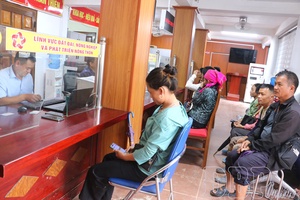
Conversely, increasing empowerment for the commune level also brings practical benefits to the people. Many administrative procedures that previously had to be carried out at the district level are now resolved right within the locality. This helps minimize travel times, save costs, and create more favorable conditions for citizens to access public administrative services.
According to Nguyễn Trung Chính, Permanent Vice Chairman of the Búng Lao commune People’s Committee, to meet new task requirements, the locality has deployed multiple synchronous solutions to ease pressure on the cadre team and upgrade work efficiency. Specifically, the commune focuses on reviewing and assigning tasks under the principle of clear people, clear jobs, and clear responsibilities; accelerating administrative reform and simplifying profile processing workflows; while strengthening the application of information technology and digital transformation in management and operational direction.
.jpg)
“Digital transformation helps significantly reduce manual workloads, upgrades profile processing efficiency, and supports operational management to be more rapid and precise,” Nguyễn Trung Chính informed.
Currently, most communes and wards across the province have deployed online dossier reception, data digitization, and inter-agency procedure integration. These solutions are contributing to upgrading the service quality for citizens and businesses, alongside the efficiency of state management at the grassroots level.
Nevertheless, the operational process of the two-tier local government model still faces numerous hardships, with some localities lacking specialized cadres under massive workloads, while infrastructure and information technology frameworks have not fully satisfied practical field demands. Even so, right within the deployment process, bottlenecks are being gradually identified more clearly to find appropriate removal solutions.
Nguyễn Thị Ban, Deputy Head of the Quài Tở commune Economic Office, stated that the cadre team always maintains a spirit of proactive learning, dedication, and maximizing time to complete tasks. She noted that there are times they must work overtime, including evenings or weekends to process workloads, and each cadre must regularly study policies and laws, applying them flexibly into local realities to resolve work most effectively.
In Tuần Giáo commune, the local authority maintains regular briefing sessions with local agencies and units to promptly grasp difficulties and bottlenecks and unify handling solutions. According to Quàng Văn Cương, Chairman of the Tuần Giáo commune People’s Committee, the locality also emphasizes listening to voters’ opinions and tracking issues of public concern in cyberspace to proactively handle them, preventing backlogs or the emergence of hot spots.
From modifications in work processing workflows to shifts in the mindset of serving the people, the two-tier local government model is generating positive movements from the grassroots-level. Despite numerous hardships during the initial operational phase, driven by the proactivity and flexibility of the government and the sense of responsibility from the cadre team, the commune level is step-by-step affirming its role as a citizen-serving center. More importantly, these movements do not merely contribute to elevating the operational validity and efficiency of state management, but also target the ultimate goal of better resolving public daily life issues, satisfying increasingly well the demands and expectations of the people in the new development era.
Kông Thao

.jpg)
.jpg)
.jpg)
.jpg)
.jpg)
.jpg)
.jpg)
.jpg)
.jpg)
.jpg)
You have 500/500 characters left
Please enter 5 or more characters!!!