



For Điện Biên province, which possesses over 455km of border shared with Lào and Trung Quốc, the implementation of the Government’s Resolution No.23/NQ-CP dated March 2, 2022, regarding inland border economic development for the 2022-2025 period has created distinct transformations. This effort has step-by-step exploited the potential and advantages of the border regions, improved the lives of the people, and consolidated the all-people border defense posture.
.jpg)
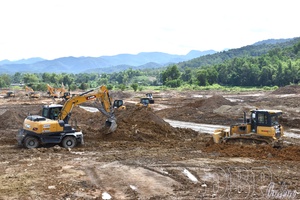
To develop the border economy, the province has synchronously implemented tasks and solutions, prioritizing investment in socio-economic infrastructure at border communes. During the 2022-2025 stage, the total investment capital for border areas reached more than VND 2,048 billion, focusing on transport works connecting border gates, inter-commune roads, inter-village roads, and essential civil projects. Many important routes have been invested in and upgraded, such as the Na Phay - Huổi Chanh - bản Gia Phú route, the Mường Nhà - Pha Lay - Mốc 130 route, the Tây Trang - Pa Thơm route, and the Quảng Lâm - Na Cô Sa route. These projects create favorable conditions for trade, the development of border gate economies, and the management and protection of the border.
Parallel to transport infrastructure, the province focuses on upgrading the system of border markets, border gate markets, and border gate economic infrastructure to effectively exploit trading advantages with Lào and China. Priority is given to completing infrastructure at the A Pa Chải border gate and the Tây Trang international border gate. By the end of 2025, the rate of households using the national electricity grid reached 96.2%, about 97% of residential areas were covered by 3G/4G signals, and 72% of people used smartphones, contributing to narrowing the gap in accessing information and public services between the border regions and central areas.
.jpg)
Creating sustainable livelihoods for border residents is identified by Điện Biên province as the core solution. Through the effective integration of National Target Programs, the province allocated a total capital source of more than VND 4,821 billion for the 2021-2025 period, prioritizing border communes with high poverty rates. Within this, from the National Target Program for socio-economic development in ethnic minority and mountainous areas, 513 projects were implemented; the National Target Program for sustainable poverty reduction implemented 108 projects; and the National Target Program for building new-style rural areas implemented 278 projects. These projects supporting production development and livelihood improvement have contributed to increasing income, sustainable poverty reduction, and limiting free migration.
With support from the State, many households in border areas have changed their production mindsets and boldly sought new directions in economic development. In 2017, the family of Tráng Seo Tẩn in Sín Thầu commune converted more than 8 hectares of corn and cassava fields to cinnamon trees, opening a new economic development path. Tráng Seo Tẩn shared that in the past, growing corn and cassava brought low income and depended heavily on the weather. Being supported by the State with seeds and techniques, his family boldly switched to cinnamon. Gradually, he found that cinnamon trees are suitable for the soil, have few pests, and the care required is not too strenuous.
.jpg)
According to Nguyễn Văn Thắng, Chairman of the Sín Thầu commune People’s Committee, the fact that people are boldly changing their crop structure is clear evidence of the effectiveness of border economic development policies. Recently, the commune has disseminated and encouraged people to change their production thinking and exploit local land and climate potential while taking advantage of State support resources in terms of seeds, capital, and science and technology. Models such as planting cinnamon, macadamia, and medicinal plants bring stable income to the people, contributing to sustainable economic development associated with maintaining security and order in the border area.
Along with agricultural production, trade and services in border areas have seen remarkable development steps. The system of border markets and border gate markets has been upgraded, and border trade activities have been maintained stably. The arrangement and stabilization of border residents continue to be implemented drastically, creating a long-term foundation for economic development. Major schemes, such as Scheme 79 and the Sơn La hydropower resettlement project, have helped thousands of households have stable places to live, production land, and essential infrastructure.
During the implementation of Resolution 23, Điện Biên province has closely combined economic development with building an all-people border defense posture. Consequently, the political situation and social order in the border areas are basically stable, creating a favorable environment for economic growth. Mường Nhà commune has 2,050 households with nearly 9,700 people, and an area with more than 41.8km of the Việt Nam - Lào border. In recent years, Mường Nhà commune has promoted the transition of crop structure toward commodity production, forming a concentrated production area of more than 4,143 hectares. Inefficient crops have been replaced by trees with high economic value; the entire commune now has 256.5 hectares of honey pineapple, 1,058 hectares of macadamia, 10 hectares of coffee, and one 3-star OCOP product. Along with that, infrastructure has been invested in synchronously, and the multi-dimensional poverty rate has decreased to 11.56%.
.jpg)
According to Đặng Văn Tuấn, Chairman of the Mường Nhà commune People’s Committee, the economic development programs and projects in the border area have created a comprehensive change in production and infrastructure while raising people’s awareness and responsibility toward border protection duties. From fragmented production with low efficiency, people have proactively switched to crops with high economic value, step-by-step forming concentrated production areas linked to consumption markets. Additionally, the invested systems of transport, electricity, domestic water, and schools have helped people settle down and stay long-term in the border area. Implementing Resolution No.23/NQ-CP, effectively mobilizing and integrating resources, taking the people as the center, and developing the economy associated with stabilizing the population and protecting border sovereignty have created an important foundation for Điện Biên to continue promoting border economic development and building a border region of peace, stability, cooperation, and sustainable development.
Thành Đạt

.jpg)
.jpg)

.jpg)
.jpg)
.jpg)
.jpg)

.jpg)
.jpg)
.jpg)
You have 500/500 characters left
Please enter 5 or more characters!!!