Vocational training tailored to practical needs and real demands

ĐBP - To fulfill targets effectively and respond well to market supply and demand, Điện Biên province places strong emphasis on surveying learner needs, local production conditions, and job creation potential across each area in its vocational training efforts.

Instead of opening classes solely at administrative headquarters, vocational education institutions coordinate with commune-level administrations, mass organizations, and village heads to survey demands, publicize policies, enroll students, and bring classrooms directly to locations near laborers.

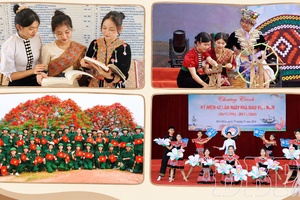
The Vocational Education - Continuing Education Center 1, now reorganized as the Vocational Education - Continuing Education Center, organized a vocational training class titled “Traditional Hand-weaving, Garment Cutting, Pattern Making, and Product Introduction” for rural workers, predominantly ethnic minority compatriots. The class was held right in Chăn Nuôi village, Si Pa Phìn commune. The course spanned 1.5 months with a training format blending theory and practice, concentrating on traditional hand-weaving skills, garment cutting and sewing, pattern design, and product introduction. Practical sessions accounted for the majority of the curriculum, enabling trainees to handle operations directly, hone skills, and progressively familiarize themselves with product manufacturing procedures.

Nguyễn Thị Thịnh, the instructor in charge of the class, stated that most learners are rural laborers and ethnic minority compatriots residing locally. Starting levels were uneven; certain older learners experienced limitations in grasping theoretical concepts and communicating in the national language. Furthermore, because trainees serve as primary breadwinners in their households, arranging study time - especially during harvest seasons - encountered considerable obstacles. Confronting these realities, hands-on, visual, and practice-intensive guidance methods were applied throughout instruction. The class was divided into small working groups so learners could assist and support one another during practice.

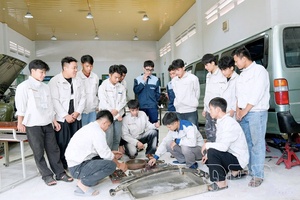
Cadres from the Vocational Education - Continuing Education Center provide hands-on instruction for trainees attending a technical vocational class on poultry raising and disease prevention in Thanh Yên commune.

Following the training course, learners demonstrated clear progress, mastering the steps of taking body measurements, drafting patterns, cutting, sewing, and finishing garments. 100% of participants passed the final assessment, with many individuals able to complete one to two full sets of clothing by hand and skillfully combine traditional handwoven fabrics with modern tailoring techniques to create garments suited to daily consumer demands.

Poòng Thị Thúy, a trainee in Chăn Nuôi village, Si Pa Phìn commune, shared that while she initially felt unfamiliar with machines, equipment, and technical operations, by the end of the course she had mastered the workflow from taking measurements, estimating fabric norms, drafting patterns, marking fabrics, and cutting blanks to finishing completed garments. Skills in sewing shirts and trousers were practiced hands-on across every single stage.

To ensure classes suit local populations, the Vocational Education - Continuing Education Center coordinates with commune and ward administrations, socio-political mass organizations, and village and hamlet heads to survey demands prior to enrollment. Based on natural conditions, designated production zones, and socioeconomic development orientations of each locality, the unit selects suitable vocations, training contents, and instructional formats. This approach helps overcome the practice of opening classes merely to fulfill administrative quotas with occupations divorced from actual demand. Residents receive clear information on training curricula, beneficiary rights, support policies, and employment opportunities before registering. Alongside cultivation and livestock husbandry trades, the Center is progressively expanding training into non-agricultural, service, and technical vocations that match labor market demands. Linking training programs with enterprises, cooperatives, OCOP products, and commodity production zones is recognized as an essential direction to secure market outlets and elevate product value.

In 2026, the Vocational Education - Continuing Education Center 1 was assigned to recruit and provide vocational training for 1,330 individuals across 16 communes and wards. Target beneficiary groups receiving priority attention include rural laborers, ethnic minority individuals, members of poor households, the unemployed, and other policy beneficiaries. On that basis, the Center determined its resolve to renew training objectives and deploy new non-agricultural occupations aligned with labor market realities.

Classes continue to be organized around practical applications and hands-on drills tied directly to post-training employment opportunities and income generation. Since the beginning of the year, the Center has opened 3 culinary arts classes for 105 students and 1 garment class for 35 trainees under commissions ordered by Si Pa Phìn commune. While knowledge acquired through short-term vocational courses may not immediately generate large-scale production setups, it equips workers to mitigate risks, boost productivity, economize expenditures, and take greater initiative in organizing production.

For training efficacy to be sustained over the long term, alongside upgrading classroom quality, continued attention must be directed toward assisting laborers in accessing capital, investing in production equipment, and connecting distribution outlets for their finished goods. Only then will the acquired knowledge and practical skills become effective tools enabling laborers to actively develop their household economies and enhance their living incomes.

Lan Phương
Comment

You have 500/500 characters left

Please enter 5 or more characters!!!

Recent news

  • 'Safe riding starts at school

    Safe riding starts at school

    SOCIAL AFFAIRS -
    ĐBP - Equipping students with knowledge of traffic laws, developing their vehicle-handling skills and fostering a sense of responsibility to follow traffic regulations are priorities for schools across Điện Biên province.
  • '“Gap” left behind departing footsteps (Part 3)

    “Gap” left behind departing footsteps (Part 3)

    SOCIAL AFFAIRS -
    ĐBP - The Party cell serves as the political nucleus at the grassroots level, translating Party guidelines directly into everyday life. A strong Party cell is defined not merely by its numerical strength, but by the quality of its contingent, its combativeness, and its capacity to rally the masses.
  • 'Keeping folk culture alive within the community

    Keeping folk culture alive within the community

    CULTURE - SPORTS -
    ĐBP - Amid resonant melodies, graceful dances and folk tunes imbued with ethnic identity continue to be safeguarded and carried forward in today’s life. At the Thành Bản Phủ Folk Arts Club, these values are preserved by members through regular practice sessions and performances, ensuring traditional culture is handed down and disseminated throughout community life.
  • 'Mùa A Nhìa - The man who is bringing technology to hillsides

    Mùa A Nhìa - The man who is bringing technology to hillsides

    SOCIAL AFFAIRS -
    ĐBP - Watching Mùa A Nhìa maneuver an unmanned aerial vehicle (UAV) to take off and then gently descend onto a patch of ground in the middle of his family’s coffee orchard in Chế Á village, Quài Tở commune, anyone would think he was a bona fide technology engineer. Yet A Nhìa simply acknowledged that he is merely a farmer who knows how to use technology.
  • 'Sowing “Party’s seeds” in Điện Biên (Part 4)

    Sowing “Party’s seeds” in Điện Biên (Part 4)

    NEWS - POLITICS -
    ĐBP - From a young person in a highland village to becoming a Party member and subsequently being entrusted with grassroots-level operational posts is a long journey. In Điện Biên, numerous “seeds” are identified, tempered through practice, afforded conditions to mature, and progressively turned into successor cadre reserves for the locality.
  • 'Mường Ảng coffee enters harvest season

    Mường Ảng coffee enters harvest season

    ECONOMY -
    ĐBP - These days, across the hillsides of Mường Ảng commune, coffee plantations are commencing their harvesting season. Ripe red cherries stand out among green foliage as nimble-fingered groups selectively pick mature clusters and pack them into sacks. A bustling harvest atmosphere permeates lands long bound to coffee cultivation over many years.
  • 'Sowing “Party’s seeds” in Điện Biên (Part 3)

    Sowing “Party’s seeds” in Điện Biên (Part 3)

    NEWS - POLITICS -
    ĐBP - The maturation of a young Party member typically begins with the guidance of predecessors. Upon reaching maturity, they in turn become pathfinders for the succeeding generation of mass prospects. This continuous progression cultivates fresh nuclei for Party organizations directly out of grassroots-level life.
  • 'Untangling zoning bottlenecks to expand macadamia and coffee acreage

    Untangling zoning bottlenecks to expand macadamia and coffee acreage

    ECONOMY -
    ĐBP - Macadamia and coffee serve as key cash crops in the restructuring of the province’s agricultural sector. Operational implementation across localities indicates that acreage for both crops is surging rapidly, exceeding targets in numerous areas. However, expanding cultivation areas confronts obstacles as land funds fall within forestry zoning, demanding prompt measures to address the bottlenecks.
  • '“Awakening” historical relics

    “Awakening” historical relics

    CULTURE - SPORTS -
    ĐBP - Early in the morning atop Hill A1, mist still blankets tree canopies. Amid the tranquil atmosphere of the Điện Biên basin, cadres and staff of the Điện Biên Phủ Museum arrived early to carry out environmental sanitation and landscape maintenance across the relic site.
  • '100 days to go digital: Điện Biên digitizes Party member records

    100 days to go digital: Điện Biên digitizes Party member records

    NEWS - POLITICS -
    ĐBP - These days, even after office hours end, teams tasked with digitizing Party member records remain hard at work. Each file is carefully reviewed, organized, scanned, checked and uploaded to the system. Điện Biên has identified this as a key task in modernizing the Party’s leadership methods and reforming administrative procedures within Party organizations, in line with the national digital transformation roadmap.
  • 'Digital government: Greater convenience from every administrative dossier

    Digital government: Greater convenience from every administrative dossier

    SOCIAL AFFAIRS -
    ĐBP - At the Điện Biên provincial Public Administration Service Center, receiving and processing administrative procedures is conducted within an electronic environment. Utilizing their VNeID electronic identification accounts, citizens and businesses can log in, submit dossiers, track processing progress, and execute online payments.