



Every DNA sample collected not only supplements scientific data to serve the identification of martyrs’ remains, but also carries the deep hope of families who have awaited news of their loved ones for many years.
.jpg)
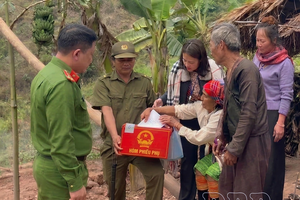
On the morning of July 25, at the DNA sample collection point deployed in Điện Biên Phủ ward, many relatives of martyrs were present early. Amidst suspense and waiting, their eyes shone with faith in a day when they might find the remains of their loved ones who sacrificed for the independence and freedom of the Fatherland.
Present early at the sampling point, Nguyễn Tô Khải from Thanh Yên commune, the elder brother of martyr Nguyễn Sĩ Quang, could not hide his emotional feelings. Martyr Quang enlisted at the age of 17 and sacrificed on January 21, 1973, in Quảng Trị. Due to family circumstances, over the past years, his relatives have not had the opportunity to search for his grave. Expressing his thoughts, Khải shared his joy and emotion that the Party and State organized DNA sampling to serve the search and identification of martyrs, as his family has always hoped to find their fallen relative.
.jpg)
At the sampling point, 90-year-old Trần Thị Múi from Mường Thanh ward was deeply moved when mentioning her younger brother, martyr Trần Ngọc Huyên. Martyr Huyên enlisted in 1966 and sacrificed in 1967 in Laos. Ever since receiving news of his death, her family has searched for information multiple times, yet still does not know where his grave lies. She expressed her family’s profound emotion that police officers came to collect DNA samples to cross-match with unidentified martyrs’ remains, hoping to receive news soon so they can bring her brother’s remains back to his native land.
Stories like those of Khải and Múi reflect the shared feelings of many martyrs’ relatives. Some have spent an entire lifetime awaiting a single piece of information regarding a loved one’s grave, while others are advanced in age and frail in health, yet still yearn to know where their relative rests.
.png)
According to the plan, from July 24 to July 26, the provincial Police coordinated with functional units to organize DNA sample collection for over 430 relatives of martyrs with unidentified grave information. Collection points were arranged across seven communes - Tủa Chùa, Tuần Giáo, Mường Ảng, Mường Luân, Nà Bủng, Mường Nhé, and Mường Chà - and two wards - Điện Biên Phủ and Mường Lay.
At these collection points, the process of receiving information, verifying files, and extracting biological DNA samples was carried out strictly and scientifically, ensuring accuracy, safety, and convenience for residents. The collected biological samples will be integrated into the DNA database to serve search, collection, and identification efforts through DNA forensic testing methods.
.jpg)
Captain Phạm Minh Thắng, Head of the Residence Registration and Management Guidance and Identity Management Team under the Police Division for Administrative Management of Social Order (the provincial Police), noted that because most martyrs’ relatives are advanced in age with limited health, and many reside outside the area, the Provincial Police coordinated with local authorities to select convenient sampling locations, arrange reasonable timing, and assign forces to guide and support relatives throughout the process.
Every DNA sample collected today serves as an essential puzzle piece in the journey to find and identify martyrs, embodying the trust of families who have waited for years, or even a lifetime. Therefore, with a high sense of responsibility, the functional forces executed their duties under the motto “leave no sample behind, confuse no relative,” ensuring collection for the correct subjects according to proper procedures and high quality standards. This stands as a practical way to honor heroic martyrs and practice the traditions of “When drinking water, remember its source” and “Gratitude,” helping ease the pain and longing of martyrs’ families and relatives.
Thu Hằng
.jpg)


.jpg)
.jpg)
.jpg)

.jpg)
.jpg)
.jpg)
.jpg)
You have 500/500 characters left
Please enter 5 or more characters!!!