



Part 3: Cultivating knowledge to fortify borderlands
From today’s classrooms, their dreams are nurtured, and local human resources are progressively cultivated. Each school is thus not merely a place for imparting knowledge, but a cradle for developing human character, instilling community vitality, and serving as “soft boundary markers” that help fortify the Fatherland’s frontiers.
The mountain road stretching from Pu Lau village to the center of Mường Nhà commune spans about 20km along rugged slopes connecting small hamlets to school facilities. Previously, this was the daunting distance that Vàng Thị Bầu had to overcome to attend class. This school year, Bầu boards at the Mường Nhà Primary and Secondary Boarding School. Having more time for her studies and staying close to her teachers, she has steadily nurtured the dream of becoming a teacher. “Boarding at school, I will try my best to study well so that later I can become a teacher and return to educate the children of my homeland,” Bầu shared.
Bầu’s dream sprang from intimate daily experiences. Every day in class, she witnesses teachers wholeheartedly teaching and caring for students both during school hours and in boarding life. In the highland student’s mind, becoming an educator means that one day, she can bring literacy and education to children in her very own village..png)
According to Nguyễn Thúy An, a teacher at Mường Nhà Primary and Secondary Boarding School, a stable learning environment is bringing tangible transformations to many students. They have grown more confident in communication, proactive in studies, and mindful about careers and future livelihoods after leaving school.
“The children all cherish very innocent dreams. What teachers need to do is help them believe that even if born in a remote village, they can achieve their dreams through study and diligence. In the future, if our students return home to serve as teachers, that will bring us immense joy,” An shared.
To realize their aspirations, students need an environment that helps them recognize their potential and offers opportunities to thrive. According to Lê Thế Hoàn, the school principal, the boarding model creates conditions for educators to stay close to students, thereby discovering their talents and interests to provide tailored guidance. Specialized classrooms, libraries, and communal spaces offer opportunities for students to practice and experience fields they previously had little access to.
At Nậm Kè Primary and Secondary Boarding School, Lò Thị Thu Huế, a student in class 5A1, is also cherishing the wish to stand at the lectern one day. As a Cống ethnic student born and raised in Nậm Kè village, Huế wants to become a teacher to bring literacy to local children. During her initial days boarding, Huế wept from homesickness. Yet with teachers staying close, encouraging her, and guiding her through every aspect of study and daily living, the young girl steadily adapted to the new environment.
“I will always try to study very well and strive to become a teacher. I will return to Nậm Kè village to teach the younger kids of my hometown, just like our teachers are teaching us right now,” Huế enthusiastically stated.
Along Điện Biên’s frontier line, many villages lie far from commune centers, and local livelihoods remain arduous. In such places, every school is intimately tied to the community’s future. Children learn to read and write, acquire legal knowledge, master healthcare basics, and gain awareness of backward customs that could affect their lives. This knowledge will follow them back to their villages, step-by-step spreading to each household.
A student receiving a well-rounded education today can become a teacher, healthcare worker, grassroots-level cadre, or skilled laborer tomorrow. Local human resource development also opens broader paths for poverty reduction. Educated youths are more proactive in choosing livelihoods, accessing science and technology, and organizing production. When living standards stabilize, villagers feel assured in staying rooted and uniting to develop their homeland.
At the groundbreaking ceremony of Si Pa Phìn Primary and Secondary Boarding School on July 27, 2025, Party General Secretary and State President Tô Lâm affirmed that the policy of investing in multi-level boarding schools across border communes holds profound humanitarian significance, reflecting the special care of the Party and State for ethnic groups in remote, disadvantaged areas.
.png)
The leader noted that school construction must go hand in hand with attentiveness to families of enrolled students and community mobilization to ensure full attendance; concurrently, education must be intertwined with preserving cultural identity, combining academic instruction with moral cultivation, and fostering love for the homeland and nation.
Party General Secretary and State President Tô Lâm’s guidance highlights that a frontier school not only transmits knowledge, but also nurtures love for one’s homeland, safeguards culture, and instills civic responsibility in the younger generation toward their place of birth.
That is also why multi-level boarding schools are likened to “soft boundary markers.” National boundary stones mark territorial sovereignty; schools cultivate strength from human capital and public trust. That strength is forged when children receive a full education, families feel secure remaining in their hamlets, residents place faith in policies, and the younger generation grasps their obligations toward their homeland.
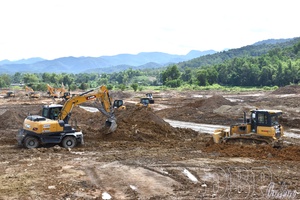
During the completion of multi-level boarding schools across Điện Biên, officers and soldiers of the Border Guard force directly contributed labor across multiple sites. According to Senior Colonel Phan Văn Hóa, Commander of the provincial Border Guard Command, starting in late July 2026, border guard stations actively coordinated with local Party committees, authorities, and project investors to deploy support forces so schools could welcome students in time for the new school year.
This partnership does not end when construction finishes. Schools and border guard stations continue collaborating to conduct legal dissemination and educate students on borderlines, national markers, and civic duties. Through these lessons, the concept of national sovereignty is no longer abstract, but closely attached to the students’ daily lives. Senior Colonel Phan Văn Hóa noted that a sturdy frontier must first be built upon stable livelihoods and public trust. When children receive schooling, the young generation possesses knowledge, and residents feel secure in their hamlets, frontier regions acquire profound endogenous strength.
Commissioning school facilities is merely the opening step. The enduring value of these schools will be decided by educational quality, student progress, and the capacity to maintain a safe, humane boarding environment. Vice Chairman of the Điện Biên provincial People’s Committee Nguyễn Văn Đoạt stated that the mandate is to organize operations safely and methodically, maximizing the efficacy of invested facilities. The province continues directing the Education and Training sector alongside communes to arrange personnel, care for boarding and study conditions, and collaborate with families so students remain committed to their schools over the long haul.
The outcomes of this policy will be demonstrated through maintaining student attendance, elevating educational quality, and steadily fostering local human resources. Through education, residents gain opportunities to improve living standards, and the community gains youths fully equipped with knowledge and skills to contribute to developing their homeland.
For Vàng Thị Bầu in Mường Nhà commune or Lò Thị Thu Huế in Nậm Kè commune, it is yet unknown how far the road ahead will carry them. But today, both have voiced the same dream: to study well, strive to become teachers, and return to serve their homeland.
Years from now, in classrooms in Pu Lau or Nậm Kè, the individuals standing at the podium may very well be the young schoolgirls educated and tempered under today’s boarding school roofs.
When knowledge is transmitted across generations, and when educated youths mature and choose to return to their roots, these frontier schools will not only cultivate futures for individual students, but will fortify the enduring strength of entire communities. These are the very “soft boundary markers” erected through intellect and the hearts of the people, contributing to keeping the frontiers of Điện Biên ever unshakeable.
Đào Phương - Vi Hiếu
.jpg)
.jpg)
.jpg)
.jpg)
.jpg)
.jpg)
.jpg)
.jpg)
.jpg)
You have 500/500 characters left
Please enter 5 or more characters!!!