



They will stand as future stewards of frontier territories, and each maturing student will also become a “soft boundary marker,” contributing to building local villages and safeguarding the Fatherland’s frontiers.
Part 1: From policy vision to schools in border areas
The policy of investing in school construction across terrestrial border communes opens opportunities for Điện Biên to resolve a long-standing challenge: creating conditions for children in remote villages to study, dine, reside, and undergo conditioning within a stable setting. Following Si Pa Phìn Primary and Secondary Boarding School, by early September 2026, Điện Biên saw an additional nine multi-level boarding schools reach completion, accommodating nearly ten thousand students in the 2026 - 2027 academic year.
In Điện Biên, the policy was concretized into 15 multi-level boarding school projects with an allocated total investment capital approaching VND 3,900 billion. The investment scope is extensive, yet the value of these structures is measured by tangible improvements: travel to class is less strenuous, studies are uninterrupted by torrential rains and flash floods, and children in far-flung hamlets gain expanded opportunities to pursue literacy and knowledge..jpg)
Along the path toward translating policy into everyday reality, Si Pa Phìn Primary and Secondary Boarding School emerged as the opening milestone. The project was approved by the provincial People’s Committee on August 27, 2025. On January 31, 2026, after more than five months of construction and an aggregate investment of VND 284.5 billion, the project was inaugurated and commissioned, standing as the nation’s first completed school under the border commune school construction initiative. Nestled amid the Si Pa Phìn mountain forests, red-roofed buildings carrying the architectural lines of Northwest stilt houses shape a space that is modern yet intimate. The school houses academic classrooms, subject-specific laboratories, six boarding blocks, a dining hall, kitchen facilities, a multi-purpose hall, an indoor swimming pool, and sports fields. Concurrently invested electricity networks, clean water systems, firefighting installations, and wastewater treatment plants formulate a well-rounded learning and living environment.
Like many peers of his age, Lìu Ngải Quý, an 8th grader in class 8C1 at Si Pa Phìn Primary and Secondary Boarding School, found his joy starting with the relief of no longer traversing nearly 15km of steep mountain tracks to class daily. Hailing from a poor household, education was previously an arduous journey for Quý. Residing on campus, he secures extra study time, joins student clubs, and grows visibly bolder.
Within the fresh classrooms, every student discovers an individual source of enthusiasm. Sùng Thị Mai loves the art club, where teachers instruct her in painting alongside friends. Nguyễn Quỳnh Anh is captivated by STEM sessions, assembling and experimenting with mechanical models firsthand. Eagerness is unmistakably evident in how children describe their new educational home.
Observing students step enthusiastically into every lesson, Nguyễn Thị Hoa, Vice Principal of the school, perceives the profound changes. According to her, the new setting enables students to stabilize routines swiftly and participate confidently in school activities, while teachers sustain lively classroom instruction that encourages practical application and creativity.
Si Pa Phìn Primary and Secondary Boarding School stands as the first completed institution under the border commune construction scheme. That milestone is extended through the schooling joys of over 1,000 pupils. Endowed with improved academic and living conditions, they acquire expanded opportunities to study, build character, and nurture ambitions. From this school, the humane essence of the policy is taking shape in daily reality.
Following the commissioning of Si Pa Phìn Primary and Secondary Boarding School, Điện Biên pressed ahead with multi-level boarding projects across remaining frontier communes. Under reports from the Department of Education and Training, nine schools that broke ground in 2025 hold an aggregate investment of VND 2,239.02 billion. An anticipated five projects commencing construction in 2026 entail total investment funding of VND 1,370 billion. These schemes are rolled out to progressively establish the multi-level boarding model across all border communes province-wide.
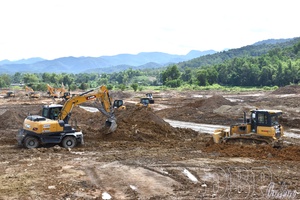
By early July 2026, construction progress across the nine ongoing projects had attained only 65% to 89%. The school opening date was drawing near, while the Northwest rainy season severely hindered material transportation and outdoor assembly. Several sites featured intricate geological formations, forcing contractors to adjust execution plans to ensure structural safety. In Núa Ngam, landslide hazards at the construction perimeter required an additional land requisition of nearly 1.4ha alongside engineering countermeasures.
To safeguard project schedules, emerging bottlenecks were addressed directly on construction sites. Technical officers tracked each component closely, collaborating with project investors and contractors to settle hurdles, while matters surpassing statutory authority were submitted to provincial authorities without delay. For projects facing remaining workloads, personnel from other construction teams were reassigned to render assistance. At Nà Bủng Primary and Secondary Boarding School alone, approximately 150 engineers, workers, and heavy machinery units were deployed at peak times to expedite remaining work items.
.jpg)
Though execution speed was accelerated, structural quality and workplace safety remained paramount. Directions issued by provincial leadership during field inspections stipulated that quality and occupational safety must never be compromised for speed. Rather than waiting for overall structural completion before installing interior equipment, components were organized on a rolling basis, cleaning, fitting, and preserving equipment as each wing reached conclusion.
Parallel to machinery humming across construction grounds, meticulous operational preparations unfolded. Schemes establishing the nine schools were completed, student rosters from grade 1 to grade 9 across localities were screened, and boarding demands for students in distant hamlets were mapped out. contingents of managers, teachers, kitchen staff, school medical personnel, and boarding supervisors were mobilized and assigned. Enrollment was calculated with a ceiling of 35 students per classroom, matching instructional conditions and care capacities.
Nguyễn Văn Đoạt, Vice Chairman of the Điện Biên provincial People’s Committee, noted that for the 2026 - 2027 school year, the 10 multi-level boarding schools alone enrolled 303 classes comprising 10,157 students, encompassing 7,070 full boarders and 3,087 day-boarders, with ethnic minority children representing 88.46%.
On September 5, 2026, the nine multi-level boarding schools held simultaneous school-opening ceremonies. Freshly completed schoolyards welcomed students, classrooms were illuminated, and kitchens were fired up. Drumbeats heralding the new school year echoed across frontier mountains, inaugurating an academic term where thousands of students study, reside, and mature within a stable boarding setting.
Đào Phương - Vi Hiếu
.jpg)
.jpg)

.jpg)
.jpg)
.jpg)
.jpg)
.jpg)
.jpg)
.jpg)
You have 500/500 characters left
Please enter 5 or more characters!!!