



Part 3: From a “private affair” to a political mission
Clearly recognizing the repercussions and root causes of this scourge, for the first time, the Standing Board of the Điện Biên provincial Party Committee issued Resolution No.27-NQ/TU dated May 8, 2026, on preventing and combating child marriage and consanguineous marriage in ethnic minority areas across the province for the 2026-2030 period. The resolution not only affirms the province’s political resolve, but also opens a new approach centered on proactive prevention, addressing root causes, and mobilizing the combined strength of the political apparatus and local communities.
No longer an individual household issue
For decades, child marriage was regarded as a domestic matter tied to traditions, customs, awareness levels, and local living conditions. This perception created substantial hurdles for intervention, as behind each early marriage lay broader social issues requiring identification and remediation. Consequently, sustainably curbing child marriage cannot rely solely on persuading individual households or young couples; it demands the coordinated involvement of local authorities, schools, families, and communities.
.jpg)
Data from several localities underscores this urgency. In the first six months of 2026, 24 out of 66 individuals entering marriage in Mường Nhé commune were underage; in Tìa Dình, the figure stood at 13 out of 24 individuals (accounting for 54.2%); Phình Giàng recorded 11 out of 44; Sín Chải recorded 44 out of 90; and Sáng Nhè recorded 57 out of 140. These statistics reflect not only the prevalence of early marriage across certain areas, but also demonstrate that the issue extends far beyond private household decisions.
Lường Văn Phượng, Vice Chairman of the People’s Committee of Phình Giàng commune, stated that child marriage in the area is no longer a collection of isolated family choices, but an issue requiring community-wide action. When early marriages occur across multiple households, the fallout extends beyond young couples, disrupting children’s schooling, limiting employment prospects for youth, and hindering long-term local development. As these consequences grow clearer, child marriage must be assessed accurately to deploy comprehensive, lasting solutions.
Developments across these communes reflect a persistent reality throughout ethnic minority areas. Over the past five years, child marriage rates have remained a protracted problem: 31.7% in 2021; 24.6% in 2022; 32% in 2023; 24.6% in 2024; and 31.5% in 2025. These fluctuating percentages show that past public outreach efforts produced changes, but were insufficient to dismantle the underlying drivers of recurring child marriages.
These trends also show that provincial focus on the problem did not originate in 2026. On September 29, 2015, the provincial People’s Committee issued a project entitled “Minimizing child marriage and consanguineous marriage among ethnic minorities in Điện Biên province for the 2015-2025 period,” targeting the elimination of child marriage and the reduction of consanguineous marriage by 2025. This was accompanied by legal education, school-based instruction, reproductive health counseling, community mobilization, and engagement with village elders, village heads, and reputable figures. While these initiatives prompted temporary shifts, elevated child marriage rates demonstrated that the issue had not been tackled at its roots.
The lack of sustained decline highlights that relying solely on communication campaigns or resolving individual cases rarely delivers enduring change. The challenge requires a broader approach encompassing economic conditions, education, employment opportunities, public awareness, and living environments. Thus, on May 8, 2026, the Standing Board of the Điện Biên provincial Party Committee promulgated Resolution No.27-NQ/TU on preventing and combating child marriage and consanguineous marriage in ethnic minority areas across the province for the 2026-2030 period. The resolution targets an annual reduction of 5% to 6% in child marriage rates while defining prevention and control as direct responsibilities of Party committees, local governments, administrative heads, departments, mass organizations, and communities.
Following the release of Resolution No.27-NQ/TU, grassroots prevention strategies began shifting. Previously, actions focused on households already planning weddings, with cadres visiting homes to dissuade families. Now, requirements are set earlier, broader, and more specifically. Rather than simply stopping scheduled weddings, departments and localities concentrate on assessing risks, tracing underlying factors, and assigning responsibilities across task forces. Families, schools, authorities, mass organizations, reputable figures, and communities act together as structural “checkpoints” before an early marriage can materialize.
Resolving the problem at its roots
Behind each early marriage lies an interplay of factors: local traditions, economic hardship, limited awareness, gaps in education and employment, and personal psychology. Preventing child marriage therefore cannot stop at halting ceremonies at the last minute; it requires identifying and mitigating causes early.
In Pú Nhung commune, 9 out of 16 individuals marrying during the first six months of 2026 were underage. Facing this reality, the commune Party committee and administration looked beyond case-by-case advocacy to analyze structural questions: Why are youth marrying early? Why are pupils dropping out? What economic hardships do families face? Do young people possess vocational training or jobs after leaving school? From this analysis, prevention was linked to poverty reduction, production development, vocational training, and job creation.
.jpg)
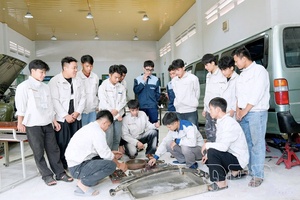
Lầu A Chá from Pú Nhung village, Pú Nhung commune, noted that the local Party committee and administration prioritize organizing vocational training and employment opportunities, especially for young people. This provides youth with stable trades and incomes, opening up alternative pathways for the future rather than early marriage. In April 2026, Pú Nhung commune collaborated with provincial Vocational Education - Continuing Education Center No.2 to launch a sheet-metal work and welding techniques class, attracting nearly 20 trainees, predominantly young locals.
This model is being adopted across multiple localities in the province. Experience demonstrates that reducing child marriage cannot be separated from poverty reduction and sustainable livelihoods. When households secure stable incomes, parents can keep children in school; when young individuals acquire vocational skills and employment, they gain greater independence and future planning capacity. Thus, policies supporting poverty alleviation, agricultural development, vocational schooling, and job generation serve as upstream preventive measures against early marriage.
Under the National Target Program for Socioeconomic Development in Ethnic Minority and Mountainous Areas for the 2021-2025 period alone, the province trained an average of over 7,700 workers annually, supported 2,432 households in career transitions, assisted nearly 30,000 households with decentralized domestic water access, and provided subsidized loan packages to tens of thousands of families. Across the province, 898 production support projects were deployed, steadily raising local earnings and living standards.
While these achievements may not immediately reflect in year-over-year child marriage statistics, they lay the groundwork for long-term transformation. If economic stability tackles the root cause, education represents an essential preventive checkpoint. Along with economic programs, Điện Biên is strengthening the role of schools in prevention, moving beyond classroom lectures to foster environments that keep pupils enrolled, offer career guidance, and expand future options.
According to Hoàng Tuyết Ban, Director of the Department of Education and Training, by 2030, 100% of educational institutions must organize prevention programs, while maintaining and scaling models such as “Schools without child marriage” and “Students say no to child marriage.” Crucially, schools must identify students at risk of dropping out to marry, families preparing engagement ceremonies, or pupils showing signs of forced marriage to coordinate early interventions.
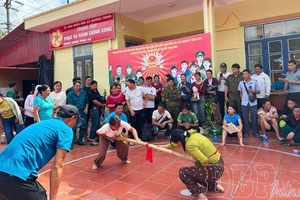
Beyond families, schools, and local authorities, communities must also function as defensive checkpoints. Điện Biên is pursuing this through 59 anti-child marriage communication clubs and models such as “Clans without child marriage,” “Villages without child marriage,” and “Communes and wards free of child marriage and consanguineous marriage.” Under Resolution No.27-NQ/TU, Mường Nhé commune piloted a model named “Saying no to child marriage and consanguineous marriage” in Nậm Là village. The initiative raises awareness among residents - particularly teenagers and parents - regarding the consequences of early marriage, while leveraging the influence of reputable figures, village heads, and mass organizations to monitor and advise families.
Director of the Department of Ethnic and Religious Affairs Nguyễn Thanh Sơn highlighted that beyond disseminating legal provisions, these models aim to establish new communal norms where schooling, vocational training, steady employment, and entrepreneurship opportunities for youth are recognized as prioritized values. When collective expectations evolve, community consensus and constructive peer influence help stem child marriage early.
Alongside prevention, handling violations strictly within the law remains essential to maintaining legal discipline. The Standing Board of the provincial Party Committee directed law enforcement agencies to prosecute and conduct pilot trials for representative cases involving sexual intercourse with underage persons, creating deterrence and raising awareness of marriage and family laws.
Once regarded as a family’s private matter, child marriage in Điện Biên is now addressed through the coordinated responsibility of the entire political system. Resolution No.27-NQ/TU emphasizes not only stopping and sanctioning violations, but addressing underlying drivers: alleviating poverty, establishing sustainable livelihoods, retaining pupils in schools, widening access to vocational training, and reshaping communal standards. Halting an impending wedding addresses only the surface; providing young people with wider future choices remains the fundamental, long-term solution.
Võ Văn Tâm
.jpg)
.jpg)


.jpg)
.jpg)
.jpg)
.jpg)

.jpg)
.jpg)
.jpg)
You have 500/500 characters left
Please enter 5 or more characters!!!