



Part 3: Joining “pieces of the puzzle” into single community
Within this process, the Party organization serves as the core nucleus: staying close to the people to understand, listening to relieve anxieties, engaging in dialogue to build consensus, and bringing policies to every population group. When communities are connected, differences cease to be barriers and transform into a source of strength, reinforcing the great national solidarity bloc.
Deep roots make a enduring tree
The history of nation-building and national defense shows that when the people’s hearts are aligned, the nation thrives; when the people are divided, the nation falters. Nguyễn Trãi once concluded that the core of righteousness lies in ensuring peace for the people, while Prince Hưng Đạo Trần Quốc Tuấn regarded sparing the people’s strength to strike deep roots and firm foundations as the supreme strategy for safeguarding the state. Inheriting these lessons, President Hồ Chí Minh and the Party have consistently defined the people as the foundation and the primary subject of the revolutionary cause. He affirmed that the nation takes the people as its roots and that deep roots make an enduring tree, noting that revolutionary strength stems from gathering, uniting, and mobilizing the power of the people.
.png)
Securing the consensus of the people requires strengthening unity across residential communities. During his lifetime, President Hồ Chí Minh attached immense importance to ethnic and religious unity. He affirmed that whether Kinh or Thổ, Mường or Mán, Gia Rai or Ê Đê, Xê Đăng or Ba Na, alongside other ethnic minorities, all are descendants of Việt Nam and blood brothers and sisters who stand together through life and death, joy and hardship, and help one another through thick and thin. This ideology serves as an important foundation persistently practiced by Điện Biên province throughout its construction and development.
Nậm Kè is a border commune that was formerly a complex area regarding ethnic and religious matters, marked by a mass gathering demanding the establishment of a “Hmông State” in Huổi Khon village in 2011. The coexistence of multiple ethnic groups places high demands on consolidating grassroots unity, taking consensus and public interest as the bedrock. Following administrative mergers, the commune’s Party committee and authorities have focused on building a contingent of cadres who stay close to the people, understand their conditions, and comprehend the traditions and customs of each community.
Nguyễn Thị Yến, Head of the Party Building Board of Nậm Kè commune, noted that generating consensus must begin by listening to and addressing public concerns. The Party committee and administration have intensified grassroots visits and tailored communication to each demographic group, ensuring residents are informed, engaged in exchanges, and involved in execution. In areas where proficiency in the national language is limited, personnel proficient in local dialects and customs are mobilized to communicate clearly and thoroughly. When cadres stay close to the people and understand their realities, consensus emerges naturally from within the community.
.jpg)
Through this approach, the number of villages and hamlets in the commune decreased from 21 down to 14 following restructuring. Operations across villages have largely stabilized; community organizational structures, citizen rights, and local responsibilities are discussed transparently, enabling ethnic groups to understand one another better, participate collectively, and share responsibilities in common tasks.
Nậm Đích village in Mường Chà commune was formed from the merger of the former Hô Hài and Nậm Đích villages. Prior to the consolidation, 100% of Hô Hài residents practiced Protestantism, whereas in Nậm Đích, religious followers accounted for approximately 30% of households. Divergent religious practices initially caused hesitation among some residents upon joining a single village. Recognizing this sentiment, the Party cell did not seek to eliminate differences; instead, it focused on communication, listening, and clarifying issues related to citizen rights, obligations, and religious activities, while mobilizing residents to adhere to Party guidelines, State policies, and legal regulations.
Vàng A Hồ, Secretary of the Nậm Đích village Party Cell, shared that after the merger, the Party cell and village management board determined that all matters must originate from the interests and aspirations of the people, allowing them to know, discuss, agree upon, and execute actions together. The Party cell places less emphasis on differences in customs or faiths, concentrating instead on practical undertakings such as economic development, security maintenance, and caring for children. When residents feel respected, empowered, engaged, and able to see tangible benefits, differences no longer pose barriers, and consensus generates community strength.
The experience in Nậm Đích demonstrates that for roots to remain deep, there must first be a Party organization capable of staying close to the people, understanding them, and uniting them. This imperative becomes clearer as residential boundaries are rearranged into larger living spaces with more diverse community compositions. Consolidating grassroots Party organizations involves far more than rearranging management units; it requires making each Party cell a genuine leadership nucleus that gathers collective will and builds public consensus.
Following restructuring, the entire province comprises 888 village, hamlet, and residential quarter Party cells, including 654 cells with branch committees, 63 cells with secretaries and deputy secretaries, 171 cells with only secretaries, alongside 701 deputy branch secretaries. A contingent of 26,893 Party members participates in grassroots cells, among whom 5,535 hold university degrees or higher, 14,189 hold upper secondary diplomas, and 9,123 hold lower secondary qualifications. Beyond serving as an organizational resource, this contingent represents a direct force in cultivating public trust, mobilizing citizens, and maintaining community cohesion.
However, in multi-ethnic villages, serving as a true bridge requires cadres to remain close to the grassroots, understand traditions, listen attentively, and command prestige. Perfecting Party organization is only the initial step; the decisive factor is transforming the Party cell into a dependable anchor where residents place their trust, where communities find common ground, and where everyone shares daily responsibilities. When popular consensus is achieved, Party organizations are robust, and communities are united, a solid foundation for sustainable development is established.
Bridging differences
Following administrative mergers, communities with divergent ethnicities, customs, and practices now share a common residential environment. For these separate pieces to unite, efforts must extend beyond redrawing geographical boundaries and administrative apparatuses to cultivating consensus and a collective civic consciousness step by step.
.jpg)
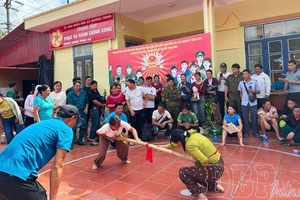
Realities in Huổi Thanh 1 village, Nậm Kè commune, reveal that turning diverse pieces into a unified collective begins with creating shared undertakings for everyone to join. The village encompasses 100 households with 692 inhabitants belonging to 3 ethnic groups: Dao, Sán Chay, and Hmông. The Party cell assigns members to stay attached to each demographic group, regularly meeting residents to grasp their thoughts, resolve lingering concerns, and mobilize them for shared tasks. From cleaning village roads and maintaining public order to building cultural lifestyles and organizing community activities, Dao, Sán Chay, and Hmông residents are involved in discussions, task assignments, and implementation. This creates opportunities to meet, share, understand one another, contribute labor, and shoulder shared responsibilities.
This cohesion is reflected directly in village meetings and the Great National Solidarity Festival. When a household is absent, regardless of ethnic background, the assigned Party member visits their home to understand the reason, provide encouragement, and offer assistance if needed. When rolling out programs and policies, the Party cell holds village gatherings, listens to feedback, and explains divergent points to reach common ground. Đặng Văn Néng, Head of Huổi Thanh 1 village, noted that through these collective efforts, residents across ethnic groups have gradually developed an identity as fellow villagers, sharing contributions and duties. Consequently, Huổi Thanh 1 has grown increasingly united in pursuing development and safeguarding borderlines and markers.
Through this methodology, the Party cell has progressively united ethnic and customary differences into a cohesive community. Solidarity in Huổi Thanh 1 does not begin with grand concepts, but is cultivated through village meetings, collective work, and persistent connections across household groups. When each community feels respected and possesses a voice in shared affairs, individual identities are not lost; rather, they contribute to building a shared community. Mùa Vừ Sếnh, an ethnic Hmông villager, shared that whenever village affairs arise, Dao, Sán Chay, and Hmông residents participate together, working hand-in-hand and sharing hardships. Although customs differ, everyone desires a peaceful and prosperous village.
Nong Sẳng village in Nà Tấu commune was established by merging the former Nong and Sẳng villages, comprising four main ethnic groups: Kinh, Thái, Hmông, and Khơ Mú. To help villagers regard the newly merged village as their common home, the Party cell recognized the necessity of addressing everyday cultural differences: village worship rituals, festivals, weddings, funerals, forest and water source protection, and preserving native languages. The Party cell organized public consultations and assigned Party members to visit individual households to listen to sentiments, explain ambiguities, and record lingering concerns.
.jpg)
According to Lò Văn Tươi, an ethnic Thái who serves as Head of Nong Sẳng village, the Party cell identified formulating a village convention as a critical task to establish community consensus after the merger. The objective was not to erase ethnic customs, but to select harmonious values for collective observance. The village gathered public feedback to agree on general rules covering cultural practices, environmental protection, security, village development, and community tourism, while prioritizing the preservation of ethnic identity. Through this, the village convention became a collective agreement, providing a foundation for all ethnic groups to join hands in building the village.
Provisions on preserving stilt houses, native spoken languages, traditional costumes, and local festivals were integrated into the convention, contributing to cultural preservation. Sùng A Và, an ethnic Hmông resident of Nong Sẳng village, shared that direct public participation made the regulations feel approachable and easier to follow. While each ethnic group maintains distinct customs, protecting roadways, keeping the environment clean, and building cultural standards remain shared duties. Through common conventions, villagers have grown attached and unified in community building.
From Huổi Thanh 1 to Nong Sẳng, experience demonstrates that village mergers gain genuine meaning only when community cohesion is established. Boundaries can shift quickly, but helping residents truly view one another as one community demands patience. In this process, the Party cell must serve as a rallying hub that listens to differences and finds common ground for collective action. This ensures individual puzzle pieces are not dissolved through administrative mergers. Each ethnic group preserves its cultural identity, while every individual holds a voice, shares responsibility, and enjoys benefits in communal endeavors. Under these conditions, differences cease to be obstacles and become diverse facets that enrich a united, thriving community.
Văn Tâm
.jpg)
.jpg)
.jpg)
.jpg)
.jpg)
.jpg)
.jpg)
.jpg)
.jpg)
You have 500/500 characters left
Please enter 5 or more characters!!!