



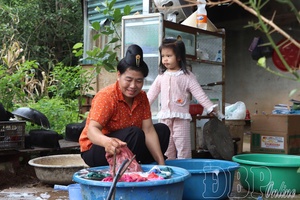
At barely 15 years of age, Lầu A Dế, born in 2011 in Xa Vua village, has already become a husband, while his wife, Chứ Thị Đớ, is eight months pregnant. In December 2025, when both were in the 9th grade, Dế and Đớ dropped out midway through school to live together. With no time left for classrooms, their lives are now tied to laborious daily chores such as laundry, raising livestock, and preparing coffee seedlings for the new planting season. Marrying at such a tender age, they face compounding hardships. Unfinished schooling, a lack of knowledge, no formal trade, and the absence of stable earnings make the young couple’s daily life far more grueling and precarious.
.jpg)
Realities in Phình Giàng indicate that child marriage and consanguineous marriage have remained acute, distressing issues over recent years.
The causes of this state of affairs stem from multiple angles. Objectively, a segment of the ethnic community remains heavily influenced by backward customs and practices; notions of marrying off children early to acquire extra farmhands and secure heirs quickly still persist. Additionally, legal dissemination and education across certain localities have lacked regularity and effectiveness. Subjectively, the awareness of parents and the adolescents themselves remains limited; many families fail to clearly recognize the consequences of early marriage, still enabling children to live together before reaching legal age.
Thoroughly recognizing the severe repercussions of child marriage on population quality, the Party committee and administration of Phình Giàng commune have been executing robust, grassroots-oriented measures. The entire political system has entered the campaign with high responsibility, focusing on direct communication and mobilization within individual households.
.jpg)
Vàng A Sấu, Secretary of the Party Cell of Xa Vua village, Phình Giàng commune, stated: “Party members of the cell, village heads, front work committee heads, village elders, and mass organization chapters such as the youth union and women’s union visit individual families directly to educate them on legal regulations regarding child marriage and consanguineous marriage. Concurrently, we integrate outreach into village meetings and conferences regarding the consequences of early marriage, urging families with teenage children to keep them in school and avoid child marriage.”
Beyond Xa Vua village, advocacy campaigns have been intensified across all villages throughout the commune, particularly in Hmông ethnic settlements.
Chá A Sình, Head of the Cultural - Social Office of Phình Giàng commune, noted: “The commune dispatches cadres to coordinate with the commune health station and population collaborators to conduct village-level outreach, inviting households with adolescent children and students to learn about the Law on Marriage and Family and the damaging consequences of child marriage and consanguineous unions. At the same time, we organize for households to sign pledges not to allow their children to marry prematurely.”
.jpg)
Tireless mobilization efforts are generating positive shifts in public mindset. Highland Hmông communities are gaining better access to and comprehension of legal provisions, recognizing that child marriage violates the law while inflicting grave impacts on family welfare, schooling, and children’s futures. Consequently, early marriage cases in the commune have dropped markedly. In the first six months of 2025, the commune recorded 28 child marriage cases out of 44 individuals marrying; in the first six months of 2026, that number dropped to 11 cases out of 42 individuals entering marriage.
Despite encouraging results, Phình Giàng views combating child marriage as an enduring mission. To curb and eventually eliminate early marriage, the commune will continue to reinforce communication across remote, isolated villages with large Hmông populations.
Discussing this orientation, Lường Văn Phượng, Vice Chairman of the People’s Committee of Phình Giàng commune, stated: The commune focuses on executing core synchronized solutions, such as continuously innovating communication formats; combining education with career orientation and academic streaming starting from lower secondary school so students confidently pursue further schooling or vocational trades. The commune will also establish youth clubs and exchange forums where teenagers find a reliable outlet to share their thoughts and aspirations, while receiving training in life skills and reproductive health care. Concurrently, it will accelerate socioeconomic development in disadvantaged areas, preserve fine traditional cultural values, evoke ethnic pride, and eliminate outdated customs.
.jpg)
Phình Giàng commune continues to enhance state management responsibility over civil status registration, integrating anti-child marriage provisions into village conventions and rules. In parallel, it leverages the role of reputable persons, village elders, and village heads in effectively implementing Resolution No.27-NQ/TU dated May 8, 2026, of the Standing Board of the Provincial Party Committee and Plan No.4971/KH-UBND of the Provincial People’s Committee.
Initial transformations in Phình Giàng demonstrate that elevating awareness and responsibility within each family provides a solid foundation to push back child marriage, affording highland children opportunities to study, develop, and decide their own futures.
Anh Nguyễn
.jpg)
.jpg)
.jpg)
.jpg)
.jpg)
.jpg)
.jpg)
.jpg)
.jpg)
You have 500/500 characters left
Please enter 5 or more characters!!!