



Guided by Xa Dung commune officers, we visited the home of Lầu A Vừ and Chá Thị Cú in Cồ Dề village - the parents of L.A.P, one of 16 child marriage cases recorded in Xa Dung commune during the first six months of 2026.
.jpg)
From the commune center, after nearly 30 minutes on a motorbike navigating a concrete road along the hillside, we parked our bike and walked another kilometer into the village, as the previous night’s rain had turned the dirt path muddy. Before us stood a small wooden house tucked against the foot of a hill. Here, the teenage couple was busy with daily chores. L.A.P held a sickle heading out to cut grass for the cattle, while V.T.V, nearly nine months pregnant, tended to the pig feed stove while hanging laundry. Looking at their small frames, few would imagine that both were about to become parents at just 15 years old.
P and V were both born in 2011 and were 9th-grade students at Phì Nhừ Junior High School. In March this year, upon discovering V was pregnant, both dropped out of school to live together as husband and wife.
Lầu A Vừ sighed as he shared: “When the children asked to marry, the family fiercely opposed it. But once we found out V was pregnant, we had no choice. Because they were under legal age, P and V could not register their marriage or hold a formal wedding, so we only performed local traditional procedures to bring them together under one roof.”
Sitting nearby, L.A.P kept his head bowed, hands tightly clasped. When asked if he regretted quitting school early, the boy softly replied, “Yes.” That single word carried palpable regret in his eyes. P said he missed his school and friends. Teachers had visited to encourage him to return, but he felt too embarrassed before his classmates. Previously, young P dreamed of joining the army to wear the soldier’s green uniform, while V hoped to become a preschool teacher to teach alphabet letters to village children.
.jpg)
Now, those notebooks have been closed. The innocent freedom of school days has ended far too early. More worryingly, neither child is equipped with reproductive health knowledge, vocational skills, or the ability to be self-reliant. Ahead lies the heavy burden of breadwinning and parenthood while still being children themselves.
V covered her face and said: “In the past, I dreamed of becoming a preschool teacher to bring letters to the village children. But due to a lack of understanding, that dream has closed forever...”
Across many highland villages in Xa Dung, child marriage resembles an inescapable loop. In Trống Hmông village, the story of Vừ Thị Dung brings a deep sense of sadness. Dung married at 15, while her husband was 16. Life year-round was tied to hill fields, with poverty clinging to the family for years. Now, her own daughter dropped out of school to marry at 15 due to an accidental pregnancy.
Inside their wooden house roofed with time-worn corrugated cement sheets, beyond a few basic household items like pots, pans, and dishes, nothing of value exists. Even the bed is assembled from hastily joined, crooked wooden planks. Dung shared that having experienced the hardships of early marriage herself, she wanted her two children to receive a full education to change their lives.
.jpg)
Tears welled up in Dung’s eyes as she confided: “In the past, I lacked understanding, so I married very early. Life year-round was arduous, tied strictly to hill fields and forests. I always hoped my children would study hard to secure stable jobs and escape hunger and poverty. But because of falling in love early, my child derailed her future. It breaks my heart...”
Stories like Dung’s family are not rare in Xa Dung. Hờ A Vừ, a population worker in Háng Trợ village - which has recorded 3 child marriage cases since the start of the year - noted that the village regularly coordinates with the Health Station and commune organizations to disseminate the consequences of child marriage. Although awareness has gradually improved and cases have decreased compared to previous years, the situation has not been fully eradicated and continues to occur in the area.
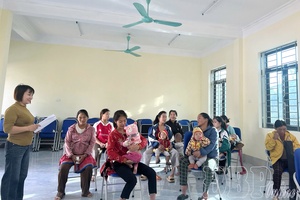
In reality, efforts to prevent child marriage in Xa Dung commune face numerous hurdles. In the first six months of 2026, the entire commune recorded 16 child marriage cases, an increase of 2 cases compared to the same period last year. To raise public awareness, local party committees, authorities, and mass organizations have coordinated dozens of dissemination sessions across 42 villages, attracting over 2,470 participants. Contents focused on the Law on Marriage and Family, the harmful impacts of child marriage and consanguineous marriage, and adolescent reproductive healthcare. Many village heads, health workers, and population workers have proactively visited individual families to explain the consequences.
Through dissemination, public awareness is gradually shifting. Lầu Thị Chá, a resident of Cồ Dề village, shared that through sessions led by commune health station cadres, she understands that child marriage violates the law and severely impacts maternal health and child development, prompting her to remind her children to study hard and avoid early romantic relationships or underage marriage.
Alongside stepped-up dissemination, the commune applied deterrent measures, including administrative fines on 10 cases totaling VND 23 million.
.jpg)
Lầu A Khá, a specialist at the Culture and Social Affairs Office of Xa Dung commune, noted: “While awareness among the majority has risen, a segment of the population still wants children to marry early to gain extra farm labor. In many cases, by the time they are discovered, the teenagers are already living together or have completed traditional wedding rituals.”
Beyond Xa Dung, child marriage remains a perplexing challenge across the entire province. According to health sector statistics, in the first three months of the year, the province recorded 322 individuals involved in child marriage, accounting for 24.8 percent of all married individuals. The 14-to-16 age group represents a particularly high proportion, concentrated in hotspots like Nà Hỳ, Sín Chải, Sáng Nhè, and Xa Dung. Behind every child marriage lie unfulfilled dreams and derailed futures at a very tender age. The vicious cycle of poverty, illiteracy, and child marriage thus continues to repeat from one generation to the next across many highland villages. Stopping child marriage requires not only government intervention but, above all, a shift in mindset within every family, parent, and the young people themselves.
Leaving Cồ Dề village as the midday sun stood overhead, the image of a thin 15-year-old boy burdened with household chores and his young, pregnant wife by the hearth remained deeply haunting. Midst the vast mountains and forests, 15-year-old dreams silently remain unfulfilled. And the lullabies sung seem meant not only to soothe infants to sleep, but also to ease the sorrow and regret of a young life...
Anh Nguyễn
.jpg)
.jpg)
.jpg)
.jpg)


.jpg)
.jpg)
.jpg)
You have 500/500 characters left
Please enter 5 or more characters!!!