



Sectors create favorable conditions for people to access and participate in the labor market, meeting domestic employment needs and expanding work opportunities abroad.
Once a poor household in Búng Lao commune, in the last two years, the life of Quàng Thị Hinh’s family in Bua village has seen many positive changes. In 2022, after being introduced by the local authority to a labor export program to the Japanese market for machinery repair work implemented by a Hanoi-based enterprise, Hinh’s husband researched and decided to register.
During the initial probation period, his income was approximately VND 20 million per month. By now, as his skills have become steadier, there are times his monthly income reaches VND 30 to 40 million. The stable source of income has helped her family gradually improve their lives, affording them the conditions to invest in economic development and rise out of poverty.
Quàng Thị Hinh shared: “Previously, family life was very difficult, but now it is different. Thanks to the salary my husband sends back, besides covering living expenses, I invest in livestock and have saved a sum of money.”
This reality shows that labor export is gradually becoming a suitable choice for many workers in the province, especially young workers in rural and highland areas. Going to work abroad under contract helps workers earn a stable income, improve skills, form an industrial working style, and accumulate experience and capital for economic development upon returning to the locality.
.jpg)
Currently, a number of localities in the province maintain coordination with enterprises such as: Labor Export, Trade and Tourism Joint Stock Company; IIG Human Resources Co., Ltd., etc., to select workers for fixed-term work abroad under contracts in markets like Qatar, Japan, and South Korea across various professions, with income levels ranging from VND 20 - 30 million/month. When participating in the program, workers are supported with travel costs, completion of loan documents, passports, health checks; trained in basic skills; and enjoy full insurance and welfare benefits according to the regulations of the host country. According to statistics, from 2020 to present, Điện Biên has sent approximately 1,000 workers abroad under contracts.
Nguyễn Tiến Đạt, Director of the Department of Home Affairs, stated: Functional sectors and local authorities have strengthened dissemination and labor market orientation; expanded links with reputable labor export enterprises; and organized training in trades, foreign languages, and necessary skills for workers. They also create conditions for workers to access support policies, especially preferential loans, contributing to removing initial difficulties when participating in labor export.
Parallel to expanding job opportunities abroad, the province focuses on connecting the domestic labor market to create more suitable choices for workers. Through organizing transaction sessions and job fairs, workers directly access recruitment information, learn about the needs of enterprises, and choose industries and positions suitable for their capabilities and actual conditions.
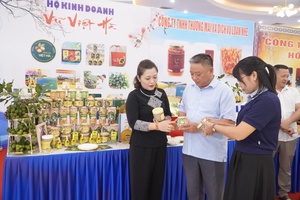
In 2025, the Employment Service Center (Department of Home Affairs) organized many job fairs in communes and wards such as: Na Sang, Tủa Chùa, Mường Ảng, Na Son, Thanh An, Tuần Giáo, Điện Biên Phủ, etc. Most recently, the provincial Job Fair attracted the participation of over 1,200 union members, youth, soldiers completing military service, police officers, and people in the area.
The fair featured 32 booths from enterprises and training institutions both inside and outside the province. Among them, 12 booths recruited workers for domestic jobs with a demand for over 14,000 positions in various industries such as: garments, electronics, mechanics, information technology, sales, and restaurant-hotel services; 5 booths recruited workers to work abroad with about 200 quotas; and 8 booths recruited workers for enterprises within the province with a demand for over 2,000 workers.
Vocational education institutions such as the Center for Vocational Education - Continuing Education 1, Điện Biên College, and Điện Biên Medical College participated in displaying booths and consulting on admissions for over 1,000 training quotas in trades like welding, industrial electricity, mechanics, automotive, makeup, bartending, etc.
As one of the units participating in the Điện Biên provincial Job Fair, a representative of Tinh Lợi Garment Co., Ltd. (Hải Phòng city) said that the company has accessed the Điện Biên labor source for 9 years and has continued to push recruitment in the province in the last 3 years. On average, the company organizes 10 trips to Điện Biên each year to connect and recruit. When the 3-level local administration was still in operation, many old communes and districts visited the company to learn, introduce, and ensure benefits for local workers.
Nguyễn Trung Kiên, in charge of recruitment for the Northern mountainous region at Tinh Lợi Garment Co., Ltd., shared: Điện Biên workers have the advantage of being hardworking, having a good sense of discipline, and sticking with the enterprise. Through the process of recruitment and labor utilization, many workers have stable jobs, guaranteed incomes, and opportunities to improve their skills. Therefore, the company identifies Điện Biên as a key area in its recruitment plan for the coming time.
Reality shows that promoting supply-demand connection through job fairs has helped many enterprises directly access local human resources, creating conditions for workers to fully grasp information about recruitment needs, working environments, and remuneration policies before making suitable choices. Particularly, with the synchronous implementation of solutions to support vocational training, labor export, and domestic labor market connection, in 2025, the entire province created new jobs for over 9,000 workers; of which, 198 workers went to work abroad under contracts. This is a positive result, contributing to increasing income, stabilizing people’s lives, and realizing the goal of sustainable poverty reduction and socio-economic development of the province.
Quang Long
.jpg)

.jpg)
.jpg)
.jpg)
.png)
.jpg)
.jpg)
.jpg)
.jpg)
.jpg)
.jpg)
You have 500/500 characters left
Please enter 5 or more characters!!!